


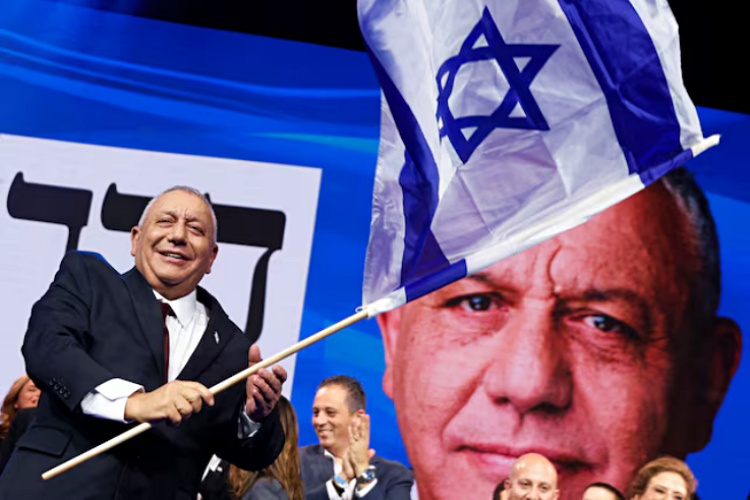
Gambiaj.com – (JERUSALEM, ISRAEL) Israel’s outgoing Prime Minister Benjamin Netanyahu is facing political defeat after opposition leader Gadi Eisenkot secured majority backing to form the country’s next government, potentially ending Netanyahu’s long political dominance and opening the way for an independent investigation into the October 7, 2023, Hamas attacks, which his government has repeatedly resisted.
President Isaac Herzog’s office announced on Friday evening that he would formally entrust Eisenkot with forming a government on Sunday, November 8, following consultations with political parties after the October 27 parliamentary elections.
Eisenkot, a former military chief of staff and leader of the Yashar party, received recommendations from six party leaders, giving him the backing of 67 lawmakers in the 120-seat Knesset.
Netanyahu, whose Likud party emerged as the largest single party in the election, secured only 46 recommendations, leaving him short of the support needed to form a government. His position was further weakened by the withdrawal of an ultra-Orthodox party from his political camp.
The outcome represents a significant shift in Israeli politics, where the election produced no outright winner but a clear parliamentary preference for a government formed around the opposition to Netanyahu.
October 7 Investigation at the Center of Political Change
Beyond removing Netanyahu from office, the emerging coalition could reopen one of the most politically sensitive questions in Israel: accountability for the security and intelligence failures surrounding the October 7 massacre.
Netanyahu has faced sustained criticism over his government’s refusal to establish a state commission of inquiry with broad investigative powers into the circumstances that allowed Hamas to launch its unprecedented attack, killing about 1,200 people and taking 251 others hostage.
Eisenkot, a former chief of the Israeli military, has made investigating the failures surrounding the attack a central element of his political position. A government backed by parties united primarily by their opposition to Netanyahu could therefore create the political conditions for an inquiry that the outgoing prime minister resisted.
Such an investigation would potentially examine military and intelligence failures, government decision-making, and Netanyahu’s own political and security responsibilities before and during the attack.
The prospect of an inquiry also raises the possibility that Netanyahu could face renewed political and public scrutiny over his handling of the country’s security establishment.
Arab Parties Become Decisive Players
Eisenkot’s parliamentary advantage has also been made possible by an unprecedented mobilization of Palestinian voters in Israel, whose political representatives have emerged as decisive players in determining the next government.
The support of Arab political parties has strengthened the anti-Netanyahu camp, creating an unusual parliamentary alignment in which parties with sharply different ideological positions share a common objective: preventing the outgoing prime minister from returning to power.
But that arrangement could prove difficult to sustain.
Eisenkot must reconcile the demands of Arab lawmakers with those of the secular right, particularly Avigdor Liberman’s political camp, whose positions on religious parties and national security could complicate negotiations.
The political challenge is to turn a parliamentary majority built largely around opposition to Netanyahu into a functioning government capable of agreeing on policy beyond his removal.
Netanyahu’s Political Future In Question
Following Herzog’s decision, Eisenkot will have 28 days to negotiate and assemble a governing coalition, with the possibility of a two-week extension if necessary.
The Likud has already denounced the emerging alliance as a “bloc of disaster” and called for a national unity government. However, the anti-Netanyahu parties have rejected that possibility, suggesting that their determination to keep him out of power remains their strongest common ground.
Although Netanyahu’s party finished first in the election, his failure to secure sufficient parliamentary backing marks a major setback for a politician who has dominated Israeli politics for years.
Eisenkot’s challenge now goes beyond replacing Netanyahu. He must demonstrate that a coalition assembled from ideologically divergent parties can govern effectively, restore public confidence in Israel’s institutions and confront the unresolved questions surrounding the October 7 massacre.
Weeks of protracted negotiations are expected to follow Eisenkot’s nomination. He has 28 days to try to forge a government, with a possible 14-day extension.
His potential pathways to power include trying to form a minority government with Arab party votes on key issues; forming a coalition with ultra-Orthodox parties that he and his allies have shunned in the past; or forging a unity government with Netanyahu.
For Netanyahu, the prospect of losing office could also mean losing the political leverage that has so far helped him resist demands for a comprehensive investigation into the deadliest attack in Israel’s history.



Leave a Reply