


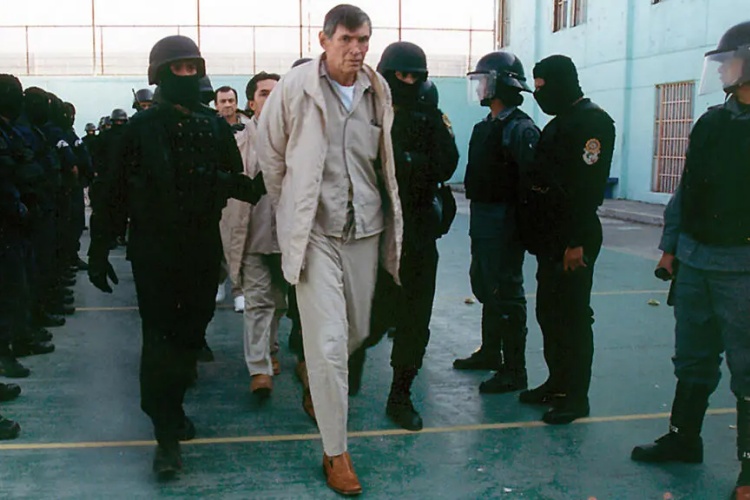
Félix Gallardo, popularly known as “El Jefe de los Jefes” (The Boss of Bosses), died on Sunday, 15 November, in a hospital in the western Mexican state of Jalisco, where he had been transferred from prison for emergency medical treatment on Friday.
Jalisco state authorities said he was admitted with low oxygen levels, an altered state of consciousness and disorientation. Despite being placed under medical observation, his condition deteriorated.
According to an official statement, he suffered multiple organ failure and died at approximately 2pm local time (20:00 GMT) on Sunday.
Félix Gallardo had been imprisoned since 1989, serving two sentences totaling 77 years for drug trafficking and his role in the murder of Enrique “Kiki” Camarena, a United States Drug Enforcement Administration (DEA) agent who was kidnapped, tortured and killed in 1985.
Architect Of Mexico’s Modern Drug Trade
A former police officer, Félix Gallardo emerged as one of the most powerful figures in the Mexican drug trade during the 1980s.
In the late 1970s, he helped establish the Guadalajara Cartel, widely regarded as Mexico’s first major drug trafficking organization. The cartel developed the structures, trafficking routes and alliances that would later influence the operations of several powerful criminal organizations in the country.
Two notorious figures in Mexico’s drug trade, Joaquín “El Chapo” Guzmán and Ismael “El Mayo” Zambada, also began their criminal careers within the wider network associated with the Guadalajara Cartel.
Félix Gallardo transformed drug trafficking into an organized business empire, capitalizing on growing demand for narcotics in the United States.
His operations included marijuana cultivation and, increasingly, the transportation of Colombian cocaine linked to Pablo Escobar’s Medellín Cartel through Mexico into the United States.
He developed trafficking routes through border cities, including Tijuana, while building alliances with other influential drug traffickers of the period.
Beyond the drug trade, he reportedly invested in legitimate businesses, including real estate, banking and the petroleum sector, using commercial activities to launder proceeds from criminal operations.
Drug Trafficking And Political Corruption
His rise also became emblematic of the deep connections between organized crime, law enforcement and political power in Mexico.
Although authorities had begun investigating him as early as the 1970s, his alleged connections within the police and political establishment helped him evade prosecution for years.
His downfall came following the killing of DEA agent Enrique Camarena, whose abduction and murder triggered an intensive investigation and a major diplomatic confrontation between Mexico and the United States.
Under mounting pressure from Washington, Mexican authorities intensified efforts to track down Félix Gallardo, leading to his arrest in 1989.
Although he consistently denied much of his alleged criminal history, he remained one of the most significant figures in the history of Mexican organized crime.
His legacy is closely associated with the emergence of the cartel system that would later become a major security challenge for Mexico, contributing to decades of drug-related violence, corruption and cross-border criminal activity.
His death closes the chapter on the life of one of the men widely considered a pioneer of Mexico’s modern drug trafficking networks, whose influence extended far beyond the Guadalajara Cartel.









Leave a Reply