


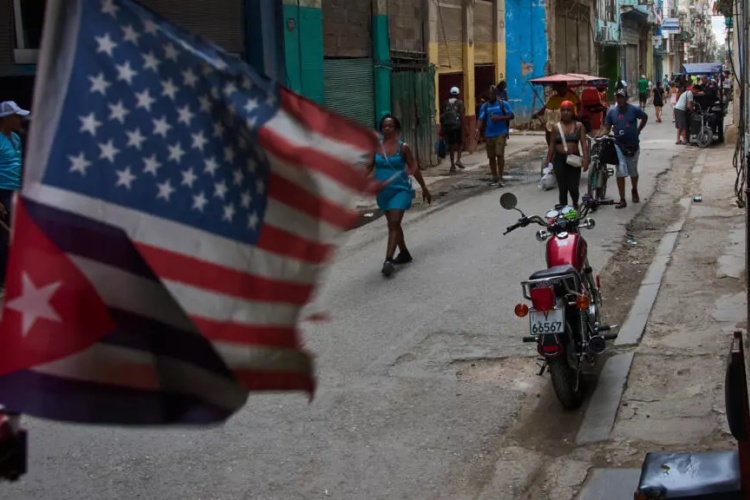
Gambiaj.com – (WASHIGNTON, United States) – US intelligence agencies have reportedly established a secret task force focused on Cuba in what American media reports suggest is an effort to weaken the communist government in Havana and encourage political change on the island.
According to Politico and The New York Times, the initiative marks a renewed focus by Washington on Cuba after years in which US intelligence operations on the island had been significantly scaled back.
The reports do not establish the full objectives or operational timeline of the task force. However, sources cited by the two newspapers indicate that the operation is aimed at identifying, influencing, and building relationships with Cubans who could challenge the country’s communist leadership.
Focus on Regime Change
The New York Times reported that the strategy is understood to involve an “alteration of the regime” rather than an outright overthrow of the government.
The distinction is significant given the history of US involvement in Cuba. In 1961, the CIA backed an invasion by Cuban exiles at the Bay of Pigs in an unsuccessful attempt to overthrow Fidel Castro.
The latest reported operation appears to rely more heavily on intelligence gathering, covert influence, and political pressure.
According to the reports, personnel from across the US intelligence community could be involved, including intelligence analysts, officers responsible for recruiting and managing informants, cyber-operation specialists, and personnel involved in clandestine influence operations.
Politico reported that such operations frequently rely on people who are natives of the country concerned, nationals of third countries, or intelligence officers responsible for developing local sources.
The ultimate objective, according to the reports, is to identify Cubans who could be persuaded to oppose or distance themselves from the current leadership.
Trump Administration Raises Pressure
The reported intelligence operation comes as President Donald Trump has placed Cuba higher among Washington’s intelligence priorities.
The administration has indicated that it would initially favor diplomatic and conventional means of exerting pressure rather than immediately resorting to military action.
US officials have reportedly discussed encouraging Havana to change its political and economic direction, including greater economic liberalization and increased access for American businesses.
Washington also wants Cuba to reduce its security and intelligence cooperation with countries such as Russia and China.
A recent update to a presidential memorandum on US policy towards Cuba called for promoting what the administration describes as a “stable, prosperous, and free” country, while directing resources toward the Cuban population rather than the government.
One of the measures outlined is greater engagement with individuals inside Cuba.
Intelligence Priority
The renewed focus follows a period of reduced US intelligence activity on the island.
In 2016, American diplomats and intelligence personnel stationed in Havana began reporting unexplained symptoms, including headaches, dizziness, and visual problems. The phenomenon became known as “Havana Syndrome.”
Although its precise cause remains disputed, the US government has continued to investigate the incidents. Earlier this month, the US Department of Defense reportedly paid millions of dollars in compensation to affected personnel.
The Trump administration has nevertheless moved to place Cuba alongside major US intelligence concerns involving Iran, Russia, and China.
Washington has also continued its longstanding economic pressure on Havana through sanctions and the US embargo.
Sanctions and Military Concerns
The United States recently imposed sanctions on five Cuban entities and eight individuals allegedly involved in supplying weapons to the Cuban government.
US Secretary of State Marco Rubio has accused the Cuban government of supporting terrorism, conducting espionage against the United States, and providing material support to violent extremist and terrorist groups.
Havana has consistently rejected Washington’s accusations and condemned the US embargo and sanctions as efforts to undermine the Cuban government and economy.
The latest reports have nevertheless raised questions about how far the Trump administration is prepared to go in its efforts to pressure President Miguel Díaz-Canel’s government.
According to the New York Times, Washington is also examining possible figures who could potentially succeed Díaz-Canel if political circumstances change.
Among the names reportedly attracting attention are Raúl G. Rodríguez Castro, a grandson of former Cuban leader Raúl Castro, and Interior Minister Lázaro Alberto Álvarez Casas.
Both men reportedly met CIA Director John Ratcliffe during a visit in May, although the circumstances and purpose of those encounters have not been publicly established.
For now, there is no confirmed indication that the United States has decided to launch a military intervention against Cuba. But the reported creation of a dedicated intelligence task force, combined with increased sanctions and diplomatic pressure, signals a significant escalation in Washington’s efforts to influence the future direction of the Cuban government.




Leave a Reply