


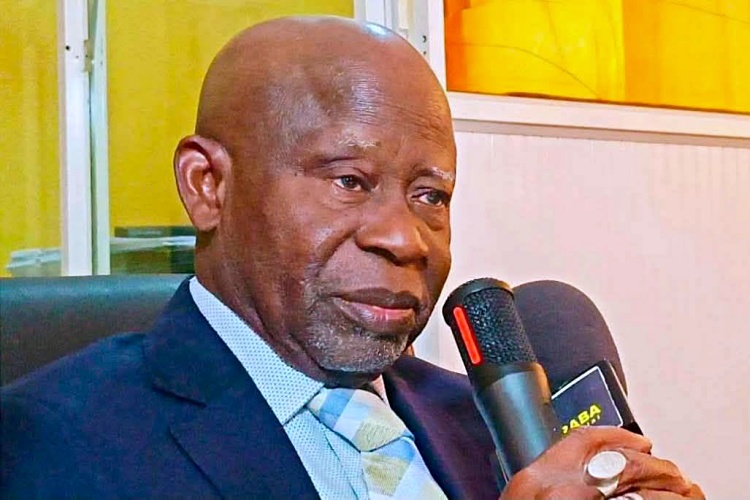
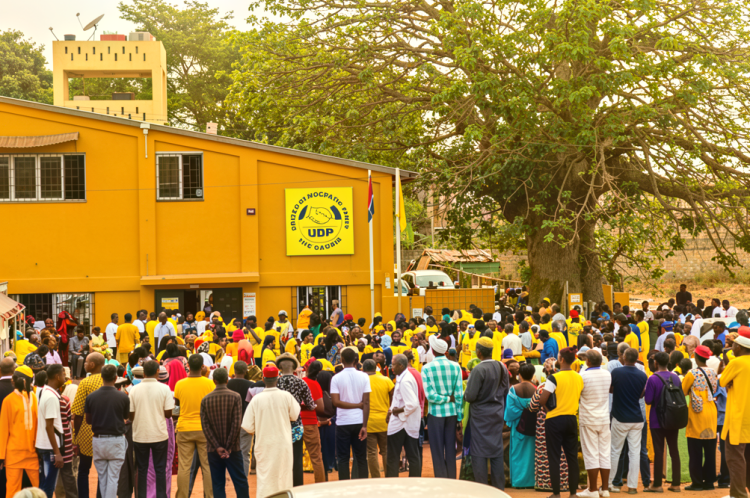
Gambiaj.com – (BANJUL, The Gambia) – United Democratic Party (UDP) leader Ousainou Darboe has called on Gambians committed to removing President Adama Barrow from power to join the UDP, as he defended his party’s withdrawal from the Coalition 2026 negotiations and urged opposition forces to rally behind the country’s largest opposition party.
Darboe made the appeal on Tuesday as he formally announced the UDP’s withdrawal from the coalition talks, insisting that the decision was not driven by arrogance, entitlement, or a desire to undermine opposition unity.
Rather, he said, the UDP had walked away because the coalition process had moved towards a structure that the party believes could weaken political accountability, undermine constitutional governance, and fail to reflect the actual electoral strength of participating political parties.
“The UDP does not advance this position out of arrogance or entitlement,” Darboe said, arguing that the party’s nationwide structures and electoral support could not simply be disregarded in determining the leadership of an opposition coalition.
He said the UDP remained convinced that it was the opposition party best placed to defeat President Barrow in the December 5 presidential election.
But Darboe also made clear that the UDP does not necessarily have to do it alone.
He called on other opposition parties, movements, and Gambians who genuinely want political change to rally behind the UDP, saying his party’s door remained open to those committed to rescuing the country.
UDP Wants Opposition to Rally Behind It
Darboe’s message comes at a critical stage in preparations for the 2026 presidential election, with the opposition struggling to agree on a common platform and a single candidate to challenge Barrow.
While the UDP has withdrawn from the current Coalition 2026 process, Darboe stressed that the party has not withdrawn from the broader objective of opposition unity.
He said the UDP was prepared to work with “like-minded political parties, democratic movements, and patriotic Gambians” to build an alliance capable of defeating the incumbent and governing effectively.
“Unity remains our objective,” Darboe said. “But unity must rest upon principles, not expediency.”
The statement effectively leaves the door open for a different opposition arrangement, potentially one built around the UDP rather than the current Coalition 2026 framework.
Party-Led Coalition vs. Candidate-Led Model
Darboe said the principal disagreement in the Coalition 2026 talks was over the structure of the proposed alliance.
The UDP had advocated a party-led coalition in which registered political parties would form the foundation of the alliance and the presidential candidate would emerge from one of the participating parties through an agreed process.
Under the model now favored by the majority of participants, prospective presidential candidates would instead submit themselves to a Coalition Mediation Committee for vetting and selection. The successful candidate would then resign from their political party and contest the election as an independent.
Darboe said the UDP could not accept that arrangement.
He argued that the experience of the 2016 opposition coalition had demonstrated the problems that could arise when a coalition candidate becomes politically detached from the party and institutions that brought him or her to power.
According to Darboe, such an arrangement ultimately weakens accountability and can make it difficult for coalition partners to collectively implement the mandate given by voters.
“We should learn from our national experience, not repeat it,” he said.
UDP Rejects Proposed Governing Council
The proposed establishment of a governing council to exercise oversight over the Presidency was another major stumbling block.
Darboe said the UDP considered such an arrangement incompatible with the Constitution, which clearly establishes executive authority and the President’s constitutional responsibilities.
“No extra-constitutional body should exercise powers not contemplated by the Constitution,” he said.
The UDP leader warned that a parallel structure exercising influence over executive decisions could create uncertainty over who ultimately holds constitutional authority.
For the UDP, he said, democratic governance should be strengthened through constitutional institutions rather than arrangements outside the constitutional framework.
Darboe Challenges the Equal Voting Formula
Darboe also took issue with the proposed mechanism for choosing the coalition’s presidential flagbearer.
He questioned the decision to give registered political parties, civil society organizations, and political movements equal voting power regardless of their electoral record.
He argued that a political party with nationwide structures and a demonstrated record of winning hundreds of thousands of votes should not have the same weight as an organization that has never contested a national election.
For Darboe, recognizing the difference does not amount to arrogance.
“Democracy is built upon representation. Representation is earned through the confidence and votes of the people,” he said.
He argued that political legitimacy must be demonstrated through popular support and that electoral strength and organisational capacity are legitimate considerations in coalition-building.
‘Offices Should Not Be the Starting Point’
Darboe also criticized what he described as a growing focus on the distribution of political positions during the coalition negotiations.
He said discussions about ministerial appointments, parliamentary representation, power-sharing, and future positions had increasingly overshadowed the national issues that should be at the center of the opposition’s agenda.
According to Darboe, Gambians are more concerned about unemployment, the cost of living, healthcare, education, economic growth, corruption, constitutional reform, and institutional accountability than about how political offices will be divided after an election.
“The UDP believes that offices should be the consequence of serving the national interest, not the starting point of coalition negotiations,” he said.
‘Nothing Could Be Further From the Truth’
Darboe also rejected accusations that the UDP was deliberately sabotaging opposition unity.
He said the party had participated in the Coalition 2026 discussions “sincerely, openly, and in good faith” and had made compromises where it could without abandoning what it considered fundamental democratic and constitutional principles.
He said the UDP’s history of resistance to authoritarian rule demonstrated that the party had made significant sacrifices for democracy, with members suffering imprisonment, torture, intimidation, exile, and death.
“Nothing could be further from the truth,” Darboe said of claims that the UDP was obstructing opposition unity.
He maintained that political disagreement with other opposition groups should not be interpreted as hostility or betrayal.
UDP Leaves Coalition, But Keeps Its Door Open
The UDP has now formally withdrawn from the current Coalition 2026 process, but Darboe stressed that the party’s broader pursuit of opposition unity remains intact.
He said the UDP respected the other parties, civil society organizations, and political movements involved in the negotiations and wished them well in whatever political path they chose.
At the same time, he invited those who share the UDP’s vision to work with the party towards a new opposition alliance.
“Our door remains open to every individual, political party, movement, and organization that shares these principles,” Darboe said.
With the December election approaching, the UDP’s withdrawal could significantly reshape the opposition landscape.
Rather than abandoning the idea of a united opposition, Darboe is effectively proposing that opposition unity should be rebuilt around a different model, one that rrecognizesthe UDP’s electoral weight while allowing other parties and movements to join forces with it.
His central message was therefore not simply that the UDP was leaving Coalition 2026.
It was an invitation.
For Darboe, the route to defeating Barrow remains opposition unity, but one built around constitutional principles, electoral legitimacy, and, potentially, the UDP at its center.




Leave a Reply