


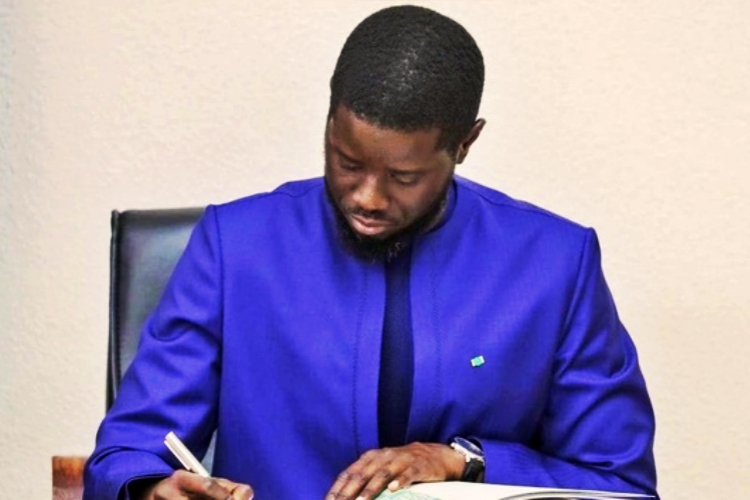
Gambiaj.com – (DAKAR, Senegal) – A major political controversy has erupted in Senegal after parliament admitted that two different versions of the same electoral reform bill were transmitted to President Bassirou Diomaye Faye for assent, forcing the president to return the legislation for a second reading in a move widely seen as an attempt to slow or block a pro-Ousmane Sonko initiative.
The bill, adopted by the National Assembly on April 28, seeks to amend Articles 29 and 30 of Senegal’s Electoral Code. The proposed changes are widely viewed within political circles as being designed to clear legal and political obstacles that could affect Sonko’s eligibility to contest the 2029 presidential election.
The controversy deepened after National Assembly Speaker El Malick Ndiaye confirmed that the presidency had indeed received “two different versions” of the text passed by lawmakers.
According to Ndiaye, President Diomaye Faye formally invoked Article 73 of the Constitution to request a second parliamentary reading of the bill after discrepancies were discovered between the transmitted versions.
The parliamentary speaker attempted to downplay the incident, describing it as a mere “material error” committed during the legislative drafting process.
“After the vote, the legislative services realized that part of the amendment adopted in committee contained a material error,” Ndiaye explained, adding that parliamentary staff later attempted to correct the mistake while preparing the final version, inadvertently creating what he called an “administrative duplicate.”
But the incident has quickly taken on a much larger political significance in Senegal, where tensions between President Diomaye Faye and Prime Minister Sonko have increasingly fueled speculation about fractures within the ruling PASTEF camp.
Although both men rose to power together under the PASTEF banner, political observers have in recent months pointed to signs of growing rivalry between the two centers of executive power.
In that context, Diomaye’s decision to send the bill back to parliament is being interpreted by many as a strategic maneuver aimed at delaying or weakening legislation perceived to favor Sonko’s long-term political ambitions.
A Bill Carfted to Enable the Eligibilty of Ousmane Sonko in 2029
The parliamentary majority backing the reform is dominated by PASTEF lawmakers loyal to Sonko, and the bill reportedly enjoys support from the heads of the Assembly’s largest parliamentary group, giving it significant political weight.
Ndiaye defended the legality of the second reading process, noting that the Constitution allows the president to request another deliberation before promulgation. Such a procedure requires approval by a three-fifths parliamentary majority and automatically suspends the promulgation deadline.
To avoid prolonged delays, parliament has activated an emergency procedure reducing examination time from eight days to four. Ndiaye insisted that the law would still be promulgated “within the same week.”
However, the affair has raised broader concerns about legislative rigor and institutional trust in Senegal. Critics argue that the transmission of two conflicting versions of a law touching on electoral eligibility represents a serious breach in the legislative validation process.
The situation also threatens to evolve into a wider institutional confrontation if disagreements between the presidency and the parliamentary majority intensify.
Under Senegalese law, the president cannot permanently block legislation passed by parliament, but he retains tools capable of delaying or complicating the process, including constitutional review procedures.
On the other hand, the National Assembly can mobilize its majority, increase political pressure, and potentially involve the Constitutional Council if it believes there is institutional obstruction.
For now, the returned bill has become more than a technical legislative dispute. It is increasingly being viewed as the clearest public sign yet of a power struggle emerging at the top of Senegal’s executive leadership over the country’s political future, and particularly over Sonko’s path toward a possible 2029 presidential bid.





Leave a Reply