


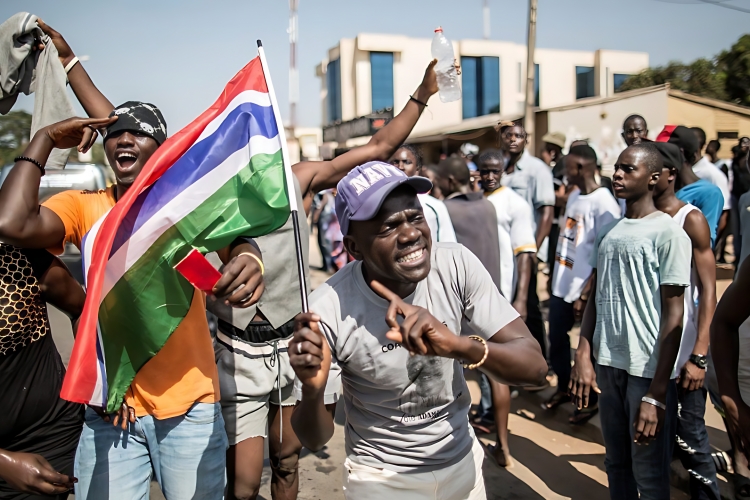
Gambiaj.com – (BANJUL, The Gambia) – There are moments in a nation’s political life when citizens must confront an uncomfortable but necessary question: at what point does political competition begin to threaten the very democracy it claims to defend?
This concern is not directed at any single political party or movement. Rather, it speaks to the collective responsibility all political actors share in safeguarding democratic stability, institutional credibility, and national cohesion.
Recent developments within our political discourse suggest that this question is no longer merely theoretical. Across public rallies, political gatherings, and online spaces, language is increasingly being used not only to inspire supporters, but also to shape expectations, deepen divisions, and cast doubt on democratic processes before they have even run their course.
Words, whether spoken carelessly or deliberately, are never neutral. They can preserve civic peace, or quietly erode it.
Elections are not decided before the first vote is cast. They are determined only after citizens have exercised their democratic right and lawful institutions have fulfilled their constitutional mandate.
Yet an increasingly dangerous pattern is emerging in which political actors persuade supporters that victory is already inevitable long before the electorate has spoken.
Such premature certainty is far from harmless. It creates unrealistic expectations, intensifies emotional investment, and lays fertile ground for unrest when outcomes fail to align with narratives of inevitability.
Already, public rhetoric within our political environment reflects these growing tensions. Assertions of guaranteed victory, increasing suspicion toward electoral systems, and the unchecked spread of unverified claims are gradually shaping how citizens perceive both their political opponents and democratic institutions themselves.
Competitive politics naturally involves persuasion, mobilisation, and strong disagreement. However, there is a critical distinction between democratic engagement and rhetoric that undermines public trust in the very systems that sustain democracy.
Even more troubling are statements that implicitly or explicitly encourage confrontation, intimidation, or the belief that numerical strength alone grants any political group greater national legitimacy. Such rhetoric is profoundly dangerous because it challenges one of democracy’s most sacred principles: that every citizen stands equal before the law.
No Gambian is more Gambian than another.
Citizenship is not determined by political affiliation, ethnicity, regional identity, religion, or the size of one’s support base. It is grounded in constitutional and legal principles. The equal dignity of all citizens remains the foundation upon which national unity and democratic legitimacy rest.
When political discourse begins to imply otherwise, even subtly, political competition risks becoming a contest over belonging itself. Once that boundary is crossed, democracy becomes vulnerable not only to political instability, but also to deeper societal fragmentation.
Leadership, particularly during politically charged moments, demands discipline. Democracy is strengthened not through loud certainty or inflammatory declarations, but through restraint, responsibility, and unwavering respect for institutional processes.
Political speech should reinforce public confidence, not weaken it. It should calm tensions, not provoke them.
Yet responsibility for preserving democratic stability does not rest solely with political leaders. Citizens, media platforms, online activists, and commentators also shape the national atmosphere.
In the age of social media, misinformation, inflammatory language, and unverified claims can spread rapidly, deepening tensions and hardening divisions before facts are even established.
The German theologian Dietrich Bonhoeffer once warned that societies become most vulnerable when citizens abandon independent thought and merely echo political leaders. In such environments, democratic institutions are not always destroyed by outside forces alone.
They can also be weakened from within through manipulation, fear, and reckless rhetoric.
Across Africa, numerous political crises have demonstrated how dangerous language can inflame divisions, delegitimise elections, and destabilise entire nations. Pre-election rhetoric that begins as confident mobilisation can gradually evolve into suspicion, rejection of lawful outcomes, and, in extreme cases, violence.
These lessons are neither distant nor irrelevant. They remain deeply applicable to any democracy seeking to preserve peace, public trust, and national cohesion.
The peaceful democratic transition experienced by The Gambia in recent years demonstrated both the fragility and resilience of national institutions. Preserving that democratic progress requires continued restraint, political maturity, and responsibility from all sides.
Another particularly destabilising trend is the rejection of electoral outcomes before the electoral process has even begun. Vigilance over democratic integrity is essential, but undermining institutions in advance without evidence does not strengthen democracy. It weakens it.
The future of The Gambia depends not only on laws, constitutions, and electoral systems, but also on the maturity of its political culture. Elections must remain contests of ideas, policy alternatives, and national vision — not arenas for fear, coercion, or emotional manipulation.
Ultimately, nations are sustained as much by the tone of their political conversations as by the strength of their institutions. Language that inflames is easy. Language that preserves peace requires wisdom.
At this critical moment, Gambians must demand political discourse that cools tensions rather than escalates them, strengthens democratic trust rather than corrodes it, and unites rather than divides.
The The Gambia we share is both fragile and precious. It must never be endangered for the sake of political ambition.
The true test of democratic maturity is not whether citizens agree on politics, but whether they remain united in their commitment to peace, constitutional order, and the shared future of the nation.
Our democracy’s survival may ultimately depend not only on how we vote, but also on how we speak before, during, and after those votes are cast.






Leave a Reply