


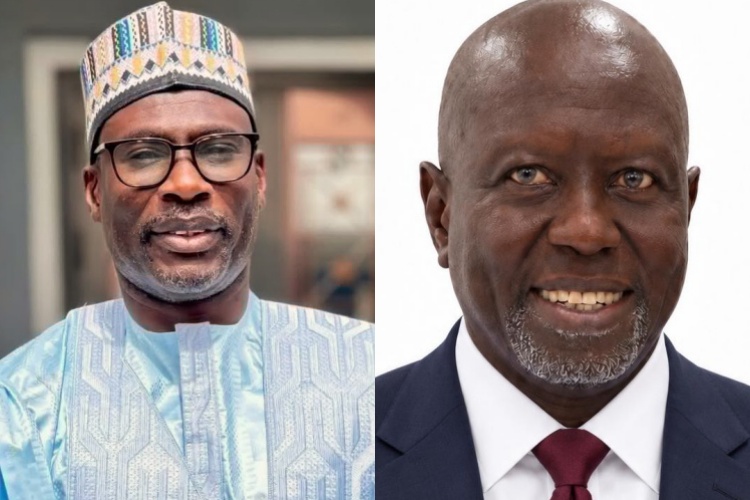
Gambiaj.com – (BANJUL, The Gambia) – Essa Faal’s political alliance with President Barrow has exposed an old question in a new form: when members of a party disagree, who has the authority to speak for the organization?
What began as a political disagreement inside the All Peoples Party-Sobeyaa (APP-Sobeyaa) has quickly turned into something more revealing.
On one side are Gambians associated with the party’s founding, under the lead signature of the party Deputy Leader Maila Touray, who have publicly distanced themselves from Essa Mbye Faal’s decision to ally with President Adama Barrow’s National People’s Party (NPP).
They have called on Faal to resign and argued that the alliance does not represent the party they helped build.
On the other is the APP-Sobeyaa leadership, which dismisses the statement as made by individuals speaking for themselves and not by the party.
At first glance, it looks like another pre-election political rupture.
But APP-Sobeyaa’s own constitution consulted by The Gambia Journal makes the dispute considerably more interesting.
The 103-page document recognizes the importance of the party’s founders. It also establishes a system of elected organs and procedures that makes neither founding status nor the position of Party Leader sufficient, by itself, to speak for the entire organization.
That distinction sits at the heart of the current controversy.
The Founders’ Question
The dissenters cannot simply be dismissed as outsiders to APP-Sobeyaa’s history.
The constitution itself recognizes Founding Members as a distinct category of membership. Its acknowledgement section also records the role of an Advisory Committee and a Task Force, described as the “Think Tank” that brought about the birth and formation of the party.
Seven people are named as members of that original task force.
There is therefore a constitutional and historical basis for describing some of the dissenters as people associated with APP’s founding.
But there is a difference between having helped establish a political party and having the authority to speak for it today.
The constitution does not appear to create a separate governing authority for Founding Members. Instead, APP-Sobeyaa’s decision-making is organized around formal institutions: the National Delegates Conference, National Congress, National Council, and National Executive Committee.
That is significant.
The constitution gives members responsibilities as well as rights, including protecting the unity and good name of the party and publicly upholding party decisions.
So, while founding status carries historical weight, it does not automatically confer institutional authority.
Then There Is Faal
The same constitutional logic applies to Essa Faal.
He is Party Leader and a member of the National Executive Committee. But he is not the party by himself.
The NEC contains several national officers, while the constitution assigns responsibilities to other organs, including the National Council and National Congress.
The NEC has considerable authority. Article 10 gives it responsibility for directing and overseeing the operations and activities of the party, subject to the directions of the National Council.
But an electoral alliance is not simply a routine administrative matter.
This is where the competing narratives begin to diverge.
The press release claims that APP-Sobeyaa’s National Executive consulted regional chairpersons before overwhelmingly supporting an alliance with NPP. However, dissenters question this decision’s legitimacy, arguing that the constitution does not expressly grant the NEC unlimited authority for such alliances.
The key issue lies not in the constitutional text but in the availability of evidence regarding the decision-making process.
The leadership claims a process occurred, yet the public still awaits the minutes, voting results, and alliance terms for clarity. This absence of documentation does not render the alliance unauthorized but highlights a gap between public discourse and the evidence needed for independent assessment.
Dissent Is Not the Same as Removal
There is another layer to the dispute.
APP-Sobeyaa’s constitution does not appear to prohibit disagreement. In fact, it provides formal mechanisms through which members can complain, appeal decisions, and challenge what they consider unfair treatment.
Disciplinary proceedings are also subject to investigation, impartiality, and principles of natural justice.
At the same time, the constitution identifies several forms of misconduct, including creating discord or factionalism, bringing the party into disrepute, and failing to uphold party policies.
So the question is not simply whether members are allowed to disagree.
They plainly have mechanisms for doing so.
The more difficult question is when public disagreement crosses the constitutional line into conduct that the party can treat as misconduct.
That would require an assessment of the specific statements and the procedures used by the party, not simply a declaration by either side.
And Faal’s Resignation?
The call for Faal to resign is politically significant, but constitutionally it is a different matter.
APP-Sobeyaa’s constitution sets out a formal process for removing an elected officer.
A written demand must be supported by 40 percent of the delegates who elected the officer. The officer must be informed of the grounds and given an opportunity to respond. An Extraordinary Delegates Conference must then consider the matter, with removal requiring a two-thirds majority of votes cast.
A press statement calling for resignation therefore does not remove the Party Leader.
But it can still be politically consequential.
It can signal a loss of confidence, expose internal divisions, and force a party to confront questions that might otherwise remain behind closed doors.
And that may be what is happening now.
A Test of APP-Sobeyaa’s Own Principles
The timing makes the dispute particularly important.
With the December presidential election approaching, APP-Sobeyaa has chosen to align itself with the governing NPP. Some people associated with the party’s founding have rejected that course.
The argument is therefore no longer only about Essa Faal.
It is about the meaning of APP-Sobeyaa itself.
The party’s constitution speaks of political, social, and economic democracy. It calls for consultation and participatory democratic culture.
Those principles are now being tested by a disagreement over one of the most consequential decisions a political party can make: whom to support in a presidential election.
The constitutional record suggests that neither side can simply claim the entire party by virtue of its history or position.
The founders have a recognized place in APP-Sobeyaa’s story, but founding status does not automatically confer present-day institutional authority.
Faal is Party Leader, but the constitution does not make him synonymous with the party or give him unlimited personal authority.
The NEC is a powerful governing organ, but the precise constitutional basis and documentary record behind the NPP alliance remain important questions.
And a call for Faal’s resignation is not the same thing as constitutionally removing him.
In the end, the most revealing part of this dispute may not be the competing press statements.
It may be what they force APP-Sobeyaa to demonstrate about itself.
If a party built around consultation and participatory politics is confronted by a fundamental internal disagreement, the real test is not simply who speaks the loudest. It is whether the institutions of the party can show how the decision was made, and whether those who disagree still have a recognized place within that process.







Leave a Reply