


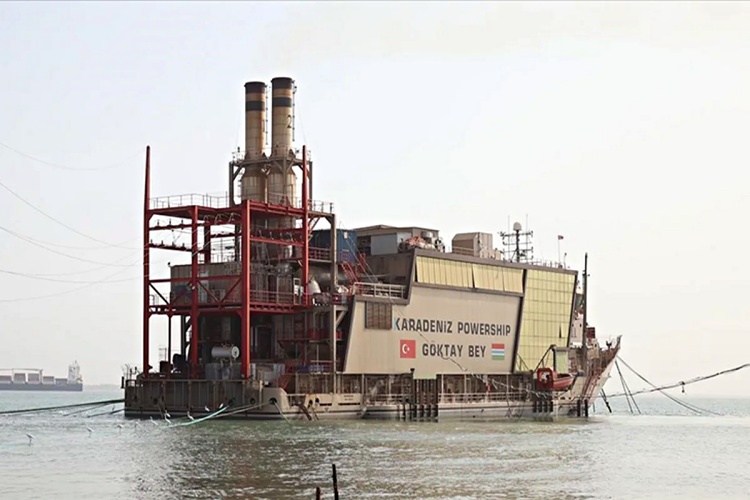
Gambiaj.com – (BANJUL, The Gambia) – The recent electricity crisis has exposed a paradox that The Gambia can no longer afford to ignore. The country has gained access to cheaper electricity, yet households, businesses, and public institutions are still struggling with prolonged power cuts. The question is therefore no longer simply how much electricity costs. It is what that electricity is worth when it is not available when needed.
That brings us back to a debate that began with Karpowership and has now become much bigger than Karpowership. Was ending the arrangement the right decision? If cheaper regional electricity was available, why has reliability remained such a problem? And what should The Gambia’s electricity system look like going forward?
A recent intervention by Mr. Omar A.B. Njie, former Country Manager of Karpowership Gambia, has brought this debate into sharper focus. His argument is that the discussion has sometimes confused the cost of electricity with the value of generating capacity that is available when the system needs it. That distinction deserves attention.
Karpowership entered The Gambia in 2018, when NAWEC was struggling to meet demand. Its floating power plant provided additional generation at a time when the country needed it. But circumstances changed significantly with the arrival of the OMVG regional interconnection and access to cheaper electricity, including hydropower from Guinea.
The cost differential is clear. The World Bank’s 2026 assessment of the OMVG project puts imported Guinean hydroelectricity at approximately US$0.11 per kWh, compared with US$0.18 to US$0.21 per kWh for the lease-based power arrangement that the imports helped replace.
The Karpowership contract expired in May 2025 and was not renewed after OMVG imports became available to substitute for that capacity. [World Bank, OMVG Interconnection Project, 2026]
On the cost of electricity alone, therefore, the economic case for the transition is difficult to dispute.
The Cost of Cheap Electricity
But electricity is not an ordinary commodity. A kilowatt-hour has little value to a hospital operating without power, a business losing production, or a household sitting in darkness.
The IMF captures this tension in its 2026 assessment. It notes that the phase-out of Karpower, together with cheaper OMVG imports, reduced the average cost of electricity, while greater reliance on imports increased energy security concerns. [IMF, 2026 Article IV Consultation]
This is where the present crisis becomes instructive. If regional electricity is cheaper, the challenge is not to abandon it. The challenge is to build enough reliable capacity and infrastructure around it so that the country can benefit from the lower cost without becoming excessively vulnerable when something goes wrong.
The Reliability Gap
The numbers show why this matters. In 2024, The Gambia had approximately 158 MW of installed generation capacity, but only about 102 MW was available as the domestic generation fleet aged. Installed capacity tells us what exists. Available capacity tells us what can actually be relied upon. [World Bank, The Gambia Infrastructure Project, 2025]
At the same time, the country has become heavily dependent on regional electricity. In 2024, OMVG imports from Senegal and Guinea supplied about 53 percent of The Gambia’s total energy supply.
On 22 September 2024, when national demand reached a recorded peak of 106.24 MW, the OMVG line supplied 62.1 MW. By 2025, OMVG imports represented about 80 percent of the energy mix, while Karpower’s contribution had fallen to 4 percent. [World Bank, OMVG Interconnection Project, 2026]
These figures reveal the scale of the transformation. Regional electricity is no longer a supplementary source. It has become central to the national system. That is economically valuable, but it also means that reliability increasingly depends on regional transmission, the national grid, substations, distribution infrastructure, maintenance, and NAWEC’s operational capacity.
The Infrastructure Behind the Power
That is why the wider investment program matters.
Sanna Touray, NAWEC’s Group Corporate Services Director, recently highlighted the nearly US$164 million investment referred to as the JAM project, covering generation, transmission, distribution, and institutional systems. He also pointed to the Jambur solar plant and the 225kV transmission line.
The significance goes beyond the individual projects. Electricity has to travel from where it is generated to where it is consumed.
The World Bank’s 2026 Public Finance Review says transmission and distribution losses continue to undermine sector performance because of infrastructure gaps and weaknesses in the 33 kV and 30 kV networks. It reports that system losses averaged 21 percent from 2020 to 2024, above the 15 percent target. [World Bank, The Gambia Public Finance Review, 2026]
The Jambur solar project shows another part of the transition. The World Bank has documented the commissioning of the 23 MWp solar photovoltaic plant with an 8 MWh battery storage system. Solar can reduce dependence on fuel-based generation and exposure to fuel-price volatility, but variable generation also requires appropriate grid integration, storage, and/or complementary firm capacity. [World Bank, 2025]
None of this makes the questions raised about Karpowership irrelevant. If reliable generation has value, then the way that value is priced and contracted matters.
Mr Njie argues that longer contracts and larger contracted capacity could have produced better pricing because fixed costs and risks could have been spread over greater volumes and longer periods. That is economically plausible. But it does not establish that a longer contract would have been the best choice for The Gambia.
A long-term commitment can also lock a utility into a particular supplier and technology after cheaper alternatives become available.
The same balanced approach is necessary when considering fuel costs. Mr. Njie argues that a substantial component of the Karpowership tariff reflected heavy fuel oil costs linked to international market prices rather than costs determined by Karpowership. If the contractual arrangements confirm this, it would be unfair to attribute every tariff increase to the producer.
But passing a cost through to the customer does not make that cost disappear. For NAWEC and consumers, the relevant measure is the total delivered cost of electricity, including fuel, capacity charges, operations, financing, and other contractual obligations.
And that brings the discussion to NAWEC itself.
The World Bank’s 2026 Public Finance Review highlights the fiscal pressures facing public utilities and the need to improve the financial performance of state-owned enterprises. [World Bank, The Gambia Public Finance Review, 2026]
The recent dispute over arrears demonstrates why the different parts of the problem must not be conflated. The IMF has reported financial obligations involving regional electricity suppliers, including Senegal’s SENELEC and Guinea’s EDG.
NAWEC Finance Director Tambedou, however, has rejected suggestions that arrears caused the recent reduction in power imports, pointing instead to engineering, electrical, and mechanical problems. [IMF, 2026 Article IV Consultation; NAWEC, September 2026]
Both financial sustainability and technical reliability matter, but they are not the same question. The cause of a particular interruption should be established from operational evidence rather than inferred from the existence of arrears.
The regional system has financial obligations of its own. The World Bank’s 2026 OMVG assessment points to outstanding obligations associated with the regional transmission system. Cheaper imported electricity therefore still depends on sustainable financial arrangements for the infrastructure that makes regional electricity trade possible. [World Bank, OMVG Interconnection Project, 2026]
Beyond Karpowership: The Bigger Question
So was leaving Karpowership a mistake?
The available evidence does not support such a simple conclusion.
Karpowership served an important purpose at a particular stage of The Gambia’s electricity development. It provided additional generation when domestic capacity was insufficient. But OMVG changed the economics of the system by making cheaper regional electricity available. Both facts can be true.
The real policy question is therefore not whether The Gambia should return to Karpowership or rely almost entirely on regional imports. It is what combination of sources provides the best balance between cost, reliability, and energy security.
Regional electricity should remain an important part of the mix. Domestic generation should provide firm capacity when required. Renewable energy should continue to expand. Transmission and distribution networks must be strengthened. And NAWEC must become financially and technically stronger.
International expertise can help, particularly where independent technical and financial assessments are required. But consultants cannot substitute for institutional ownership. Ultimately, NAWEC needs the management capacity, maintenance culture, procurement discipline, and financial systems to operate a modern electricity utility.
For the ordinary Gambian, however, the test is much simpler than the contracts, tariffs, and megawatts.
A household should be able to switch on a light and expect it to work. A business should be able to plan its operations without constantly calculating the cost of an outage. A hospital should be able to depend on electricity when lives are at stake.
The question is therefore no longer simply how much we pay for a kilowatt-hour. It is what we are paying, in economic and human terms, when that kilowatt-hour is not there when we need it.
That is the real cost of keeping the lights on.





Leave a Reply