


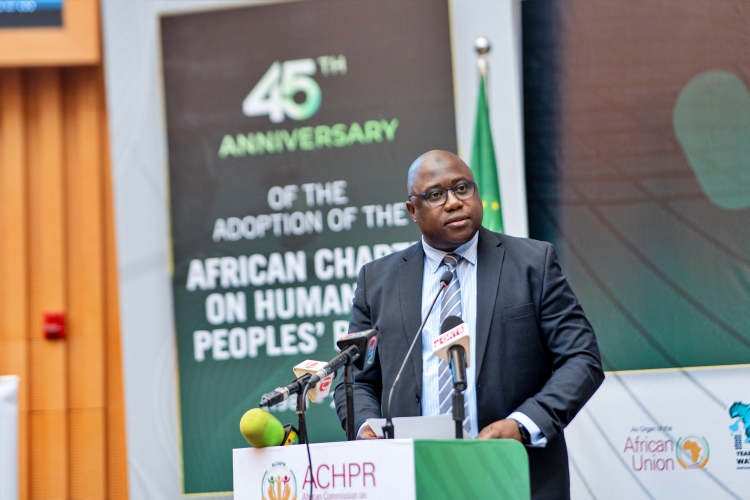
Gambiaj.com – (BANJUL, The Gambia) – The Attorney General and Minister of Justice, Dawda Jallow, on Monday urged African governments to move beyond rhetoric and take concrete steps to protect human rights across the continent, warning that shrinking civic space, armed conflict, and attacks on vulnerable communities continue to threaten democracy and justice in Africa.
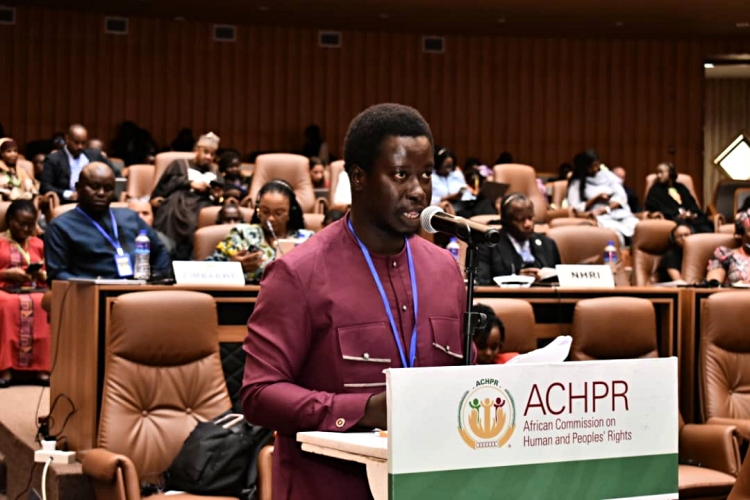
Speaking at the opening of the 87th Ordinary Session of the African Commission on Human and Peoples’ Rights in Banjul, the justice minister said the gathering must produce “decisions that can be measured and held accountable.”
“Human rights are not abstractions,” the minister declared. “The real test of this Commission, and of every government in this room, is not the quality of our speeches. It is whether the people who depend on these protections can feel their effects.”
Addressing delegates from across Africa, diplomats, civil society organizations, and human rights institutions, the minister noted that the 87th session coincides with the 40th anniversary of the coming into force of the African Charter on Human and Peoples’ Rights and 45 years since its adoption.
He described Banjul as more than just the headquarters of the Commission.
“Banjul is not simply a geographical location,” he said. “It is a statement of intent – a declaration made forty years ago that Africa would build its own architecture of justice and hold itself accountable to it.”
The minister warned that Africa is facing mounting pressure from armed conflict, democratic backsliding, and increasing attacks on human rights defenders.
“We should say this plainly: our continent has real and serious problems,” he stated. “Acknowledging them honestly is not weakness. It is the beginning of credible leadership.”
He cited ongoing crises in Sudan, the eastern Democratic Republic of Congo, and the Sahel, saying millions of people continue to suffer displacement and the collapse of the rule of law.
At the same time, he urged African states to recognize the continent’s institutional achievements, describing the African Charter on Human and Peoples’ Rights as a framework rooted in African history and values.
“The African Charter was not borrowed,” the minister said. “It was born from our own history, our own suffering, and our own determination to define dignity on our own terms.”
Reflecting on The Gambia’s experience under former authoritarian rule, the minister said the country understands “in concrete terms what it means when institutions fail, when rights are suppressed, and when justice becomes the privilege of the powerful.”
He highlighted reforms undertaken since 2017, including the expansion of legal aid services, the introduction of mobile courts, and stronger responses to gender-based violence.
“We have done this not because it is politically convenient,” he said, “but because we believe that no government can claim legitimacy without accountability and no state can claim stability without justice.”
The minister also defended The Gambia’s international human rights engagement, including its involvement in proceedings before the International Court of Justice concerning the Rohingya people.
He further called on African states to domesticate regional human rights instruments, adequately fund accountability institutions, and strengthen cooperation between human rights mechanisms and peace and security institutions.
“Underfunded accountability institutions are not merely ineffective,” he warned. “They are a signal to violators that consequences are negotiable.”
The minister additionally called for stronger protections against climate-related displacement, online censorship, cyber abuse, and attacks on environmental defenders, arguing that Africa’s human rights framework “must evolve to meet the world as it is.”
He also advocated for greater inclusion of young people, persons with disabilities, indigenous communities, displaced populations, and informal workers in shaping the continent’s human rights agenda.
“The spirit of Banjul must travel far beyond these halls,” the minister said in closing. “The legacy of this Commission will be measured not by the sophistication of its resolutions, but by the protection it delivers to ordinary African men, women, and children.”






Leave a Reply