


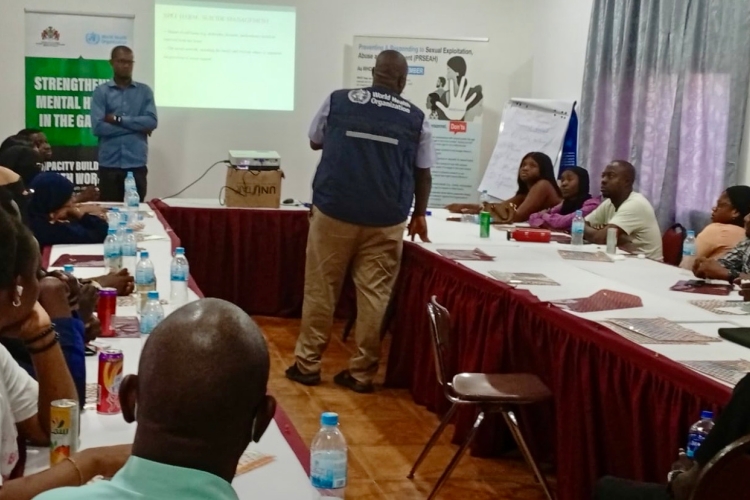
Gambiaj.com – (TENDABA, The Gambia) – A four-day training conducted by the World Health Organization (WHO) on the Mental Health Gap Action Programme (mhGAP) 2.0 guidelines is expected to significantly improve access to mental health care in The Gambia by equipping frontline health workers with the skills to identify, manage, and refer patients suffering from common mental health conditions.
The training was organized in collaboration with the Ministry of Health and the National Mental Health Programme. It brought together 25 healthcare workers, including nurses, midwives, and community health workers from across the country.
The initiative comes at a time when many Gambians, particularly those in rural communities, continue to face serious barriers in accessing mental health services due to long travel distances, financial hardship, and persistent stigma surrounding mental illness.
By training frontline providers who are often the first point of contact for patients, the program is expected to decentralize mental health services and make care more accessible at the community level.
“This training has changed how I understand and approach mental health conditions,” one participating nurse said. “I now feel more confident identifying patients who need support and providing care with empathy.”
Mental health services in The Gambia have traditionally been concentrated in urban areas, leaving many communities underserved. Conditions such as depression, anxiety, epilepsy, and substance use disorders often go undiagnosed and untreated, affecting individuals, families, and livelihoods.
The mhGAP 2.0 guidelines are specifically designed to bridge this gap by enabling non-specialist healthcare workers to provide evidence-based mental health interventions within primary health care facilities.
During the training, participants engaged in case studies, role plays, and group discussions aimed at improving their ability to recognize and respond to mental health conditions.
Health officials say the knowledge gained through the program could transform mental health care delivery across the country. Community health workers will now be able to provide earlier interventions, improve referrals, and offer support closer to where patients live.
This means that people experiencing anxiety, depression, or emotional distress may no longer have to travel long distances to seek help, while families caring for relatives with mental health conditions can access guidance within their own communities.
“People trust us because we are part of the community,” a participating community health worker said. “Now we have the skills to support them in ways we could not before.”
The training also aims to reduce stigma associated with mental illness by encouraging more compassionate and informed care at health facilities. Officials believe that improving providers’ understanding of mental health conditions will help create safer and more supportive environments for patients.
The initiative builds on commitments made by The Gambia’s Minister of Health, Hon. Dr. Ahmadou Lamin Samateh, during the launch of the Mental Health Investment Case Report 2025 and the National Mental Health Policy (2025–2030).
At the event, the minister stressed the importance of integrating mental health into primary health care as part of efforts to achieve universal health coverage.
“Integrating mental health into primary health care is essential to achieving universal health coverage,” Dr. Samateh stated, noting that strengthening frontline capacity improves access to services and reduces delays in care.
Health experts say integrating mental health services into primary health care will also ease pressure on specialized facilities while improving the affordability and continuity of care nationwide.
At the end of the training, participants pledged to share the knowledge gained with colleagues through mentorship and peer learning to further strengthen the country’s health system.
WHO says it will continue supporting The Gambia in scaling up implementation of the mhGAP program as part of broader efforts to strengthen community-based mental health care across the country.


















Leave a Reply