


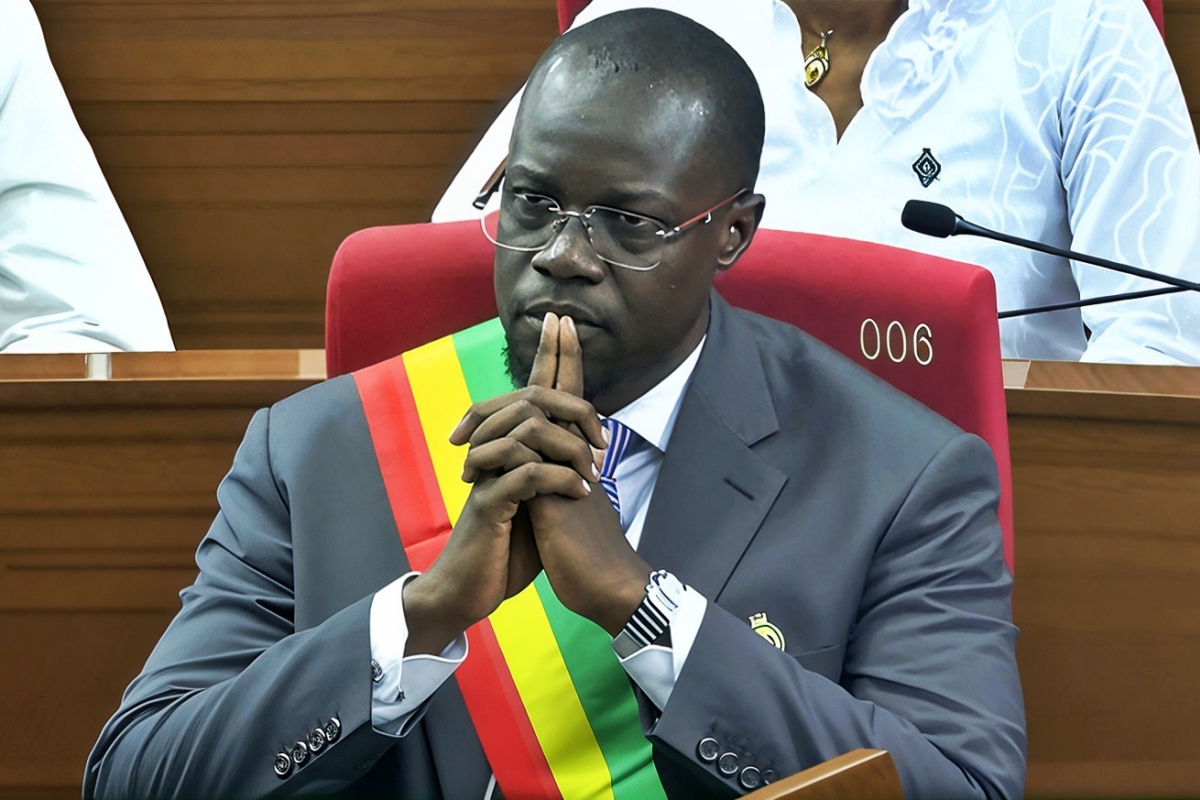
Gambiaj.com – (DAKAR, Senegal) – Senegal’s Constitutional Council on Wednesday declared itself without jurisdiction to rule on a legal challenge aimed at blocking Ousmane Sonko’s integration into the National Assembly, effectively sealing his position as Speaker of the country’s parliament and dealing a decisive blow to opposition lawmakers who had sought to derail his parliamentary career.
The ruling, delivered during a session chaired by Acting President Aminata Ly Ndiaye, Vice-President of the Council, brings to a close a legal battle that had cast a shadow of uncertainty over the political future of the Pastef leader, one of the most consequential figures in contemporary Senegalese politics.
The Challenge That Failed
The legal action was initiated on June 1, 2026, when legislator Tafsir Thioye and 17 fellow parliamentarians filed a petition with the Constitutional Council, asking it to declare unconstitutional a decision taken on May 24, 2026, by the Bureau of the National Assembly.
That decision had formally integrated Sonko into the assembly as a deputy following his departure from government, a transition the petitioners argued violated the Constitution.
The group of 18 lawmakers contended that the Constitutional Council had dual authority to intervene: first, as the body responsible for overseeing the regularity of legislative elections; and second, as the institutional regulator of how the branches of government function.
They grounded their arguments in Article 92 of the Constitution and Article 2 of Organic Law No. 2016-23 of July 14, 2016, further citing a series of previous rulings by the constitutional court to buttress their case.
The Council’s Reasoning: A Jurisdiction Too Narrow
The Constitutional Council, however, was unpersuaded. In a point-by-point rejection of the petitioners’ arguments, the Council drew a sharp legal line around the limits of its own authority.
It first reminded the parties that Article 92, Paragraph 3 of the Constitution strictly confines the Council’s electoral jurisdiction to national elections and that even this limited competence expires the moment final results are officially proclaimed.
The Council further clarified that reviewing the legality of an administrative act falls outside its mandate, except in cases where such an act directly bears on the integrity of an ongoing electoral process.
The May 24 decision integrating Sonko into the assembly, the Council noted, came long after the proclamation of results from the snap legislative elections held on November 17, 2024. Furthermore, it concerned solely the formal admission of a former government minister who had become a lawmaker upon leaving office, a procedural matter entirely disconnected from any active electoral contest.
On all these grounds, the Council concluded it simply lacked the jurisdiction to entertain the petition.
What the Ruling Means
The decision is significant far beyond legal technicalities. With the Constitutional Council closing what petitioners had hoped would be a judicial door to challenge his presence in parliament, Sonko’s status as Speaker of Senegal’s National Assembly is now legally unassailable through that avenue.
As the leader of Pastef, the party that swept the November 2024 legislative elections, Sonko’s hold on the speakership reflects not just legal standing but a dominant political reality in post-transition Senegal.
The ruling also underscores a constitutional principle that courts in many democracies have grappled with: the boundaries between judicial oversight and the internal governance of elected institutions.
By affirming that the integration of a sitting lawmaker is an administrative matter beyond its reach, the Constitutional Council has reinforced the primacy of the National Assembly’s Bureau in managing its own membership.
For the 18 opposition lawmakers who brought the challenge, Wednesday’s outcome represents a significant political setback. For Sonko and Pastef, it is yet another institutional validation of a political ascent that has reshaped the Senegalese democratic landscape.









Leave a Reply