


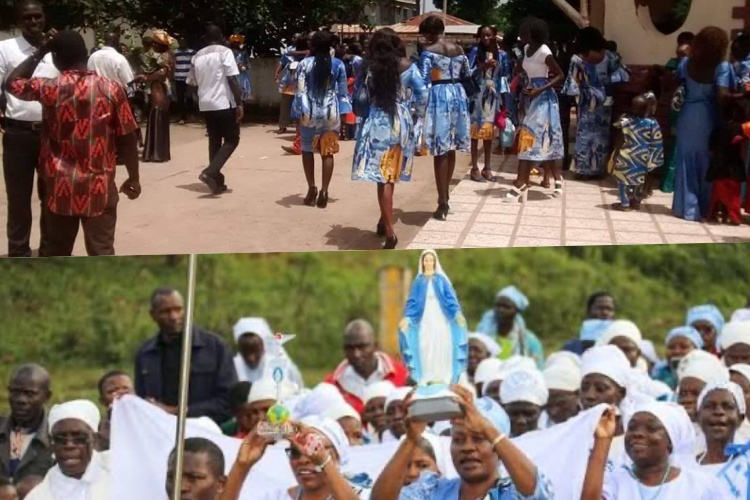
Gambiaj.com – (BANJUL, The Gambia) – Every year on 15 August, a familiar expression is heard across The Gambia: Sang Marie. For many Gambians, those two words bring back memories of church bells, hymns, colorful processions, family gatherings, and communities coming together in celebration.
For Catholics, Sang Marie marks the Feast of the Assumption of the Blessed Virgin Mary, an important celebration in the Christian calendar. It commemorates the Christian belief that, at the end of her earthly life, Mary, the Mother of Jesus Christ, was assumed body and soul into heaven. It is a celebration of faith, hope, and the promise of eternal life.
But in The Gambia, Sang Marie has come to mean more than a Catholic feast. It has become part of our shared national experience. Many Gambians who are not Christians know the day, greet their Christian friends and neighbors, and share in the spirit of the occasion.
That simple gesture reflects something that has long been valued in our country: people of different faiths can respect one another without giving up their own beliefs.
One of the strongest links between Christianity and Islam is the place given to Mary. Christians honor her as the Blessed Virgin Mary and the Mother of Jesus Christ. Muslims know her as Maryam and hold her in exceptionally high esteem.
Maryam occupies a unique place in the Holy Qur’an. She is the only woman named individually in the Qur’an, and an entire chapter, Surah Maryam, the nineteenth chapter, bears her name. Her place in Islamic scripture is therefore unlike that of any other woman. Surah Maryam recounts the miraculous birth of Prophet Isa, peace be upon him, and presents Maryam as a woman of exceptional faith, purity, and devotion to Allah.
Her story is also a story of trial. She faces circumstances that would have been difficult for anyone to bear, yet she remains steadfast and puts her trust in God.
There are lessons in her story that remain relevant today. It speaks of patience in difficult times, humility in times of blessing, and courage when the future is uncertain. It reminds believers that we do not always understand God’s wisdom immediately and that hardship does not necessarily mean that God has abandoned us.
The respect for Maryam is also reflected in the Islamic scholarly tradition of West Africa. Sheikh Ahmadou Bamba, the revered Senegalese Muslim scholar and founder of the Mouride tradition, wrote with deep admiration about Maryam and her virtues.
His khassida, Fuzti Bi Zarfil Hasanat, reflects the high regard accorded to her faith, purity, and devotion within a religious tradition that has had a profound influence across Senegal and the wider Senegambian region.
This is worth remembering because Maryam is not simply a figure of ancient history. Her story has been studied, reflected upon, and honoured across generations and cultures, including within our own West African religious tradition.
Christians and Muslims, of course, do not understand Mary and Jesus Christ in exactly the same way. Those differences are fundamental to each faith and should be acknowledged honestly. Christians believe that Jesus is the Son of God and honor Mary as the Mother of Christ. Muslims regard Isa, peace be upon him, as a great prophet of Allah and Maryam as his blessed mother.
Yet these differences do not prevent Christians and Muslims from recognizing qualities associated with Mary and Maryam that are deeply valued by both traditions: faith, purity, courage, humility, patience, and devotion to God.
A Shared Gambian Experience
This is perhaps where Sang Marie takes on a wider meaning in The Gambia. Our religious beliefs are not identical, but we can still share values that make our society stronger. Respect does not mean that we must agree on matters of faith. It means recognizing the dignity of people whose beliefs may be different from our own and accepting that we can live together peacefully.
The Gambian experience has shown this for generations. Muslims and Christians have lived side by side, attended one another’s family ceremonies, shared moments of joy, comforted one another in times of sorrow, and worked together for their communities.
A Muslim may greet a Christian on Christmas or Sang Marie’s day, just as a Christian may extend greetings to a Muslim during Eid. These gestures do not require anyone to compromise their faith. They are expressions of friendship, courtesy, and good neighborliness.
That is one of the things that makes The Gambia special. Our religious diversity has, for the most part, been a source of coexistence rather than conflict. We have inherited a culture in which respecting another person’s faith does not mean abandoning our own.
A Tradition Worth Preserving
But traditions survive only when each generation chooses to preserve them. That responsibility is particularly important today. Around the world, religious differences are sometimes used to create fear, suspicion, and division. The Gambian experience should remind us that another path is possible.
The story of Mary points us towards qualities that any society can value: faith in difficult circumstances, humility before God, courage in times of uncertainty, and compassion for others. These are values that matter in our homes, our communities, and our country.
Sang Marie therefore gives us an opportunity not only to celebrate, but also to reflect on what we want to preserve as a nation. For Christians, it is a day to honor the Blessed Virgin Mary and celebrate the Feast of her Assumption.
For Muslims, Maryam is one of the most honored women in the Holy Qur’an. For all Gambians, the occasion can remind us of the bonds of friendship and respect that have existed between our communities for generations.
We should not take those bonds for granted.
Our children should learn that respecting another person’s faith is not a weakness. It is part of living in a society where people are free to worship according to their conscience. They should also understand that peaceful coexistence is not something guaranteed for all time. It has to be protected and passed from one generation to the next.
Whether we call her Mary or Maryam, her story continues to speak to millions of believers. Perhaps that is one of the lessons Sang Marie offers us. We may not share every belief, but we can still recognize the values that bring people together.
May this year’s celebration of Sang Marie strengthen the bonds of friendship between Christians and Muslims throughout The Gambia. May it remind us that our differences need not divide us and that respect for another person’s faith can exist alongside a deep commitment to our own.
May we continue to protect the culture of tolerance, friendship, and mutual respect that has served our country so well.
That has long been the Gambian way. May it remain so for generations to come.






Leave a Reply