


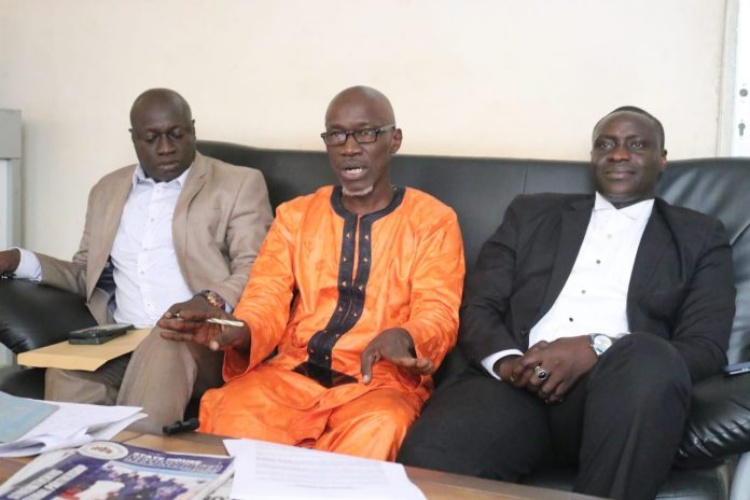
Gambiaj.com – (BANJUL, The Gambia) – The Gambia Law Society has declared that Chief Justice Edrissa M.O. Faal is constitutionally eligible to hold office, taking a position that directly contradicts the constitutional challenge filed by the Gambia Bar Association over his appointment.
The Law Society, which represents lawyers in private practice, made its position public on Tuesday, August 11, saying Faal should continue performing his duties while the legal challenge is being determined by the Supreme Court.
The statement, read by Counsel L.K. Mboge on behalf of the Society’s members during a press briefing, marks a significant split within The Gambia’s legal profession, with two major legal organizations now holding opposing views on the constitutionality of the Chief Justice’s appointment.
The Gambia Bar Association filed a constitutional challenge on July 31, questioning whether Faal satisfies the requirements set out in Section 139 of the 1997 Constitution.
Law Society backs JSC determination
The Law Society said the Judicial Service Commission considered Faal’s eligibility before his appointment and was satisfied that he met the applicable constitutional requirements.
The Society said it attaches “due significance” to that institutional determination.
“It is our considered view that the Chief Justice, Edrissa M.O. Faal, is eligible to hold the office to which he has been appointed, and we support his continuation in office while the constitutional process takes its course,” the statement said.
The Society also stressed that disagreement among lawyers over constitutional interpretation should not be viewed as a weakness within the profession.
It said membership of the legal profession does not require lawyers to hold identical views, arguing that professional independence allows lawyers to reach different conclusions provided their disagreements are expressed with civility and respect.
Dispute centres on constitutional qualification
At the heart of the dispute is Section 139 of the Constitution, particularly the provision dealing with the legal experience required for appointment as Chief Justice.
While the Bar Association argues that Parliament must formally recognize the United States before legal experience gained there can count toward the constitutional qualification, the Law Society takes a different view.
The Society’s position suggests that Section 139(5)(b) gives Parliament the power to prescribe non-Commonwealth common-law countries but does not make such a prescription a mandatory precondition for legal experience obtained in those countries to qualify.
The Law Society did not set out an extensive legal interpretation of the provision in its statement but maintained that Faal meets the constitutional requirements.
‘Not political or personal’
The Law Society sought to distance its position from any political or personal dispute.
“Our position is neither political nor personal,” it said, adding that it was not directed against the Gambia Bar Association or lawyers who had reached a different conclusion.
The Society argued that reasonable lawyers can, after conscientiously examining the same constitutional provisions, arrive at different interpretations.
“Such disagreement is not a weakness of the profession,” it said, describing responsible disagreement as an attribute of an independent Bar.
The organization said that with the matter now before the Supreme Court, the Court is the appropriate institution to determine the constitutional questions.
It expressed confidence that the Supreme Court would consider the matter objectively and determine it in accordance with the Constitution, the law, and established principles of constitutional interpretation.
Supreme Court to have final say
Faal remains Chief Justice pending the determination of the case. The Supreme Court has not yet set a hearing date for the Bar Association’s constitutional challenge.
The Attorney General and Faal’s legal representatives are expected to file responses to the petition.
The Law Society said its support for Faal’s continued tenure should not be interpreted as an attempt to preempt the Court.
It reaffirmed its commitment to the rule of law, judicial independence, institutional integrity, and the right of lawyers to exercise independent professional judgment.
The Society concluded by reiterating its support for Faal’s continued discharge of his responsibilities while the constitutional process takes its course.
The opposing positions of the two legal organisations mean that the legal profession is not united over the Chief Justice’s appointment. While the Gambia Bar Association is asking the Supreme Court to determine whether Faal meets the constitutional requirements, the Gambia Law Society maintains that he does.
The final determination will rest with the Supreme Court.









Leave a Reply