


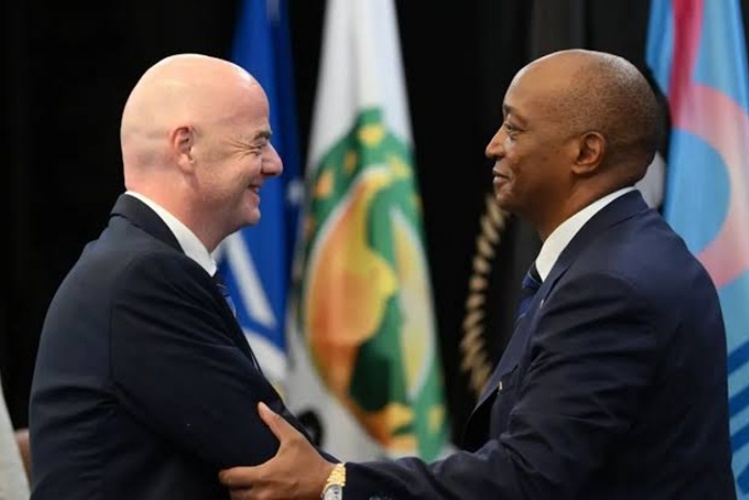
Gambiaj.com – (BANJUL, The Gambia) – The Confederation of African Football’s cautious response to Gianni Infantino’s controversial plan to open FIFA’s flagship competitions to private investors has exposed a growing fault line in global football governance, with critics questioning whether CAF can genuinely scrutinize the proposal independently given its increasingly close relationship with the FIFA president.
On Wednesday, CAF stopped short of either endorsing or rejecting FIFA Forward Enterprise (FFE), the proposed commercial subsidiary through which FIFA intends to raise billions of dollars by selling minority stakes to private investors.
Instead, CAF said its president, Patrice Motsepe, would convene the organization’s executive committee next week to “assess and evaluate” the proposal, while urging African member associations to examine it.
On paper, the position is one of consultation. In the increasingly polarized debate surrounding FIFA’s plan, however, the measured language stands in sharp contrast to the reaction from other confederations.
UEFA and its 55 member associations have rejected the proposal unanimously and threatened to boycott FIFA competitions if the plan remains on the table. CONCACAF and its 41 member associations have also rejected it, citing concerns about due process, the compressed deadline, and the absence of prior scrutiny by FIFA’s appropriate governance bodies.
The Asian Football Confederation, while stopping short of rejecting the proposal, has similarly expressed concern that FIFA announced the initiative without first consulting its members.
Against that backdrop, CAF’s response has been interpreted by some observers as strikingly accommodating.
Why CAF’s position is attracting suspicion
The concern is not simply that CAF has declined to oppose the proposal. It is the context in which that decision has been made.
Motsepe and Infantino have developed an unusually close political and institutional relationship since the South African businessman took over as CAF president in 2021. Infantino has repeatedly portrayed Motsepe’s leadership as part of a successful partnership between FIFA and African football, while Motsepe has consistently presented the FIFA president as an important ally of the continent.
In February 2026, CAF went further, describing Infantino as a “loyal and trustworthy friend and partner” of African and world football.
Just two months later, CAF’s 54 member associations unanimously agreed to support Infantino’s bid for another term as FIFA president from 2027 to 2031. That endorsement was politically significant because Africa controls 54 of FIFA’s 211 votes and therefore represents one of the most important blocs in any presidential contest.
Infantino, for his part, has openly praised Motsepe’s leadership. When Motsepe was re-elected CAF president in March 2025, Infantino described him as a key figure in African football and highlighted the close collaboration between FIFA and CAF. Motsepe is also a FIFA vice-president.
That history makes CAF’s current position vulnerable to the accusation that the confederation is reluctant to confront a FIFA president whom its leadership has repeatedly supported.
It does not establish that Motsepe or CAF is acting improperly. But it explains why the response is being viewed through a political lens.
The money changes the equation.
There is also a powerful financial dimension to the debate.
FIFA says FFE could be valued at about $20 billion and could raise as much as $4.2 billion by selling minority stakes to private investors.
Under the proposed arrangement, each of FIFA’s 211 member associations could receive a one-off payment of $20 million in early 2027, while allocations under the FIFA Forward program for the 2027-2030 cycle could rise from $8 million to $20 million.
For African football associations, many of which remain heavily dependent on international football development funding, those figures are difficult to dismiss.
FIFA has already significantly increased its financial footprint in Africa under Infantino. FIFA said its Forward programme was expected to have delivered about $1.28 billion to African football by the end of 2026.
This creates a complicated incentive structure.
CAF and its national associations have a legitimate interest in securing more resources for football development. Its statement explicitly framed the issue around increasing “financial and other resources” for the development and growth of football in Africa and globally.
But critics can reasonably ask whether the promise of substantially increased funding risks weakening the confederation’s willingness to challenge FIFA on questions of ownership, governance, and accountability.
That is particularly important because the proposed commercial structure would involve private investors taking minority interests in a company controlling some of FIFA’s most valuable competitions.
The World Cup is not simply another commercial asset. It is the centerpiece of international football and one of the most valuable sporting properties in the world.
UEFA sees a governance crisis; CAF sees an opportunity to examine
The difference in language is telling.
UEFA has argued that FIFA’s proposal was developed without adequate consultation and has rejected the idea that the process can be described as democratic. Its members have warned that selling stakes in FIFA competitions to outside investors could permanently change the relationship between football and commercial capital.
CONCACAF has raised similar procedural objections, arguing that the proposal was presented without proper review or approval by relevant FIFA governance bodies.
CAF, by comparison, has emphasized consultation and development.
That approach may reflect a different set of priorities rather than blind loyalty to Infantino. African football has long argued that the global football economy does not distribute its resources fairly and that the continent needs substantially greater investment.
From that perspective, a proposal promising potentially billions of additional dollars for member associations could reasonably be viewed as something to investigate rather than immediately reject.
But that argument also exposes the central contradiction.
If CAF’s primary objective is to secure more money for African football, it may have less incentive than UEFA to challenge a system that promises to increase the financial resources available to African associations.
The danger is that development funding becomes intertwined with political loyalty.
A relationship that has become difficult to separate from policy
The perception of CAF as an ally of Infantino did not emerge with the FFE controversy.
In 2022, CAF publicly defended Infantino after controversial comments he made while advocating the idea of a biennial World Cup. CAF said his position had been misunderstood and reiterated the continent’s support for a more frequent World Cup. In April this year, the relationship became even more politically consequential when African football associations unanimously backed Infantino’s re-election campaign.
And in July, Motsepe again publicly defended Infantino, describing the FIFA president as someone with a deep commitment to football and strong support for Africa.
The pattern has therefore become difficult to ignore: when Infantino faces major political pressure, CAF leadership has frequently positioned itself closer to FIFA than some of its counterparts elsewhere.
That does not mean every CAF decision is dictated by FIFA, nor does it prove that the organisation will ultimately endorse FFE.
Indeed, CAF has not yet endorsed the proposal. Its executive committee is only due to assess it next week.
But the political optics are already damaging.
Africa holds the votes, and Infantino knows it
There is another reason why CAF’s response matters beyond the commercial proposal itself.
Africa is the largest voting bloc in FIFA’s presidential election. Combined with Asia’s 47 votes, African and Asian support gives Infantino a formidable electoral base.
CAF and AFC both backed Infantino in April, giving him the support of 101 associations before taking into account the backing already secured from South America.
That makes the relationship between Infantino and African football leaders strategically important.
It also means that the current FFE dispute is not merely a disagreement over corporate restructuring. It is part of a much broader contest over who controls the future direction of world football and how FIFA’s enormous commercial revenues are governed.
For African football leaders, there are clear benefits to maintaining a strong relationship with FIFA.
For FIFA, maintaining Africa’s support is equally valuable.
That mutual dependence is precisely why CAF’s neutrality is now being questioned.
The real test comes next week
CAF’s executive committee meeting could therefore become a defining moment.
If CAF ultimately endorses the proposal without demanding stronger safeguards on transparency, investor rights, conflicts of interest, valuation, revenue distribution, and FIFA governance, critics are likely to interpret that decision as evidence that Motsepe’s CAF is prepared to protect Infantino’s interests.
If, however, CAF demands full disclosure, independent financial scrutiny, proper consultation with national associations, and guarantees that the World Cup and other competitions remain under football’s institutional control, it could demonstrate that its relationship with FIFA does not compromise its independence.
For now, CAF is keeping both doors open.
Its language allows the organization to remain aligned with FIFA’s development argument while avoiding the outright confrontation that has brought UEFA and CONCACAF into open conflict with Infantino.
That may be pragmatic African football diplomacy.
But it also creates the perception that CAF is aiding and abetting Infantino at precisely the moment when FIFA needs allies.
The question, ultimately, is not whether Africa needs more money for football. It unquestionably does.
The more difficult question is whether the continent should accept that money in exchange for supporting a fundamental restructuring of the ownership and commercial control of football’s biggest competitions.
That is the question Motsepe and CAF’s 54 member associations will have to answer, and their response will reveal whether the relationship between African football and Infantino is merely a strategic partnership or something considerably more politically intertwined.





Leave a Reply