


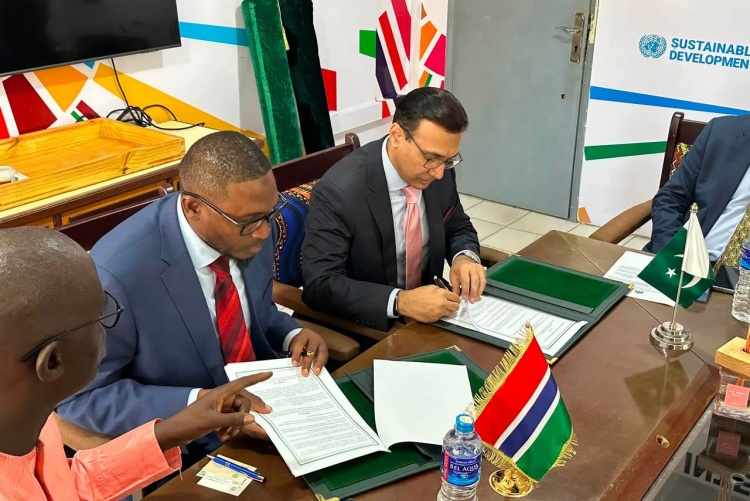
Gambiaj.com – (BANJUL, The Gambia) – The Gambia and Pakistan have signed a Memorandum of Understanding (MoU) aimed at securing a more reliable supply of rice and other essential agricultural commodities while creating new export opportunities for Gambian producers under a government-to-government trade framework.
The agreement, signed between The Gambia’s Ministry of Trade, Industry, Regional Integration, and Employment (MoTIE) and the Trading Corporation of Pakistan (TCP) in Banjul, is expected to strengthen bilateral trade, improve food security, and deepen economic cooperation between the two countries.
The MoU will allow Gambian businesses greater access to high-quality rice and other agricultural products at preferential prices through direct government cooperation. Officials said the arrangement is designed to improve the availability and affordability of staple foods, stabilize domestic markets, and strengthen the country’s food supply chain at a time of global price volatility and supply disruptions.
Focus on Food Security
Speaking at the signing ceremony, officials described the agreement as a significant step towards safeguarding The Gambia’s food security, with rice remaining the country’s principal staple food.
The Director of Trade at MoTIE said the partnership reflects both governments’ commitment to ensuring a dependable supply of agricultural commodities, particularly rice, to help maintain price stability and guarantee consistent market availability.
He noted that the ministry continues to engage reputable international suppliers to ensure essential commodities remain available for Gambian consumers.
The Permanent Secretary at the Ministry of Trade said the agreement goes beyond a simple trade arrangement and represents a strengthening of the longstanding friendship between The Gambia and Pakistan.
He stressed that ensuring a reliable, affordable, and sustainable rice supply is a national priority, particularly as The Gambia continues to depend heavily on imports to meet domestic demand.
According to him, the collaboration with the Trading Corporation of Pakistan will improve access to quality food commodities while strengthening market stability and national food security.
Benefits for Businesses, Exporters, and Long-Term Partnership
Beyond improving food imports, the agreement is also expected to create commercial opportunities for Gambian businesses.
The Permanent Secretary said the MoU will encourage business-to-business partnerships, expand trade and investment relations, and support private sector growth through stronger commercial links with Pakistan.
He added that the agreement aligns with The Gambia’s broader development agenda by diversifying sources of essential commodities, improving supply chain resilience, and strengthening strategic international partnerships.
The Pakistani delegation also signalled that the relationship would not be limited to exports into The Gambia.
Speaking on behalf of the Trading Corporation of Pakistan, the head of delegation said Pakistan is equally interested in purchasing Gambian products and helping local producers reach international markets.
“We are not only here to sell,” he said, adding that TCP already trades with markets across the Middle East and Asia and is prepared to source products from Gambian farmers, producers, and exporters.
The delegation said this could create new market opportunities for Gambian agricultural products while strengthening two-way trade between the countries.
Following the signing ceremony, officials from both sides discussed implementation mechanisms for the agreement, including strengthening trade cooperation and building institutional capacity.
The Pakistani delegation was also scheduled to brief the Minister of Trade, Industry, Regional Integration and Employment on the outcomes of the visit.
Officials from both governments described the MoU as the beginning of a long-term strategic partnership that will support food security, promote private sector development, expand trade and investment, and deliver lasting economic benefits for businesses and consumers in both The Gambia and Pakistan.










Leave a Reply