


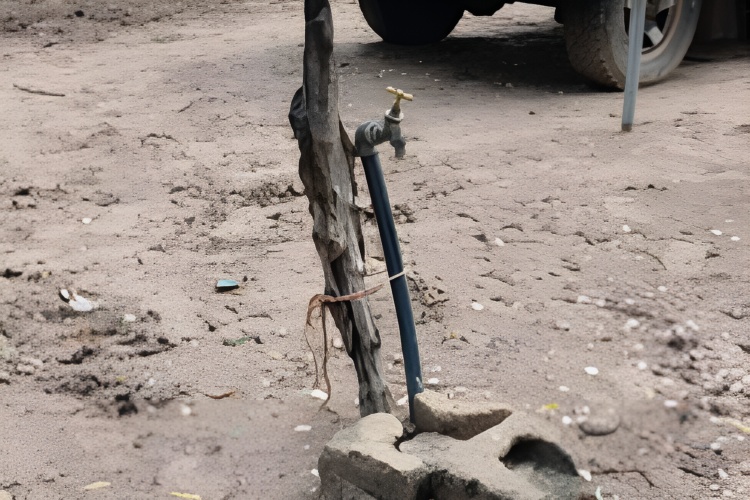
Gambiaj.com – (BANJUL, The Gambia) – In rural Gambia, many donor-funded boreholes are falling into disrepair and remain unusable. Take Jinack in The Gambia’s Lower Niumi District of North Bank Region, for instance; its pumps have been dry for a staggering 18 months. Unfortunately, this isn’t just a one-off situation.
Jinack Kajateh and neighbouring Nigi are serene and secluded islands tucked away in the mangrove-fringed waters along the northern bank region of The Gambia, right where the Sine-Saloum delta greets the Atlantic Ocean. In these communities, children are forced to fetch water from contaminated open wells. Although awarded, they were never carried out, according to local sources. Health officials are now reporting a troubling increase in diarrhoea cases linked to these unsafe water sources and hygiene.
Through documents and interviews, a clear pattern emerges: the promises of safe water have been
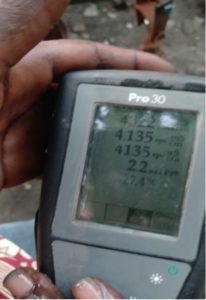
Photo: Water quality tests showed that the salinity was at X PPT (x parts per thousand), which stands for parts per thousand.
shattered by failure to repair, missing parts, and a complete lack of accountability, leaving rural Gambians to bear the consequences.
In Jinack, the situation hasn’t improved despite budget allocations for rural water delivery and maintenance. The pumps are still out of order, no repairs have been carried out, and the Ministry hasn’t provided any details on how that money was used.
The Government of The Gambia reported that it is taking steps to tackle the water crisis in Jinack, which they link to climate change and the troubling issue of saltwater intrusion.
Former Fisheries Minister James Gomez has made it clear that drilling a borehole on “Paradise Island” is a top government priority, aimed at freeing residents from their reliance on water imported from across the border.
The Ministry has also announced that it will provide resources to help the Jinack community access clean drinking water.
However, in reality, the neighbouring villages of Jinack Niggi and Jinack Kajateh are still heavily reliant on water purchased from Senegal. The island’s groundwater has been compromised by saltwater intrusion, leaving wells either completely dry or too salty to drink.
Photo: Submerging the Sensor Machine in the water to obtain a measurement
With local sources no longer an option, residents are forced to travel across the border or to nearby Gambian villages like Kanuma, Medina Kanum, Mayamba, Essau, and Barra to buy clean, drinkable water for their daily needs. Many families are also reporting frequent cases of diarrhoea among their children due to factors such as contaminated water wells in The Gambia.
The lack of water supply in many communities affects various aspects of life, including health, education, and livelihoods.
At Jinack Lower and Upper Basic School, many students miss class. Girls leave home as early as 5 am to fetch water or wait for the Banjul boats.
“I miss 2 periods every day,” shares 13-year-old Isatou Jammeh. A senior staff member, who preferred anonymity, notes a 40% drop in attendance when the borehole runs dry. “We teach to empty desks,” he laments.
For Awa Sarr, 45, a rice farmer in Jinack Nigi, water costs D50 a day for just 20L, money that should go toward food. “That was for rice and oil. Now it’s for one bucket,” she explains. With transport costs, families can spend up to D1, 500 a month. “We farm to buy water, not to eat.”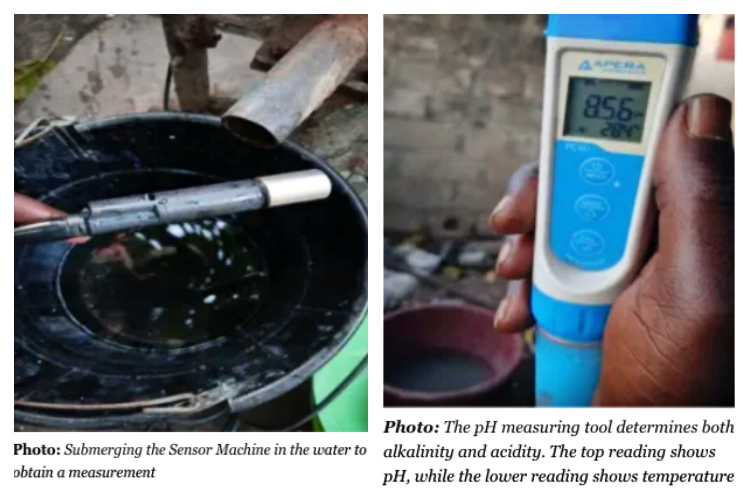
Private philanthropists step in
In Bakindik Koto, in Gambia’s Lower Niumi District, in the North Bank Region, the struggle for clean water has spanned generations. For the people living there, the simple act of turning on a tap was a luxury they had only recently begun to enjoy.
“I would say it’s been more than 50 years because I will be 50 next year. I was born into a village without tap water until last year, when some generous folks like Dembo Njie and his brothers dug a borehole for us in Bakindik Koto,” Amadou Manneh, the Village Development Committee Chairman, shared.
This borehole, made possible by private donations, was a game-changer, providing the community with its first piped water source. However, it hasn’t completely resolved the issue. “But it’s still not enough for everyone,” he added.
With the supply being so limited, families have to seek alternatives, which often come with a hefty price tag and a lot of hassle. Many make the trek to Jinack in Barra, Senegal, or Banjul when the weekly boat heads to the capital for supplies.
“But at either location, we have to pay for transport and the water itself, which can cost anywhere from D125 to D150 ($2) dalasi for 20 litres, depending on how we get there,” he further explained.
Others turn to sachet water that’s brought in from Karang, Senegal. “We also buy water bags from the
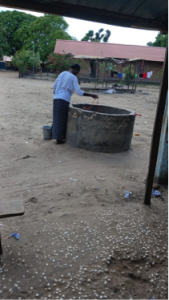
Photo: Century Village Well in Jinack Kajteh
shopkeepers at the border in Karang. A bag costs D5, and a packet goes for D150.”
“The lack of safe and portable drinking water sources has serious health implications. Residents report a rise in waterborne illnesses, especially during the rainy season. We definitely face issues with water-related illnesses like diarrhoea, particularly when the rains come, and our wells get flooded. People tend to take advantage of the abundant rainwater, but those wells are usually uncovered and exposed to all sorts of bacteria.”
When the new taps were installed last year, the community developed a plan to manage them. “After the taps were set up by the philanthropy, we suggested charging D2 dalasi for each 220-litre fetch. But that idea hasn’t been put into action yet,” said the VDC Chair.
Resort to self-help
The Team Tiemen water initiative was launched in May 2023 as a private philanthropic project to provide fresh drinking water to areas of Jinack Island in the North Bank Region. This initiative is tackling a persistent issue where the local groundwater is too salty for people to drink.
Dembo Njie, the village coordinator for the self-funded Tiemen water project in Jinack Kajateh, shared that the initiative was a true community effort, and they didn’t keep track of the total expenses.
“If we had been keeping records, we might not have completed the project because people would feel like they were risking their families’ future for a community endeavour,” he explained.
According to him, the borehole is roughly 4 kilometres away from the communities.
“The distance from the borehole to the communities is about 4 kilometres. We had to cross two rivers with pipes for about a kilometre, and then another kilometre through the mangroves,” the coordinator said.
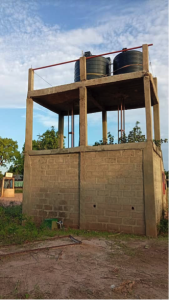
Photo: A local water source from Bakindic Koto serving both Jinack Kajateh and Nigi
When it comes to transparency, the coordinator emphasised that from the very beginning, every contribution is communicated back to the community. “From the start, any contribution, even something as small as D5 or “Atayaa” (green tea), is shared with the community during the village forum. We also let them know how the money or gifts are utilised, and we share photos,” he noted.
The coordinator did recognise that not everyone is on board with the project. Some residents, when asked, mentioned they still purchase water from Senegal, but the coordinator pointed out that it’s ultimately their choice and not something that can be contested.
Government neglect
The responsibility for implementing water and sanitation interventions rested with the Ministry of Fisheries and Water Resources.
The Directorate of Water Resources at the ministry is, however, in charge of constructing water and sanitation facilities in schools and health centres, carrying out water quality assessments, and handling the chlorination of water supplies. In 2025, the Ministry of Fisheries and Water Resources was earmarked a total of D56.5 million, which is only 0.15% of the approved government local fund.
Aside from local resources budgeted to tackle the problem, the government has also benefited from foreign aid. For example, through the Ministry of Water Resources (under the Water, Sanitation and Hygiene Project Monitoring initiative), it has received grants of about USD 38.5 million from the African Development Bank to finance the Climate Smart Rural WASH Development Project.
According to the ministry, “the purpose of the project is to contribute to improving the socio-economic and environmental conditions of the rural and peri-urban population through improved access to sustainable WASH infrastructure and services in the Gambia and will be implemented over a period of approximately 63 months, beginning October 16, 2018.”
We have contacted the Ministry of Fisheries and Water Resources to ask for information, including the percentage of non-functional rural hand pumps in rural Gambia, especially the North Bank Region, between 2023 and 2025; copies of all maintenance contracts awarded for Jinack and nearby villages in Lower Niumi over the last two years; records of budget allocations for rural water repairs in Lower Niumi; and the Ministry’s written protocol and average response time for repair requests from Rural Water Committees, as well as an official explanation for any instances where contracts were awarded but the work wasn’t completed.
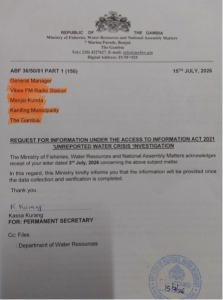
Photo: Response to the ATI request from the Ministry of Fisheries and Water Resources
The Ministry responded 16 days later, stating that they would provide the requested data for 2023, 2024, and 2025 once they finish their verification process. They did not mention when they would be done with the verification.
UNICEF states that access to WASH services has improved in The Gambia, with 90 per cent of households having access to safe drinking water and 60 per cent of the population having access to improved sanitation. However, “only 31 per cent of households have a handwashing facility, and 73 percent of households are at risk of Escherichia coli faecal contamination, indicating poor water quality” in the country.
According to the UNICEF report, capacity gaps have been identified in The Gambia by Global Analysis and Assessment of Sanitation and Drinking Water (GLAAS) surveys as major challenges to the sector.
Sanitation and Water for All (SWA) has estimated that “The Gambia loses approximately 638 Million Dalasi (US$ 24 million) per year, or the equivalent of 1.2% of annual Gross Domestic Product (GDP) USD 2.4 billion a year (equal to 3.5 % of GDP) because of poor water and sanitation.”
In an interview on July 20, 2026, Sarjo Manneh, a Wildlife and Conservation Officer, expressed serious concerns about the failing rural water systems in The Gambia, emphasising that communities have not been equipped with the necessary tools for sustainability.
“The 2022 rural water failure occurred because there was no complete transfer of knowledge to ensure sustainable use and maintenance,” Manneh explained. “Currently, locals are only trained to connect pipes and replace spare parts, but when a major breakdown happens, they still have to seek outside help. That’s not true ownership.”
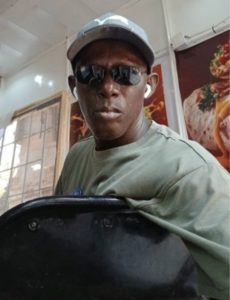
Photo: Sarjo Manneh, a Wildlife Conservation Officer
He advocated for a fundamental change in training methods. “We need Training of Trainers (TOT) for Regions, Wards, and Districts, and it should involve locals. When we build capacity at the grassroots level, responses will be quicker, and maintenance won’t rely on people coming from Banjul every time.”
Manneh also highlighted significant management issues. “In many communities, management selection is based on family ties rather than competence. You end up placing a relative with no interest in charge, resulting in the wrong person in the wrong position,” he pointed out.
“The second issue is financial mismanagement. The income generated from the facility is often treated as personal or family property. The person in charge benefits, leading to system collapse.”
He warned that the collapse of rural water systems has far-reaching consequences beyond just thirst. “The lack of drinking water in rural communities poses a threat to human life, the economy, and the environment. It begins with the wetlands that sustain our lives and livelihoods. When water fails, we face resource depletion, over-harvesting, and ultimately, poverty.”
The author, Ousman A. Marong, is the CEO of Roots Online Media. The story, ‘Broken Pumps, Broken Promises: How Rural Gambia Is Left Without Safe Water,’ is his latest investigation published on DUBAWA, Lamtoro Online, and The Gambia Journal.











Leave a Reply