


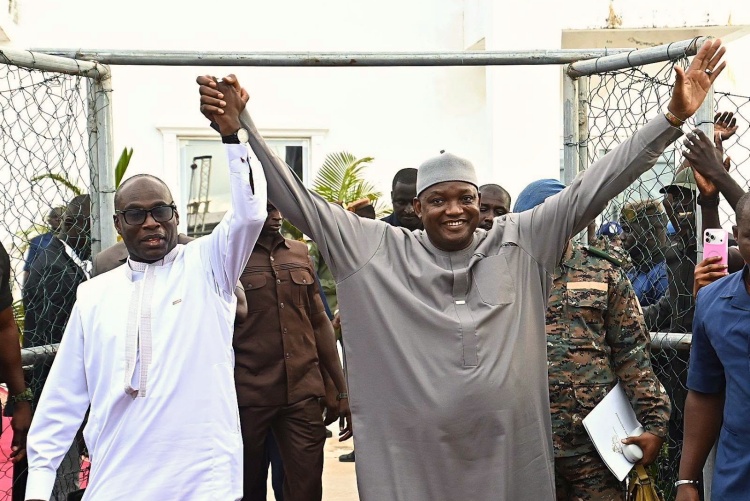
Gambiaj.com – (BANJUL, The Gambia) – There was something symbolic about the way Essa Mbye Faal and President Adama Barrow emerged from State House on Sunday. The two men walked out together, holding hands as supporters cheered. Only a few years ago, Faal was challenging Barrow for the presidency. On Sunday, the former presidential challenger stood beside him as a new political ally.
The moment captured a broader transformation taking place in Gambian politics ahead of the December 5 presidential election: President Barrow’s National People’s Party is steadily drawing former opponents into an expanding political alliance.
Faal, the former lead counsel of the Truth, Reconciliation and Reparations Commission and leader of APP-Sobeyaa, formally signed an agreement with Barrow on Sunday. The terms have not been made public, but the political message was clear.
Faal is now part of the NPP-led Grand Alliance.
From Presidential Challenger To Political Ally
Faal’s journey into Barrow’s camp is particularly striking because of where he stood in 2021.
He was one of the candidates who challenged Barrow for the presidency at a time when the opposition was presenting itself as an alternative to the president’s increasingly consolidated political establishment.
Five years later, Faal says his assessment of the political landscape has led him in a different direction.
Speaking at State House, he said he had considered the available alternatives and concluded that neither side of the opposition represented where he belonged.
His explanation was framed around national interest rather than personal political reward.
“I have not asked for any job, but I will take any job in the interest of the country,” Faal said.
That statement is likely to remain part of the debate surrounding the alliance.
Faal’s critics have questioned the political logic of joining a government he previously opposed, while his supporters see the decision as a strategic choice based on what he considers to be the national interest.
The terms of the agreement could ultimately provide more insight into what APP-Sobeyaa expects from the partnership.
Barrow’s Coalition Strategy
Faal’s arrival is significant not simply because of his own political profile, but because of what it says about the direction of the election campaign.
Barrow’s coalition has been growing by incorporating politicians who have, at different points, positioned themselves outside the president’s political camp.
Last month, Gambia Democratic Congress leader Mamma Kandeh signed a similar agreement with the NPP, adding another former presidential challenger to the president’s coalition.
Faal now becomes another prominent figure to make the journey from presidential opponent to Barrow ally.
The pattern has given the NPP-led alliance a broader political character, extending beyond its traditional party structure and into sections of the opposition landscape.
For Barrow, the significance may therefore lie as much in the accumulation of political personalities as in the formal agreements themselves.
The president appears increasingly comfortable allowing former critics to cross the political divide without requiring them to erase their previous positions.
That has also produced an unusual feature of the current campaign: some of Barrow’s strongest critics are now acknowledging his ability to build and maintain political relationships.
The Opposition Within the Opposition
But Faal’s decision has also exposed a more complicated reality.
The agreement with the NPP has faced resistance from within APP-Sobeyaa itself. Some individuals associated with the party’s founding and organizational structures have publicly opposed the alliance and called for Faal to step aside.
The dispute raises a question that goes beyond Faal personally: how much of his political organization can he carry with him?
A political leader may sign an agreement, but electoral alliances ultimately depend on people, structures, activists, and voters following that decision.
The internal disagreement therefore provides an early test of whether Faal’s political capital is primarily personal or whether it extends sufficiently into the organization he leads.
‘Everything Is Dead And Buried’
Faal himself appeared confident about the political consequences of the alliance.
Responding to suggestions from within the NPP-led Grand Alliance that the election was already “Game over” and effectively settled, he said those making such claims had made a “slight mistake.”
But he then delivered an even stronger assessment, saying that, in reality, “Everything is dead and buried. Adama Barrow has already won the election. We’ve gone past the election”
It was an unusually confident statement in a campaign in which several opposition formations are still attempting to consolidate their own alliances.
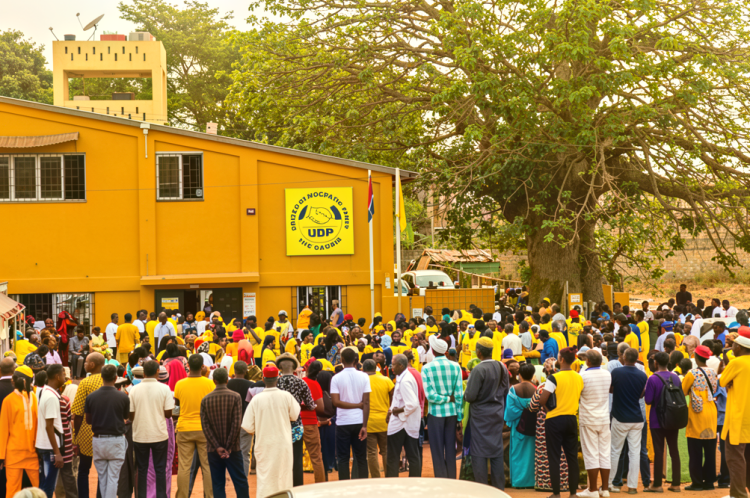
The United Democratic Party remains in the field, while Talib Bensouda’s UNITE movement and other opposition groups continue to organize around alternative political arrangements.
Faal’s statement therefore reflects not only his new political position but also the confidence now surrounding the expanding NPP coalition.
Even Critics See the Political Calculation
The reaction to Faal’s decision has been sharp, particularly among those who view his alliance with Barrow as a retreat from the political position he previously occupied.
Yet even some critics of the president have acknowledged the effectiveness of Barrow’s political outreach.
Nama Keita, a US-based Gambian who supports Talib Bensouda’s UNITE movement, offered a revealing observation on Facebook.
Keita argued that politicians who underestimate Barrow’s ability to connect with ordinary Gambians do so at their own political risk. He also pointed to the president’s willingness to maintain relationships with people who have previously criticized him.
The observation is important because it comes not from a Barrow supporter but from someone aligned with an opposition movement.
It captures one of the paradoxes of Barrow’s political strategy. The president has faced sustained criticism over his record and governance, yet he has also demonstrated an ability to absorb political opponents into his orbit.
Faal’s arrival at State House on Sunday, following Kandeh’s earlier alliance, suggests that this process is continuing.
The immediate question is no longer simply how many politicians Barrow can bring into his coalition. It is whether those alliances can translate into the broader political support the NPP hopes to consolidate by December.
Meanwhile, the challenge for Faal is different: convincing his own supporters that crossing the political divide was not a surrender of his previous principles but a decision consistent with his stated belief that “The Gambia first” must come before political loyalties.
The handshake at State House may have sealed the agreement. The voters will determine what that handshake ultimately means.



Leave a Reply