


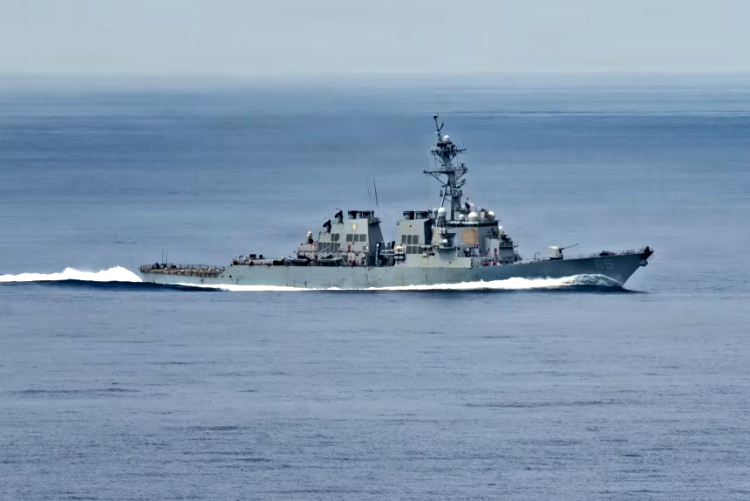
Gambiaj.com – (WASHINGTON, United States) – A US Navy guided-missile destroyer spent four days without working toilets, galley services, air conditioning, and potable water after an engineering failure caused the warship to lose power during operations in the Indo-Pacific.
The USS Benfold, an Arleigh Burke-class guided-missile destroyer, suffered the engineering casualty on July 24 while conducting routine operations, according to US Navy 7th Fleet spokesperson Cmdr. Matthew Comer.
The incident, first reported by USNI News, occurred in the South China Sea, although the Navy has not disclosed the precise location.
Four Days Without Power
The almost 10,000-ton warship lost the ability to maneuver under its own power after generators failed. The power loss also disrupted essential services aboard the vessel, including toilets, air conditioning, galley operations, and access to potable water.
The incident occurred during some of the hottest conditions of the year in the South China Sea, where daytime temperatures in late July typically ranged between 89 and 98 degrees Fahrenheit, or about 32 to 37 degrees Celsius.
The Navy said no crew members were injured during the incident, praising the sailors for what it described as their “resilience, grit, professionalism, and unwavering steadiness.”
The cause of the generator failure remains under investigation.
The USS Robert Smalls, a guided-missile cruiser, provided cooked meals to the Benfold during the power outage, while other ships assigned to the Japan-based USS George Washington Carrier Strike Group also assisted the disabled destroyer.
After four days without power, the Benfold was towed to Subic Bay in the Philippines for repairs. The Navy said repairs were completed on August 8, and the destroyer subsequently returned to duty.
Navy Under Pressure
The incident comes amid growing scrutiny of the operational demands being placed on the US Navy as it manages commitments across multiple regions, including the Middle East and Indo-Pacific.
The Benfold is frequently associated with the USS George Washington Carrier Strike Group. The carrier is currently preparing to head to the Middle East to relieve the USS Abraham Lincoln and its strike group, which has been involved in operations related to the war with Iran.
The Navy has not said whether the Benfold will join the George Washington strike group in the Middle East.
The Abraham Lincoln has itself faced scrutiny following reports of low morale and mental health concerns among its crew after spending more than 200 days without a port call during operations against Iran.
Analysts and Democratic lawmakers have argued that the Navy is being stretched by the demands of the Iran war alongside its wider global commitments.
Second Pacific Power Failure
The Benfold incident is also the second reported loss of power involving a US Navy destroyer in the US Indo-Pacific Command area of responsibility in recent months.
In May, the USS Higgins lost power and propulsion for several hours in the Indo-Pacific region following what the Navy described as an “engineering casualty” involving its electrical system.
The Navy did not disclose the exact location of the Higgins incident.
Former US Navy captain Carl Schuster, who once experienced a power failure aboard a destroyer near Puerto Rico, said four days without power in the South China Sea would have been significantly more stressful.
He said officers would have been dealing simultaneously with engineering problems, crew morale, navigation, weather, food supplies, and the uncertainty of when assistance would arrive.
“I can assure you four hours in the waters southeast of Puerto Rico is not nearly as stressful as four days in the South China Sea,” Schuster said.
Workhorses of the US Fleet
The Benfold and Higgins belong to the Arleigh Burke class, which forms the backbone of the US Navy’s surface combatant fleet.
More than 70 Arleigh Burke-class destroyers are in service. The vessels are approximately 500 feet long and, depending on their configuration, carry crews of between 329 and 359 sailors.
The ships are designed to perform a wide range of missions, including air defense, anti-submarine warfare, surface warfare and ballistic missile defense, making their availability particularly important as the US Navy maintains a global operational presence.
The Benfold’s four-day loss of power highlights the potential operational consequences of engineering failures aboard warships operating far from ports and support facilities, particularly as the Navy continues to face demands across multiple theaters.














Leave a Reply