


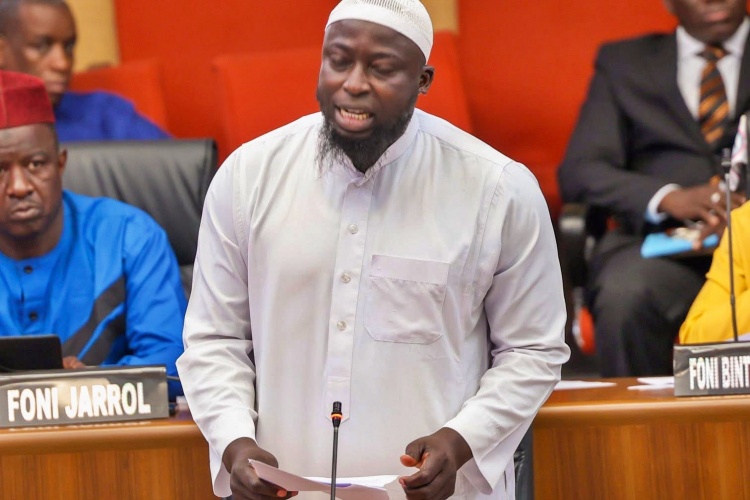
Gambiaj.com – (BANJUL, THE GAMBIA) Former President Yahya Jammeh’s decision to place Foni Kansala National Assembly Member Almameh Gibba at the head of the APRC No to Alliance Movement for the December 5, 2026 presidential election may be one of the most consequential political calculations of his post-presidency.
On the surface, Jammeh has simply chosen a flagbearer. But viewed against the political and sociological landscape of the 2026 election, Gibba’s selection appears to represent something more deliberate: an attempt to give electoral form to the ideological instincts and emotional loyalties that have sustained Jammeh’s political constituency since his removal from power.
Gibba is not merely a politician from Foni, one of the regions most closely associated with Jammeh’s political base. His positions on religion, culture, national sovereignty and the former president himself place him unusually close to several of the constituencies that historically found political and emotional resonance in Jammeh’s leadership.
For a former president who has remained in exile in Equatorial Guinea since 2017, that may be precisely the point.
The Ideological Fit
Gibba’s political trajectory offers perhaps the clearest explanation for Jammeh’s choice. At first, Gibba may look to be at odds with Yahya Jammeh on issues like the ban of female genital mutilation (FGM).
In March 2024, Gibba introduced a private member’s bill seeking to repeal the ban. He argued that what he described as female circumcision should be treated as a matter of personal, cultural and religious choice.
After the National Assembly rejected the bill in July 2024, Gibba joined religious leaders in taking the matter to the Supreme Court.
Hon. Gibba’s campaign to overturn Jammeh’s 2015 prohibition of female genital mutilation has placed him at the center of a deeply polarizing debate about religion, tradition, culture and individual rights.
The divisions on FGM enabled Yahya Jammeh’s supporters of the Islamic State and their sympathizers to reconstruct and unify a social and political base around the theme of the female genital mutilations.
Whatever one’s position on the issue, Gibba’s campaign has established him as one of the country’s most prominent political advocates for a socially conservative interpretation of religious and cultural rights.
That is significant for Jammeh.
The former president’s political appeal was never based exclusively on party structures or conventional policy platforms. It was also deeply rooted in identity, cultural symbolism, religious sentiment and a powerful emotional relationship with sections of the electorate.
Gibba’s politics appear to intersect with that constituency.
The Foni Connection
The geographical dimension may be just as important.
Gibba represents Foni Kansala, an area within the wider Foni region that has remained one of the strongest reservoirs of support for Jammeh and the APRC.
That gives the former president a candidate who does not have to manufacture a relationship with his traditional political base. Gibba is already embedded within it.
His political language on sovereignty and foreign military presence is particularly relevant in Foni, where relations with Senegal have periodically generated strong political sensitivities.
Gibba has pledged to remove foreign troops from The Gambia if elected and has repeatedly raised concerns over incidents involving Senegalese forces in Foni Bullock.
For voters whose political consciousness has been shaped by questions of national sovereignty, Gambian territorial integrity and the country’s relationship with Senegal, such positions can carry considerably more emotional weight than conventional campaign promises.
Jammeh may therefore have concluded that Gibba can speak to his old constituency in a political language it already understands.
Keeping Jammeh At The Centre
There is another important calculation.
Gibba has not attempted to separate himself politically from Jammeh’s legacy. On the contrary, he has openly advocated for Jammeh’s safe return and reconciliation and has discussed efforts to challenge the confiscation of assets associated with the former president.
This is potentially crucial for Jammeh.
The former president cannot personally contest the 2026 election. He remains outside the country, and his political movement has struggled with the fundamental problem of how to preserve the Jammeh brand without Jammeh physically leading the campaign.
Gibba offers one possible answer.
Rather than presenting a candidate who seeks to replace Jammeh, the movement has chosen someone whose political identity can reinforce the former president’s continuing relevance.
That distinction matters.
A candidate who attempted to build an independent political identity might eventually become a rival centre of authority. Gibba’s record, by contrast, suggests a political figure whose emergence can keep Jammeh himself at the center of the movement’s narrative.
From Emotional Loyalty To Electoral Strategy
The deeper question is whether Jammeh’s affective political base can be converted into an electoral coalition capable of winning nationally.
That is far from guaranteed.
Jammeh’s support has always extended beyond policy preferences. For many of his supporters, it has involved nostalgia, personal loyalty, regional identity and a perception that his government represented a particular form of national independence and social order.
Gibba can potentially activate some of those sentiments. But reproducing Jammeh’s political reach is another matter.
The 2026 electorate is not the same electorate that voted in previous elections. A significant portion of the population is younger, while the political environment is considerably more competitive and fragmented.
Gibba therefore faces a difficult balancing act.
He must retain the voters for whom Jammeh remains politically and emotionally important while convincing voters who may have no direct attachment to the former president.
The Risk Of Ideological Narrowing
The very qualities that make Gibba attractive to Jammeh’s traditional base could also become limitations.
His position on FGM, for instance, gives him a clearly defined ideological constituency but also places him on one of the most controversial fault lines in contemporary Gambian society.
The issue has attracted strong opposition from women’s rights organizations, human rights advocates and international partners. A campaign built too heavily around such culturally divisive questions could make it harder for Gibba to broaden his appeal beyond socially conservative constituencies.
The same applies to his sovereignty-driven rhetoric.
Opposition to foreign troops can resonate powerfully in Foni and among voters suspicious of external influence. But a presidential campaign requires answers on the economy, employment, education, healthcare, electricity, infrastructure and public finances.
The challenge for Gibba will be transforming an identity-based political message into a credible national governing proposition.
Perhaps Jammeh’s Best Available Bet
Yet, from Jammeh’s perspective, Gibba may represent one of his more logical political choices.
He is young enough to offer generational renewal, but sufficiently aligned with the former president’s political worldview to reassure the traditional APRC base. He comes from Foni, has an elected national platform and has demonstrated a willingness to confront politically sensitive questions involving religion and culture.
Most importantly, he does not appear uncomfortable with the Jammeh question.
That may be the most important consideration of all.
Jammeh is not simply looking for someone to carry the APRC flag. He needs someone capable of carrying the political memory of Jammehism into an election in which the former president himself cannot appear on the ballot.
Gibba may be the closest approximation to that political vehicle.
Whether that translates into a serious national challenge to President Adama Barrow and the other opposition contenders is another question. But if Jammeh’s objective is to preserve his political influence, consolidate his traditional constituency and keep his ideological legacy alive through the 2026 election, the choice of Almameh Gibba appears far from accidental.
It may, in fact, be Jammeh’s most carefully calibrated political bet yet.




Leave a Reply