


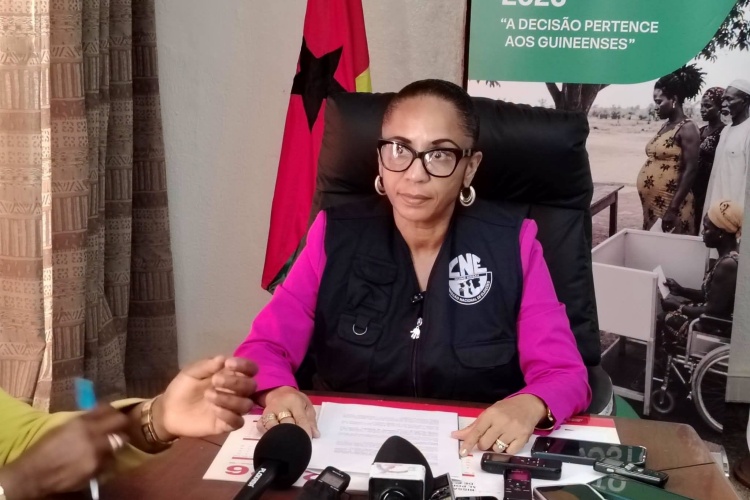
Gambiaj.com – (BISSAU, Guinea-Bissau) – Guinea-Bissau’s National Elections Commission (CNE) has said political parties are categorically excluded from campaigning for either the “Yes” or “No” side in the country’s August 30 referendum on a proposed new constitution.
CNE President Carmem Isaura Tavares Batista Lobo said the Referendum Act specifies who may participate in the campaign to educate voters and promote the options being put to the electorate.
According to Lobo, the law allows counselors, civil society actors, and legally constituted groups of voters recognized by the Supreme Court of Justice to campaign on the referendum question.
“The campaign for the referendum consists of justifying and clarifying the questions submitted to popular consultation, as well as promoting the corresponding options,” Lobo told O Democrata in a joint interview with Última Hora.
She said voters seeking to participate in the campaign as an organized group must number at least 2,000, including at least 100 residents from each region.
Party Leaders Can Participate, But Not Under Party Banners
Lobo said political figures are not completely barred from taking part in referendum campaigning, but they cannot do so on behalf of their political parties.
She explained that party leaders may join legally recognized citizen groups alongside members of civil society and other eligible voters. Such groups must, however, be validated by the Supreme Court of Justice.
The same framework applies to the monitoring of polling stations. Each legally constituted citizen group may appoint a delegate and an alternate delegate to each polling station.
“The law provides for the monitoring of the referendum through citizen groups,” Lobo said.
The arrangement effectively removes political parties as institutional actors from the referendum campaign and places the formal responsibility for advocating either option on citizen groups and other participants recognized under the referendum legislation.
Referendum Set for August 30
The referendum was decreed by Transitional President General Horta Inta-a on July 6 following approval of a proposed new Constitution by the National Transitional Council.
The vote will be conducted through universal, direct, secret and personal suffrage on August 30.
Among the proposed constitutional changes is an expansion of the powers of the head of state and a reduction in the number of members of the National People’s Assembly from 102 to 65.
Transitional authorities have argued that the reduction is intended to improve parliamentary productivity, strengthen the quality of debates, and allow for more effective consideration of issues of national importance.
CNE Prepares 3,562 Polling Stations
Lobo said preparations for the referendum began immediately after the vote was scheduled, with the CNE developing an operational timetable and budget and beginning the procurement of electoral materials.
The commission plans to establish 3,562 polling stations across 2,036 districts, serving an estimated 914,428 registered voters.
The voter figures are based on updated electoral registers from the most recent elections. However, voters in the Guinean diaspora in Africa and Europe have been excluded because the Referendum Law limits participation to citizens residing inside Guinea-Bissau.
Lobo said the CNE has already begun training trainers on civic education and on voter sensitization activities. Training for polling-station officials also started last Saturday across the country.
The National Printing Press, Incacep EN, is responsible for producing ballot papers, result sheets, and other sensitive electoral materials.
According to Lobo, printing of the ballots has already begun, with the CNE expecting the materials to be ready shortly. Distribution of polling kits to stations nationwide is scheduled for August 24 to 27.
Referendum to Cost More Than CFA1.8 Billion
The CNE estimates that the logistical and operational cost of the referendum will exceed 1.8 billion CFA francs.
Lobo said the costs are comparable to those of a national election because the commission must provide the infrastructure and materials required to operate polling stations throughout the country.
However, the CNE is reducing the number of officials assigned to each polling station as part of efforts to contain costs.
Each polling station will have a president, secretary, and electoral officer, in addition to delegates and alternates representing legally recognized citizen groups.
No Diaspora Vote
Unlike previous national elections, the August 30 referendum will not include voting in the diaspora.
Lobo said the exclusion is expressly provided for under the Referendum Law, meaning only citizens residing in Guinea-Bissau will participate in the constitutional vote.
The CNE therefore did not include diaspora voters in its estimated electorate of 914,428.
Observer Presence Remains Uncertain
Lobo also said the Referendum Act does not expressly provide for the deployment of national or international observers to monitor the referendum.
She noted, however, that the provision refers to the electoral law in cases where it is silent, and the electoral law provides for national and international observers.
Despite that provision, Lobo made clear that the current referendum framework does not specifically provide for the presence of observers on polling day.
Vote counting and local tabulation will follow procedures similar to those used during regular elections. After polling closes, ballot boxes will be opened, votes counted, and results sheets posted at the polling stations.
The referendum will therefore take place under a distinct legal framework that excludes political parties as formal campaigners, limits participation to resident voters, and places campaign and monitoring responsibilities largely in the hands of legally recognized citizen groups.










Leave a Reply