


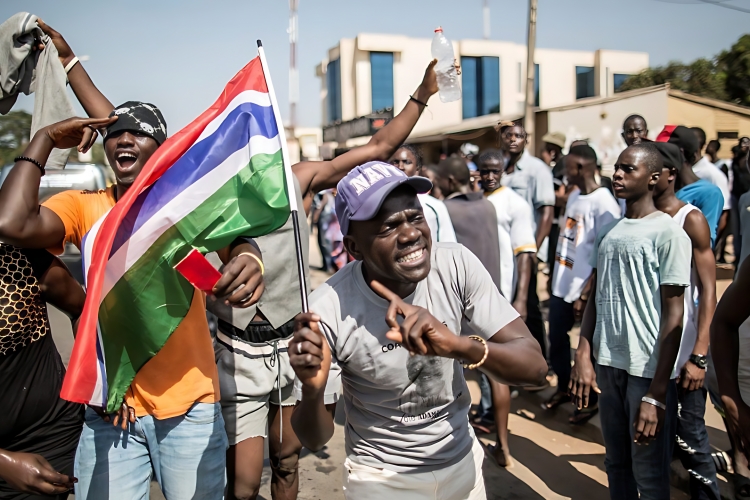
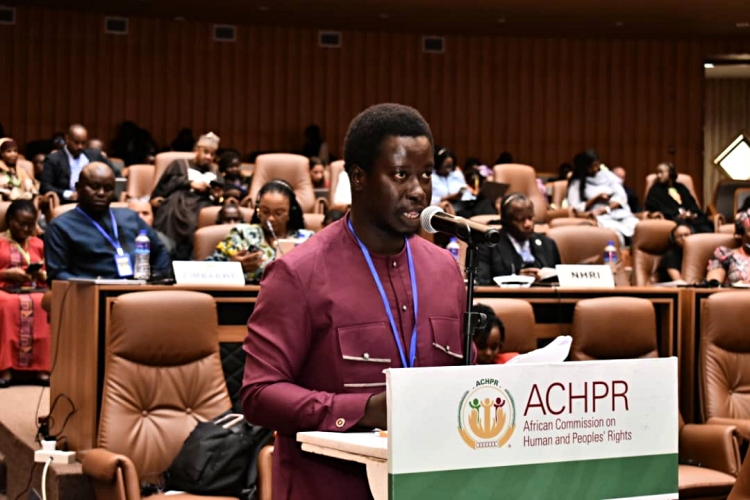
Gambiaj.com – (BANJUL, THE GAMBIA) The Gambia has reaffirmed its commitment to strengthening human rights protections, but government statements before the African Commission on Human and Peoples’ Rights have highlighted persistent gaps between international commitments and implementation at home.
The government’s submissions covered the implementation of human rights treaties, decisions and recommendations, as well as concerns over female genital mutilation (FGM) and women’s participation in political leadership.
The statements come after The Gambia became the first African Union member state to ratify the African Union Convention on Ending Violence Against Women and Girls in July 2026.
President Adama Barrow signed the instrument on 16 July, and it was deposited with the African Union Commission on 27 July. Ghana later became the second country to ratify the Convention in September.
Ratification And Implementation
The government says it is preparing to domesticate the Convention through a review of national legislation, stronger institutional coordination, capacity building for law enforcement and justice officials, public awareness campaigns and improved data collection.
However, the report stresses that ratification represents the beginning of a legal obligation rather than proof that the obligation has been fulfilled.
The issue is particularly important in relation to FGM, which remains criminalized under the Women’s (Amendment) Act 2015. The government said state institutions, civil society organizations, law enforcement agencies, religious leaders and community actors continue to cooperate on the issue.
It also referred to the Attorney General’s defense of the prohibition before the Supreme Court in Almamy Gibba and Others v Attorney General.
The effectiveness of the prohibition, however, will depend on enforcement, prosecutions, access to justice, prevention and protection measures for girls at risk.
Women Remain Underrepresented In Parliament
The government also acknowledged the limited representation of women in the National Assembly.
Women currently occupy only five of the 58 parliamentary seats, representing about 8.6 per cent of the legislature. The government recognized that the figure falls short of its aspirations and international benchmarks.
The government cited stronger female representation in other public institutions, including the judiciary, where women account for 16 of 29 judges.
But those gains do not address the parliamentary deficit, where elected representation determines participation in lawmaking, public expenditure oversight and national policy decisions.
A possible structural change could come through the Draft Constitution Amendment Bill 2026, which proposes 14 reserved parliamentary seats for women and two for persons with disabilities.
The proposal was reviewed and subjected to consultations in January 2026, but its eventual adoption and implementation remain important questions.
The government further reported that 18 of the 22 registered political parties committed to reforms aimed at advancing women’s political participation at a national conference in December 2025.
Human Rights Reporting Backlog
The government has also acknowledged shortcomings in fulfilling its reporting obligations under Article 62 of the African Charter on Human and Peoples’ Rights.
Two state reports remain outstanding. The country’s second periodic report, covering 1994 to 2018, was considered by the African Commission in 2021.
The government says it is working to improve coordination among ministries, consolidate information from public institutions and prepare the outstanding reports.
It has also proposed establishing a standing national reporting and follow-up mechanism and creating a dedicated Human Rights Division within the Ministry of Justice.
The proposed division would coordinate the implementation of regional and international human rights obligations and monitor progress in responding to treaty provisions, decisions and recommendations.
From Commitments To Results
The government’s statements present a series of proposed reforms, but their credibility will ultimately depend on implementation.
For the Convention on Ending Violence Against Women and Girls, this will mean examining the laws and policies adopted, resources committed, institutional responsibilities and protections available to women and girls.
For FGM, the key measures will include enforcement of the criminal prohibition, access to justice and the effectiveness of prevention and protection mechanisms.
For women’s political participation, attention will turn to the fate of the reserved-seats proposal and whether political parties fulfil their commitments.
And for treaty compliance, the government will be expected to submit its outstanding reports and demonstrate progress in implementing recommendations from regional human rights institutions.
The Gambia’s achievement as the first AU member state to ratify the Convention is significant, but it does not remove the need for scrutiny.
The government’s own statements point to the central challenge: distinguishing between what the state has promised, what it has formally adopted and what it has actually delivered.
As the report concludes, The Gambia’s next measure of human rights progress will be what changes after the statements end.





Leave a Reply