


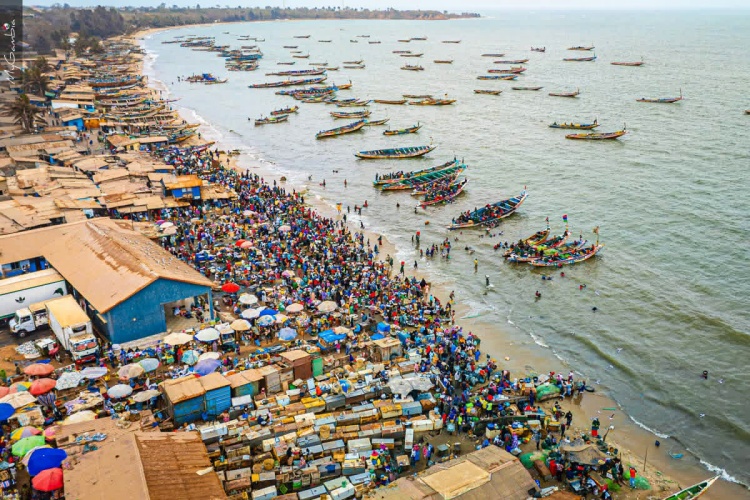
Gambiaj.com – (TANJI, THE GAMBIA) – By the time the smoke begins to clear over Tanji Riverside, the women who have spent hours buying, smoking, drying and selling fish are still counting what the day has brought them.
For some, the answer is painfully small.
After a full day of work, some women say they can go home with less than D200 in their pockets.
Yet they return the following morning.
They return because fish vending is not simply a business for them. It is how they feed their children, pay household bills and keep their families going. Their work is physically demanding and financially uncertain, but for many, there is little choice.
At their selling site, which they describe as their office, the women say the rising cost of fish is eating away at whatever little profit they might have made.
Anzel Ndey Jatta, one of the vendors, said a pan of bonga fish sells for between D3,500 and D4,000, while catfish can cost between D12,000 and D15,000.
The women say the pressure begins even before they start selling.
Fishermen sell their catch to middlemen, who then resell it at higher prices. By the time the fish reaches the women, the cost has already increased, leaving small-scale vendors with little room to make a profit.
“This is our business, but when we buy fish at these prices, we make no profit,” Jatta said.
It is a difficult calculation. The women must find money to buy the fish, pay for firewood and cover other operating costs. Then they must sell to customers who themselves may be struggling with the rising cost of food.
For women with little capital, the margin between survival and loss can be painfully thin.
For widows, the pressure is even greater.
Fatima Bojang said many women have children and households depending on them, while their limited capital makes it difficult to buy enough fish to sustain their businesses.
She said some fish is bought directly from fishing boats by retailers, pushing the price of a batch to as much as D7,000.
“For people in our financial situation, how can we afford to pay D7,000 for fish? If you are a widow whose husband has died and left you with children to care for, where will you find D7,000?” she asked.
Her question captures the dilemma facing many of the women.
They need money to buy fish so they can make money. But the more expensive the fish becomes, the harder it is to make anything from selling it.
Some finish the day with less than D200. Others borrow money to finance their purchases, adding debt to the list of pressures they already carry.
And the difficulties do not end with money.
Too Little Space To Work
At the riverside, the women also have to contend with cramped working conditions.
The space available for smoking and drying fish is too small, they say, forcing activities that require room and proper ventilation into the same congested area.
“When you smoke fish, you cannot dry fish in the same space. The area designated for smoking and drying fish is too small, and we need it to be expanded,” Bojang said.
For women whose livelihoods depend on preserving fish properly, inadequate space can become more than an inconvenience. It limits how much they can process and store and makes an already demanding job harder.
There is also the worry that whatever little they have may not remain theirs.
Living With The Fear Of Theft
Adama Jallow said theft has become another burden for the vendors.
She said women frequently lose belongings and stock, leaving them to absorb losses they can ill afford.
“We are living in peace here, and we are appealing to the government to help us maintain the place where we sell our fish,” Jallow said.
Her appeal is simple: better security and closer monitoring of the selling areas.
For women working on narrow margins, losing a small amount of stock or equipment can have consequences that stretch well beyond a single day.
Fatoumatta Jah also pointed to the lack of storage facilities and persistent theft as major challenges for women who depend on fish smoking and drying as their primary source of income.
When Higher Prices Reach The Customer
The vendors are also calling for a reduction in taxes on fish.
They argue that high purchasing costs leave them with little choice but to increase the prices they charge customers. But higher prices can drive customers away or lead to complaints, creating another problem for women already struggling to sell enough.
It becomes a cycle.
The fish costs more. The women charge more. Customers complain. Sales become harder. And the profit that remains at the end of the day becomes smaller.
The women welcomed recent improvements in lighting at the site, but they say lighting alone cannot solve the problems confronting them.
They want more space to work, proper storage facilities, better security and measures that would make fish more affordable for small-scale vendors.
More Than A Fish Market
What is happening at Tanji Riverside is about more than the price of fish.
It is about women whose daily economic survival depends on a chain of costs they have little power to control.
They stand between fishermen and consumers, absorbing the rising cost of the product while trying to keep prices within reach of ordinary families. Their businesses may be small, but the responsibilities attached to them are not.
Every day, they come to the riverside to work.
They smoke fish. They dry fish. They bargain with customers. They count their money. And, for some, they return home with less than D200 after a full day.
Yet they come back again.
At Tanji Riverside, these women are not asking for luxury. They are asking for the basic conditions that could allow their work to sustain them: enough space to operate, somewhere safe to store their goods, protection from theft and fairer business conditions.
For them, the question is not whether they want to work.
They already are.
The question is whether, after working all day, there will be enough left in their hands to make the struggle worthwhile.













Leave a Reply