


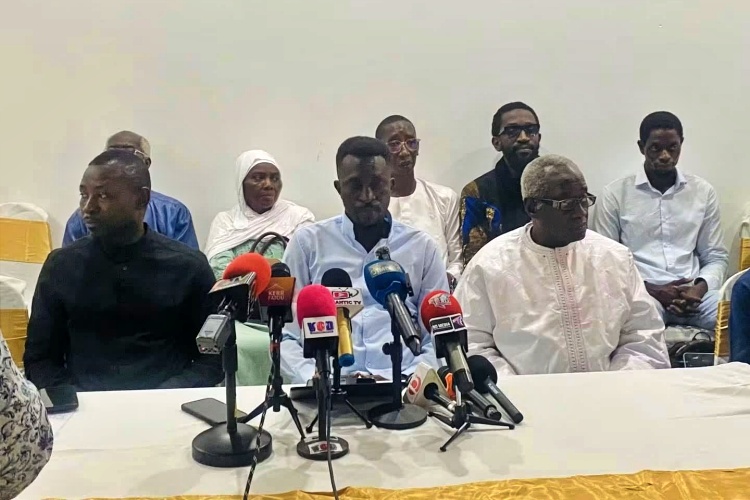
Gambiaj.com – (BANJUL, THE GAMBIA) – Team Gambia appears poised to select its own presidential candidate for the December 5 election, setting up a potential third opposition candidacy as efforts to unite forces against President Adama Barrow face competing political interests and disagreements over how a coalition flagbearer should be chosen.
At the heart of the emerging divide is Team Gambia’s insistence on an independent, inclusive and policy-driven selection process, a condition that could prove difficult to reconcile with the existing arrangements of the Gambia First Coalition, led by United Democratic Party (UDP) leader Ousainou Darboe, and Coalition 2026, built around Kanifing Mayor Talib Bensouda.
The disagreement raises a central question for the opposition less than eight weeks before the election: should political movements abandon their separate ambitions in pursuit of a single candidate, or should they retain their individual identities and allow voters to decide among competing alternatives?
An Independent Selection Process
Team Gambia, an initiative associated with political figures Halifa Sallah and Sidia Jatta, has presented itself as an alternative to what its supporters regard as the concentration of presidential ambitions within existing coalition arrangements.
Its approach places emphasis on inclusivity, policy commitments and safeguards intended to ensure that the eventual candidate is accountable to the process that produces them. Its slogan, “With Their Hands Clean“, also reflects the initiative’s attempt to distinguish itself through political integrity and a commitment to reform.
Supporters argue that Team Gambia should not be expected to subordinate its selection criteria to the ambitions of established opposition leaders.
In their view, joining either of the existing coalitions without an opportunity to compete under its own rules would undermine the very principles on which the initiative was established.
The argument is particularly significant because Team Gambia’s potential candidates are not necessarily disconnected from the other opposition formations.
Lamin J. Darboe, for instance, is associated with both the UNITE movement aligned with Bensouda and Team Gambia, illustrating the overlapping political relationships that could complicate the selection process.
The possibility that he could emerge as Team Gambia’s flagbearer also underscores why the process may have consequences beyond the identity of the eventual candidate.
Why The Existing Coalitions May Not Accommodate Team Gambia
The Gambia First Coalition and Coalition 2026 have already developed their own political arrangements around presidential candidates.
Gambia First is a UDP-led coalition seeking to elect Darboe, while Coalition 2026 has been organized around Bensouda, whose political movement has gained momentum in the run-up to the election.
Although Team Gambia and these formations may share positions on constitutional reform, a one-term presidential mandate and other governance changes, agreement on policy does not necessarily resolve the question of who should lead a coalition.
For Team Gambia’s conveners, the distinction between supporting a candidate and participating in a process to select one appears fundamental. Neither Darboe nor Bensouda would necessarily be required to surrender their existing candidacies under their current coalition arrangements, while Team Gambia’s insistence on independent candidature could require both to compete under a different framework.
That creates an institutional obstacle rather than merely a disagreement over personalities.
Bensouda, in particular, could potentially have sought the support of Team Gambia by entering its selection process and winning the endorsement of its aspirants and wider electorate. Such a route might have offered a means of reconciling his growing political movement with Team Gambia’s demand for an independently selected candidate.
But with the election approaching, the room for negotiating a new arrangement is narrowing.
The Risk Of A Divided Opposition
The prospect of Team Gambia fielding a separate candidate has prompted concerns among those who believe the opposition must consolidate its support to improve its chances of defeating Barrow.
From this perspective, introducing another candidate so close to election day could divide opposition votes and weaken the collective challenge to the incumbent. Even a candidate with strong personal credibility and a reform agenda could struggle to overcome the electoral arithmetic created by competing opposition campaigns.
Bensouda’s growing movement may make him a formidable contender, but political momentum alone does not guarantee victory.
Similarly, Darboe’s established party structures give him a recognized electoral base, but a UDP-led coalition does not automatically command the support of all opposition voters.
The concern is that three opposition candidates could compete for overlapping constituencies while Barrow benefits from the division.
Those opposing a separate Team Gambia candidacy therefore argue that the initiative’s credibility and political influence would be better deployed within a broader coalition than through an independent presidential bid.
Yet that argument also assumes that the existing coalitions can accommodate Team Gambia without requiring it to abandon the principles underpinning its selection process.
Principle Versus Electoral Pragmatism
The disagreement exposes a deeper tension between political principle and electoral pragmatism.
For Team Gambia’s supporters, accepting an already designated flagbearer could amount to endorsing a political arrangement that the initiative was created to challenge. They argue that an independent selection process offers voters a meaningful alternative to what they see as a predetermined choice between established political formations.
Critics, however, contend that political actors must consider the consequences of their decisions within the realities of an approaching election.
With less than eight weeks remaining, a separate candidacy could make opposition unity more difficult to achieve and potentially reduce the chances of changing the government.
The two positions are not necessarily irreconcilable on policy. They differ primarily over the process through which a common candidate should emerge and whether existing presidential ambitions can be reopened.
That distinction matters because opposition unity cannot be achieved through shared reform promises alone. It also requires agreement on leadership, candidate selection and the distribution of political authority.
A Third Candidate Or A Last-Minute Compromise?
If the existing coalitions maintain their current positions, Team Gambia may proceed with its selection process and present its own candidate to voters.
Such an outcome would preserve the initiative’s independence and give its supporters a candidate they consider legitimate. It would also leave the opposition facing the challenge of persuading voters to choose among multiple alternatives to Barrow.
The consequences would depend partly on how Team Gambia conducts its campaign, the strength of its candidate and whether its supporters would otherwise have backed Darboe, Bensouda or another opposition contender.
Without reliable evidence about voter preferences, the extent to which a third candidacy would affect the final result remains uncertain.
A last-minute compromise remains conceivable, particularly if one of the existing candidates were willing to enter Team Gambia’s selection process. But that would require a significant change in political calculations from the current coalition leadership.
Ultimately, Team Gambia’s flagbearer process has become a test of whether opposition parties can reconcile competing ambitions with their stated objective of political change.
The initiative may see an independent candidacy as the only credible way to preserve its principles. Others may regard the same decision as an electoral risk that the opposition can ill afford.
With the December 5 election drawing closer, the central challenge is no longer simply identifying a candidate capable of challenging Barrow. It is determining whether the opposition can agree on a legitimate way to choose one before the opportunity for a unified campaign disappears.






Leave a Reply