


Gambiaj.com – (BANJUL, The Gambia) – The Gambia Government spent D15.42 billion in the first six months of 2026, with D3.10 billion going towards debt interest as rising debt-servicing costs continue to put pressure on the national budget.
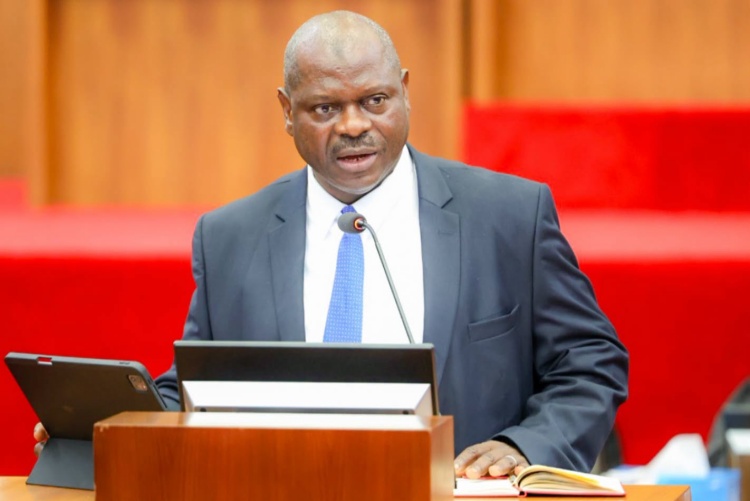
The figures were presented to the National Assembly by Finance and Economic Affairs Minister Seedy Kieta in his mid-year statement on the implementation and monitoring of the 2026 national budget.
According to the minister, total government expenditure and net lending increased by 6 percent compared to the same period in 2025, reaching D15.42 billion by the end of June. This represented 42 percent of the D36.49 billion approved annual budget.
Debt interest was among the largest expenditure items, reaching D3.10 billion by June, equivalent to 45 percent of the amount budgeted for the entire year.
Of that amount, D2.50 billion was spent on domestic debt interest, an increase of 17 percent compared to the same period last year. External debt interest stood at D600 million, up 21 percent year-on-year.
The figures underline the growing share of government resources being absorbed by debt servicing at a time when the Finance Ministry says fiscal space remains constrained.
Personnel emoluments accounted for D5.06 billion, while subsidies and transfers reached D3.62 billion.
Together, salaries, subsidies, and debt interest amounted to D11.76 billion, accounting for about three-quarters of total government expenditure during the first half of the year.
Education, Health, and Agriculture
The Ministry of Basic and Secondary Education was the largest spending ministry, with expenditure of D3.13 billion, equivalent to 53 percent of its annual budget.
The ministry attributed the spending mainly to personnel costs for sub-vented schools, school feeding programs, school improvement grants, and textbook printing.
The Ministry of Health spent D1.48 billion, representing 47 percent of its annual budget, while the Ministry of Interior spent D1.16 billion, or 49 percent.
Agriculture recorded an expenditure of D955.46 million, equivalent to 54 percent of its annual budget. The spending was largely driven by agricultural input and groundnut subsidies, machinery and transfers to public agricultural institutions.
Meanwhile, capital expenditure stood at D1 billion by June, representing 28 percent of the D3.54 billion annual capital budget and a 27 percent decline from the same period in 2025.
Revenue and Fiscal Pressure
The government’s domestic revenue stood at D15.35 billion during the first half of 2026, leaving expenditure and net lending D68.86 million above revenue.
The gap was nevertheless 74 percent lower than the D265.41 million recorded during the same period in 2025 and 89 percent below the D615.44 million deficit projected in the approved budget.
The Finance Ministry said the government is pursuing fiscal consolidation measures for the remainder of 2026, including reducing expenditure, increasing domestic revenue mobilization, and limiting borrowing needs.
However, with D3.10 billion already spent on debt interest by mid-year, debt servicing remains one of the major pressures on the government’s limited fiscal space.







Leave a Reply