


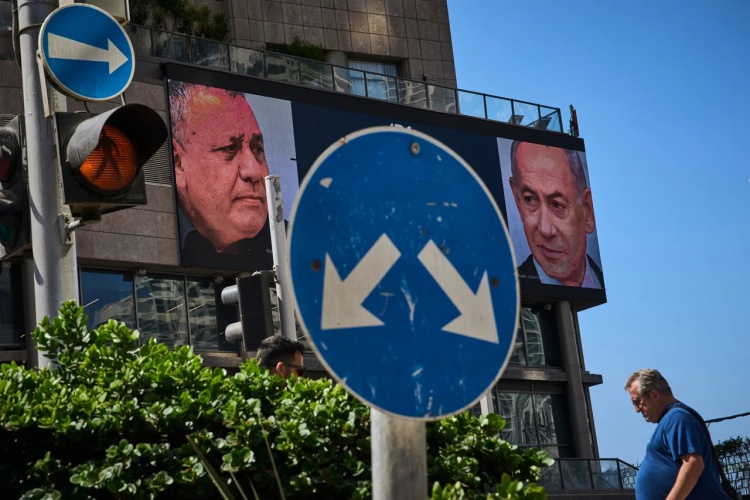
Gambiaj.com – (TEL AVIV, ISRAEL) – Israel faced renewed political uncertainty on Wednesday after election projections showed neither Prime Minister Benjamin Netanyahu’s right-wing bloc nor the opposition had secured enough seats to form a government, leaving Arab parties with a potentially decisive role in the next coalition.
Netanyahu’s bloc is projected to win 54 seats in the 120-member Knesset, while the opposition, led by his main rival Gadi Eisenkot, is expected to secure 47 seats. Arab parties are projected to win a record 17 seats, making their support potentially crucial to any effort to form a parliamentary majority.
The results extend Israel’s prolonged political deadlock, which has produced six elections in seven years, reflecting deep divisions over leadership, religion, democratic values and the country’s future direction.
Opposition Urged To Work With Arab Parties
The emerging parliamentary arithmetic has renewed debate within the opposition over whether to cooperate with Arab parties to remove Netanyahu from power.
Yair Golan, leader of the left-wing Democrats Party, has urged opposition leaders to overcome their ideological differences and work with Arab lawmakers, arguing that such cooperation is necessary to secure a majority.
“Netanyahu lost. I know how to count to 120,” Golan said, calling on opposition parties to abandon what he described as racial divisions between Jewish and Arab voters.
He said the opposition needed to overcome its reluctance to work with Arab parties if it wanted to form a government.
Arab lawmaker Ahmad Tibi also indicated that his camp was prepared to support an alternative administration. Speaking on Israeli Army radio, Tibi said the opposition could form a government if its leaders were willing to cooperate with Arab parties.
“Netanyahu won’t be able to form a government,” Tibi said. “The other side can, if they want, if they have courage.”
Arab citizens account for about 20 per cent of Israel’s population, but their parties have often faced resistance from major Jewish political blocs over the prospect of formal coalition partnerships.
Netanyahu has historically opposed such arrangements, although he reached out to Mansour Abbas’s Raam party after the 2021 election. His reliance on far-right and ultra-Orthodox parties has since remained central to his political strategy.
Herzog Calls For Compromise To Avoid Another Election
Netanyahu’s leadership has been a defining issue in Israel’s political divisions, particularly as opposition parties have largely refused to join governments under him amid his corruption trial.
His political position has also been shaped by the controversy surrounding his government’s proposed judicial overhaul, which triggered widespread protests before the Hamas-led attacks of October 7, 2023, and the subsequent multi-front war.
The election has therefore become a contest not only over who governs Israel but also over its democratic institutions, religious identity, military service obligations and political accountability.
President Isaac Herzog, in his first public statement since the polls closed, urged political leaders to remain open to compromise and avoid another election.
“We must do everything we can, certainly after yesterday, to avoid another round of elections,” Herzog said on Wednesday.
Following certification of the results, Herzog is expected to consult political parties to determine which candidate has the best chance of forming a government. If no candidate succeeds, the country could be forced into another election.
Herzog also praised the high voter turnout, describing it as evidence of public commitment to democracy.
“Yesterday’s election day was truly impressive, with the highest turnout in decades. It is a badge of honor for Israeli society, and it was remarkable to see how deep the desire for democracy is in Israel,” he said.
With neither major bloc commanding a majority, the coming negotiations are expected to test whether opposition leaders can overcome their differences with Arab parties or whether Israel will remain trapped in its cycle of inconclusive elections.








Leave a Reply