


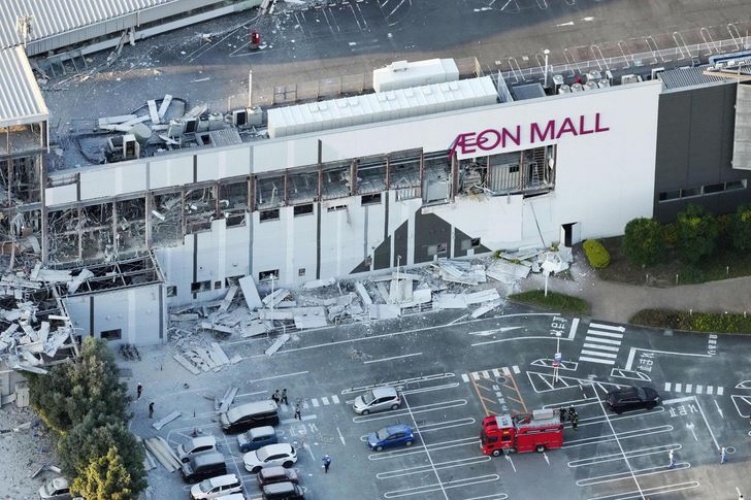
Gambiaj.com – (KYUSHU, Japan) – At least one person has been killed and more than 100 injured after a powerful earthquake struck southwestern Japan on Tuesday, toppling buildings, triggering fires, and leaving dozens of people feared trapped inside a shopping mall.
The 7.1-magnitude earthquake struck Kumamoto Prefecture on the island of Kyushu at around 4:27 p.m. local time, according to the Japan Meteorological Agency (JMA). The quake registered the highest level of seven on Japan’s Shindo seismic intensity scale.
The U.S. Geological Survey measured the earthquake at magnitude 6.8.
People feared trapped in collapsed mall
Emergency services said a number of people were trapped inside a shopping mall in Kashima after part of the building collapsed.
Private broadcaster TBS reported that a “considerable number” of people were feared dead inside the mall after firefighters said its second floor had collapsed.
NHK, citing police sources, reported that between 20 and 30 employees could not be contacted. Emergency vehicles were seen outside the building as rescue operations continued.
Police told AFP they could not immediately confirm reports of deaths inside the mall. Kyodo News reported that four people had been taken to the hospital and were conscious.
Elsewhere in Kumamoto, a house collapsed and killed one person, according to Kyodo. Several people were also reportedly unaccounted for at a factory in Yatsushiro after the tip of a chimney fell.
Television footage showed fires burning in parts of the region, along with damaged bridges, a derailed freight train, and homes left at risk of collapsing.
Chiharu Hara, a 35-year-old recruitment agent who was in Kumamoto when the earthquake struck, described the experience as terrifying.
“The office swayed violently side-to-side. I was afraid it would collapse. Everyone panicked,” Hara told AFP.
Hospitals overwhelmed as fires and outages spread
The earthquake caused widespread disruption, with roads closed and high-speed Shinkansen services suspended across the affected area. Kumamoto Airport was also temporarily closed before reopening later in the evening.
Two hospitals reported receiving at least 50 injured patients each, according to NHK. Victims were reportedly being treated for burns and fractures sustained after being trapped beneath objects.
One hospital worker told NHK that ambulances were arriving continuously with injured people, while water leaks and failures in the electrical system were affecting the facility.
Around 10 people were also reported injured at a nursing home for elderly residents.
Prime Minister Sanae Takaichi said authorities had confirmed casualties, collapsed buildings, damaged roads, and fires, as well as disruptions to water and electricity supplies.
The government mobilised 3,600 military personnel for disaster relief operations, while 20 aircraft were deployed to assess the damage from the air.
The JMA initially issued a tsunami alert following the earthquake but withdrew it at around 6:10 p.m.
Thousands without power
The earthquake left around 45,000 households and facilities without electricity in the Kumamoto region, according to Kyushu Electric Power.
The utility said three nuclear reactors operating in the region were functioning normally, while Japan’s Nuclear Regulation Authority reported no immediate abnormalities at nuclear power facilities.
Unverified footage circulating on social media also appeared to show sections of the historic Kumamoto Castle wall collapsing, although authorities had yet to confirm the extent of damage to the centuries-old landmark.
A succession of aftershocks followed the main earthquake, including a magnitude 6.1 tremor at around 5:08 p.m.
A local NHK journalist wearing a helmet reported live from the broadcaster’s newsroom that strong shaking continued well after the initial quake, making it difficult to remain standing.
Memories of deadly 2016 earthquakes
The latest disaster has revived memories of the devastating earthquakes that struck Kumamoto in 2016.
The region was hit by a magnitude 6.5 earthquake, followed two days later by a magnitude 7.3 tremor. The disasters killed 273 people and injured more than 2,800.
Japan is among the world’s most earthquake-prone countries, sitting along the western edge of the Pacific “Ring of Fire,” where several major tectonic plates meet.
The country experiences hundreds of earthquakes each year, although most cause little or no damage.
Japan continues to carry the scars of the magnitude 9.0 earthquake that struck offshore in 2011. The resulting tsunami killed or left missing around 18,500 people and caused the catastrophic failure of the Fukushima nuclear power plant.
Rescue teams were continuing to search damaged buildings and assess casualties as aftershocks persisted across southwestern Japan.
















Leave a Reply