


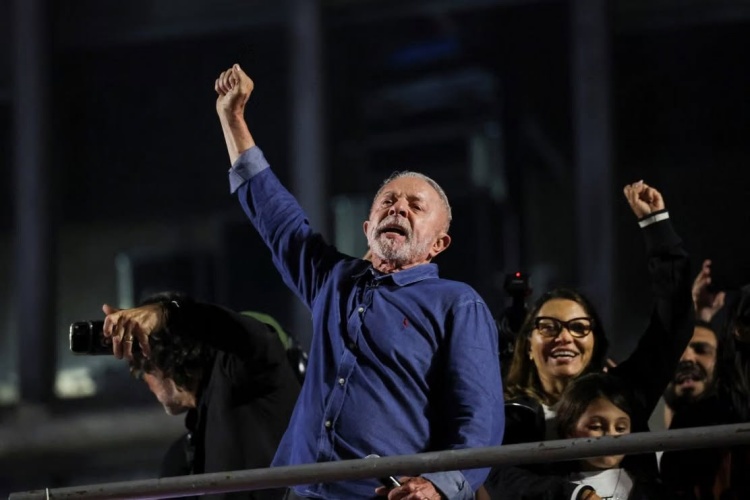
Gambiaj.com – (BRASILIA, BRAZIL) – Luiz Inácio Lula da Silva has won a fourth, non-consecutive term as president of Brazil after defeating far-right challenger Flavio Bolsonaro in one of the country’s closest and most consequential elections in years.
Lula secured 51.79% of the vote against 48.21% for Bolsonaro, overturning a two-point deficit from the first round and defying expectations that Brazil would join the growing conservative wave across Latin America.
The result was immediately disputed by Bolsonaro, the eldest son of former president Jair Bolsonaro, who said he would seek “the annulment of the elections.”
Speaking in Brasilia after the result, Bolsonaro said “it is impossible to recognize the elections”, arguing that “many things remain to be clarified” following a controversy that led Brazil’s Supreme Court to extend voting by two hours.
The dispute adds a new layer of uncertainty to an election that has already exposed deep political divisions in Latin America’s largest country.
Lula, 80, presented the election as a defense of democracy and urged Brazilians to see voting as a way of protecting democratic institutions.
In his victory speech, he said voters had turned out because his campaign had convinced them “that the vote was very important to guarantee democracy in the country.” He also said voters had defeated what he described as “interference” from digital platforms and promised to regulate them.
A Remarkable Political Comeback
Lula’s victory represents one of the most remarkable electoral reversals in Brazil’s recent history.
After trailing Bolsonaro in the first round, the veteran left-wing politician managed to mobilise his supporters between the two rounds, particularly through social media and large rallies held across the country.
Turnout also played a significant role. Abstention fell to its lowest level in two decades, while the number of blank and invalid ballots also declined.
Lula’s campaign portrayed the election as a choice between democratic stability and a return to the politics associated with the Bolsonaro era.
For Lula, the result is also a personal political triumph. A former metalworker from the impoverished northeastern state of Pernambuco, he first became president in 2003 and remained in office until 2010.
His political career was later damaged by corruption allegations and a conviction that resulted in him spending 580 days in prison. The conviction was subsequently annulled on procedural grounds, allowing him to return to electoral politics.
Now, as he approaches his 81st birthday on October 27, Lula has secured another four years in office and is expected to be 85 when his new term ends in 2030.
Bolsonaro Camp Refuses To Concede
The election result has not brought an immediate end to Brazil’s political confrontation.
Bolsonaro’s call for the election to be annulled is likely to intensify tensions among his supporters, some of whom were already questioning the legitimacy of the voting process.
During election day, Lula had accused authorities in several cities of preventing some voters from reaching polling stations after buses were reportedly taken off the roads.
The Supreme Court subsequently ordered voting to continue for an additional two hours, a decision that became a central point of contention for Bolsonaro supporters.
Some voters openly questioned the legitimacy of the extension.
But Bolsonaro’s defeat does not mean the end of the conservative movement he represents.
The right made major gains in legislative elections held three weeks earlier, leaving Lula facing a Congress dominated by conservative forces.
That could severely restrict his ability to implement his program and force his government to negotiate with an opposition-controlled legislature.
A Divided Brazil
The scenes after the result reflected the depth of Brazil’s political divide.
Lula supporters poured into the streets of São Paulo and Rio de Janeiro, celebrating with flags, music and fireworks.
For Bolsonaro supporters, the mood was markedly different.
Some expressed fears of economic decline and political instability, while others questioned the legitimacy of the election.
The divide is likely to remain one of Lula’s biggest challenges.
His victory has preserved Brazil as one of the last major progressive governments in a region where conservative forces have gained ground in countries including Argentina, Chile and Colombia.
The election also carries wider regional significance because of Brazil’s size, economic influence and diplomatic weight.
Several Latin American leaders congratulated Lula, including Mexican President Claudia Sheinbaum and Cuban President Miguel Díaz-Canel. Chilean President José Antonio Kast, despite his political alignment with Bolsonaro, also congratulated Lula and said Brazil and Chile had much in common for the future.
Lula’s Difficult Road Ahead
Despite the celebrations, Lula begins his new term with limited political room for manoeuvre.
His government will have to deal with a conservative Congress, a deeply divided electorate and continuing pressure over the economy and public spending.
During the campaign, Lula sought to reconnect with poorer voters by expanding popular social measures, including his flagship Bolsa Familia program.
But delivering on those promises while maintaining economic stability will be a major test.
His fourth term will also place him in an unusual position: an ageing political veteran returning to power at a time when many voters across the region have been turning away from established political movements.
Lula has now defeated Bolsonaro at the ballot box.
The harder task may be governing a Brazil that remains almost evenly divided between the political forces he represents and those determined to oppose him.





Leave a Reply