


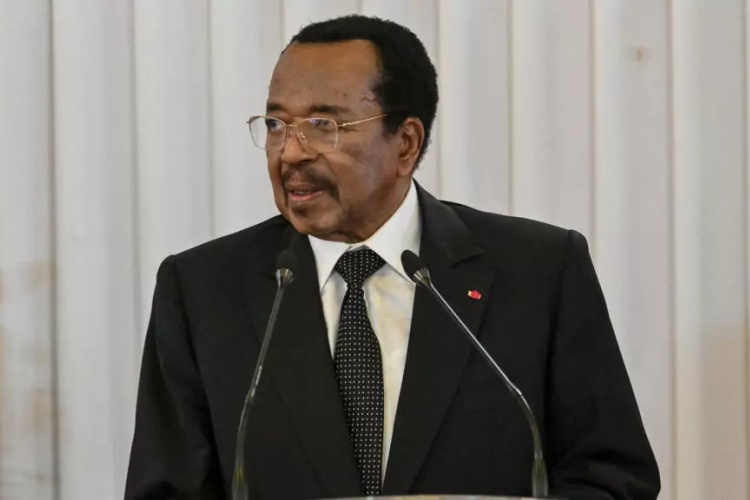
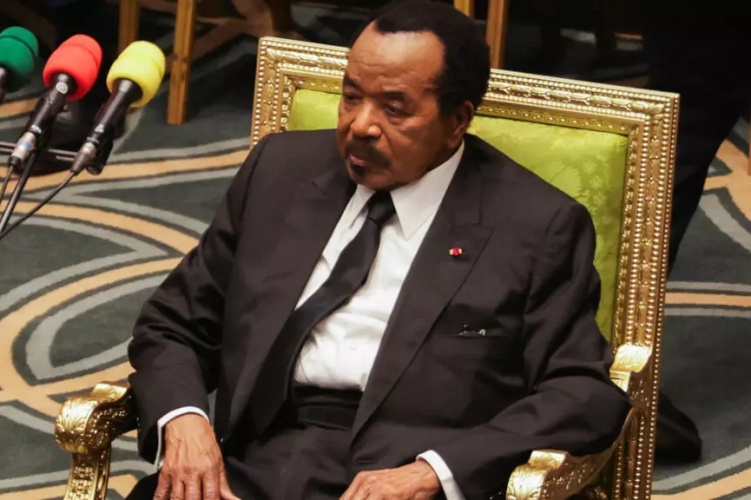
Gambiaj.com – (YAOUNDE, Cameroon) – The prolonged absence of Cameroon’s 93 year-old President Paul Biya is increasingly being accompanied by a different form of political communication: rather than appearing in public to demonstrate that he remains in charge, the 93-year-old president is asserting his authority through decrees, appointments, and decisions issued in his name.
After nearly two months outside the country, the government has also become more explicit in defending the president’s continued exercise of power, while a major reshuffle at the top of the military has placed trusted officers in key positions, including the elite Presidential Guard.
Taken together, the developments appear designed to project a message of institutional continuity and presidential control at a moment when questions about Biya’s health, whereabouts, and ability to govern have intensified.
The government’s latest public reassurance came from Communication Minister and government spokesman René Emmanuel Sadi, who told RFI that Biya would return to Cameroon “very soon”, while rejecting opposition demands for the Constitutional Council to declare a vacancy in the presidency.
Biya has been outside Cameroon since 7 June, when the presidency initially described his departure as a short private stay in Europe. Sadi acknowledged that the president was in Geneva but denied that he was hospitalised there, saying Biya had undergone an intervention some time ago and could have used his stay in Switzerland for medical consultations.
He declined to give a precise date for the president’s return.
From the president’s image to presidential decisions
The government’s response to the prolonged absence marks a notable change from earlier episodes when the presidency sought to answer rumors about Biya’s health or whereabouts by putting the president himself at the center of the narrative.
In 2004, for example, after rumors circulated that Biya had died in Switzerland, the presidency issued an official statement before the president returned to Yaoundé and personally addressed the speculation.
More recently, during the 2025 presidential election campaign, the authorities used highly publicized presidential audiences and meetings to demonstrate Biya’s continued presence and political activity.
The current strategy is different.
With Biya neither regularly seen nor heard, the presidency is increasingly relying on official acts bearing his signature. On 30 July, he authorized the Minister of Economy, Planning and Regional Development to sign financing agreements worth nearly 28 billion CFA francs with the Islamic Development Bank.
More significantly, on 3 August, presidential decrees promoted five colonels to the rank of brigadier general and announced a series of changes within the military hierarchy.
The approach, according to political scientist Joseph Keutcheu, represents a shift from demonstrating the president’s physical presence to demonstrating the functioning of the state under his authority.
“The body of the head of state is no longer at the center of the narrative; the permanence of the state takes over,” Keutcheu said, describing the succession of decrees, appointments, and official acts as an attempt to show that “the machine is running” and decisions are still being made.
The strategy may be partly driven by the difficulties of relying on public appearances by a president whose advanced age has increasingly become a sensitive issue.
But it also allows the government to move the debate away from Biya’s health and towards the constitutional and institutional question of whether the state continues to function.
Military reshuffle puts loyalists in key positions
The most politically sensitive element of this new phase is the reorganization at the top of the armed forces.
The decrees signed in Biya’s name have changed senior military command positions across several regions and units, including the Presidential Guard, while installing a new major general at the head of the armed forces’ general staff.
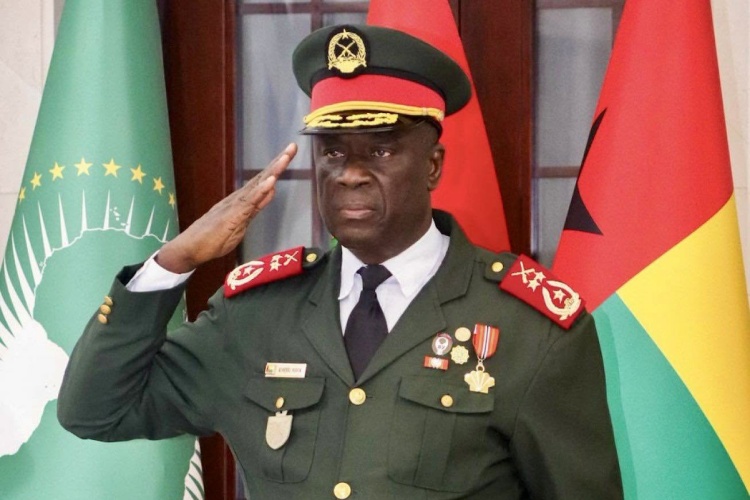
General Raymond Jean Charles Beko’o Abondo has been promoted to brigadier general while retaining command of the Presidential Guard, a position he has held for 13 years.
His promotion is particularly significant because it marks the first time since the creation of the elite unit in 1985 that the Presidential Guard has been commanded by a brigadier general.
The reshuffle also follows the retirement of a senior general, who was admitted to the “second section” on 28 July, the formal terminology used for the retirement of senior military officers.
General of Division Ebaka Hippolyte has subsequently been appointed as the new major general of the armed forces’ general staff.
Six new territorial army commanders have also been appointed across four of Cameroon’s five inter-service military regions, covering areas of strategic importance, including the Centre, where the capital Yaoundé is located; the eastern border with the Central African Republic; the Littoral; the conflict-affected South-West; and the northern regions, where the military continues to confront Boko Haram.
The appointments are therefore more than routine administrative changes. They touch the command structures responsible for protecting the presidency, the capital, and the country’s most sensitive security zones.
A retired colonel, speaking anonymously, said such appointments could only be made by the head of state.
A message to the security establishment?
The timing and nature of the reshuffle inevitably raise questions about its political significance.
There is no evidence in the material available that the presidency has explicitly described the changes as a warning or message to its loyalists in the security establishment. But the appointments can reasonably be read as reinforcing the chain of command around the presidency at a moment of heightened uncertainty.
In particular, maintaining Beko’o Abondo at the head of the Presidential Guard while elevating him to general rank sends a potentially important signal to the security establishment: the unit closest to the president remains under the command of an officer with long experience in the position.
The wider reshuffle similarly ensures that senior military posts across strategically important regions are occupied by officers appointed under Biya’s authority.
For a regime whose political survival has historically been closely linked to the loyalty of the security apparatus, the significance of such appointments goes beyond military administration.
At a minimum, they demonstrate that the president—or the presidential institution acting in his name—continues to exercise formal authority over the armed forces despite his physical absence from the country.
At a deeper political level, the moves could be interpreted as an effort to reassure the regime’s hardest-core loyalists that the chain of command remains intact and that the president retains the power to determine who occupies the most sensitive positions in the security architecture.
That interpretation, however, remains an inference rather than an officially stated objective.
The unanswered questions
The problem for the government is that institutional acts may demonstrate formal authority without necessarily resolving the public’s questions about Biya himself.
Thomas Atenga, professor of communication at the University of Douala, argues that the strategy is taking place against a broader decline in confidence in official government communication.
The president’s absence has fuelled speculation about his health and prompted opposition calls for the Constitutional Council to examine whether a vacancy exists.
Sadi has rejected that argument, pointing to the Constitution’s provisions on death, resignation, and permanent incapacity and stressing that prolonged absence alone does not constitute a vacancy.
But questions remain over why Biya has stayed abroad for so long, why the government has not provided a clear explanation for the prolonged stay, and why the new government promised by the president after his October 2025 re-election has still not been formed.
Biya announced the formation of a new government in December 2025, but eight months later the cabinet remains unchanged.
Sadi insisted that all ministers remain fully in office and that the president has simply taken his time in deciding when and how to make changes. The same explanation has been given for the still-vacant position of vice-president created by a constitutional revision adopted in April.
For the opposition, however, the issue is no longer simply whether institutions are technically functioning.
Justin Noa, secretary-general of the opposition Movement for the Renaissance of Cameroon, has acknowledged the military appointments but called for more evidence that Biya is effectively exercising the functions of president, particularly given the continued delay in forming the promised government.
A test of how long the strategy can hold
The new communication strategy may allow the government to maintain an image of continuity for as long as presidential decrees continue to flow and the security and administrative machinery remains operational.
But it does not eliminate the central question surrounding Biya’s prolonged absence.
As political scientist Joseph Keutcheu observes, the effectiveness of the strategy will ultimately depend on how long the absence lasts, whether the government’s explanations remain consistent, and how much confidence citizens continue to place in official statements.
For now, the message coming from Yaoundé is that the state remains functional, presidential authority remains intact, and the military command structure is being actively managed.
The appointments at the top of the armed forces add another layer to that message. While they cannot, on their own, establish the president’s physical condition or prove the extent of his day-to-day involvement in government, they do show that the security architecture around the presidency is being actively consolidated under his authority.



Leave a Reply