


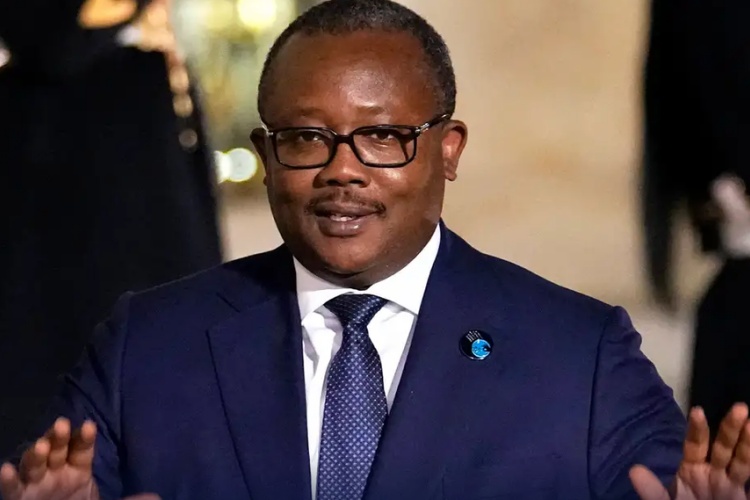
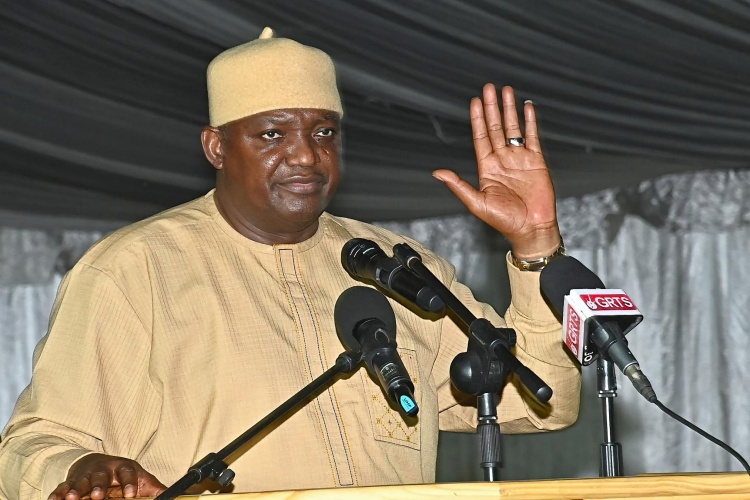
Gambiaj.com – (BISSAU, Guinea-Bissau) – Former Guinea-Bissau President Umaro Sissoco Embaló says he will return home on October 4, nearly a year after the military takeover that removed him from office, a return that could inject a new and potentially destabilizing force into a political transition already being reshaped by a powerful new presidency.
Embaló announced his “voluntary return” on Monday, calling for his arrival to take place in an atmosphere of “harmony, tolerance, and mutual respect.” He said Guinea-Bissau’s national interest and stability should take precedence over political differences.
But behind the conciliatory language lies a more complicated political question: what does Embaló intend to do once he is back, and how will the military authorities respond to a former president whose removal remains surrounded by allegations that the November 2025 coup was not quite what it appeared to be?
Embaló was overthrown on November 26, 2025, one day before electoral authorities were expected to announce provisional results from the presidential election. Both Embaló and opposition candidate Fernando Dias da Costa had claimed victory.
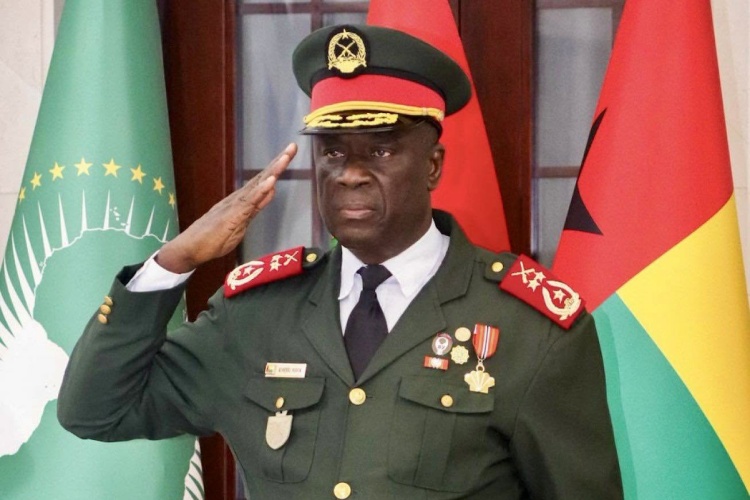
The military subsequently suspended the electoral process, installed General Horta N’Tam as transitional president, and began a one-year transition. Embaló left the country and eventually settled in Morocco.
The Coup That Never Settled the Political Argument
The circumstances surrounding Embaló’s removal have never been fully separated from the disputed election.
The opposition and some political actors have questioned whether the events of November 26 represented a straightforward military coup or whether the appearance of a coup served a political purpose: stopping the publication of results at the moment when Embaló faced the possibility of defeat.
International IDEA recorded that opposition figures and regional actors questioned whether the takeover had been staged to halt the electoral process and preserve Embaló’s influence over power.
The suspicion was fuelled by the military’s subsequent choices.
General Horta N’Tam, who became transitional president, had previously been regarded as close to Embaló. His transitional government also appointed Ilídio Vieira Té as prime minister; Té had been associated with Embaló’s political camp. The transitional administration was consequently viewed by opponents not simply as a military government but as one containing important figures connected to the former president.
That history gives Embaló’s October 4 return an importance that goes beyond a former head of state coming home.
It potentially brings back into the country one of the central political actors around whom the entire disputed transition has revolved.
A New Constitution Changes the Equation
The timing is particularly significant because Guinea-Bissau has just changed the rules of the political game.
In August, voters approved a new constitution in a referendum backed by the transitional authorities. The National Electoral Commission reported 70% support for the new text. The reform moves Guinea-Bissau away from the previous semi-presidential arrangement towards a much stronger presidential system.
Under the new constitutional framework, the president will appoint and dismiss the prime minister and members of government, chair the Council of Ministers, and have powers to dissolve parliament in certain circumstances. Parliament itself is being reduced from 102 seats to 65.
That represents a fundamental shift in the center of political gravity.
Under the previous system, the prime minister emerged from the parliamentary majority, creating the possibility of a divided executive when the president and parliamentary majority belonged to competing political forces. That arrangement repeatedly produced institutional confrontation.
Indeed, Embaló himself dissolved the opposition-dominated parliament in December 2023 after accusing political opponents of attempting to overthrow his government. He subsequently governed for extended periods without a functioning legislature before his own removal by the military.
The new constitution addresses that problem by giving the presidency substantially greater control over the executive.
That could mean fewer institutional battles between a president and prime minister. But it also means that who occupies the presidency becomes considerably more consequential than under the old arrangement.
Why Embaló’s Return Matters
This is where Embaló’s return acquires a different political meaning.
The December 6 elections are supposed to mark the end of military rule and the restoration of civilian government. General Horta N’Tam is barred from contesting the election under the transitional arrangements.
Embaló, however, is returning to a country where the presidency has just been constitutionally strengthened.
That creates an obvious political question without necessarily answering it: is Embaló returning simply as a former president or as a political actor preparing to reclaim influence over the post-transition order?
His own statement offers no explicit answer.
Instead, he speaks about national unity, social peace, and respect for the rule of law. His appeal for a peaceful reception could also be interpreted as an attempt to prevent his return from becoming a confrontation between his supporters, the opposition, and the military authorities.
But the political symbolism is difficult to ignore.
The man removed from the presidency by a military intervention is now preparing to return just as that same military-led transition has helped create a constitutional system in which the presidency will wield considerably greater authority.
The Opposition Faces a Different Political Battlefield
For the opposition, Embaló’s return presents an equally complicated calculation.
Opposition forces have consistently challenged the legitimacy and circumstances of the November takeover.
Fernando Dias’ camp maintained that the election had been won before the military halted the process, while opposition parties criticized the constitutional referendum and, in particular, the concentration of power in the presidency.
PAIGC, one of the country’s major opposition forces, boycotted the referendum, arguing that the process lacked adequate institutional safeguards.
The opposition therefore enters the December election facing not merely a contest for control of parliament but a contest for an institution that will now have substantially more authority.
That changes the stakes.
Under the previous arrangement, parliamentary arithmetic could constrain a president. Under the new constitution, a president with the necessary political authority will have far greater control over government formation and a greater ability to confront or dissolve the legislature in specified circumstances.
The reduction of parliament from 102 to 65 seats also changes the mechanics of coalition-building and representation.
For political parties that previously relied heavily on parliamentary strength to balance presidential power, the new system represents a significant structural change.
From Coup Politics to Presidential Politics
The deeper irony is that Guinea-Bissau may be emerging from military rule into a political system designed, at least in part, to prevent the kind of executive-legislative paralysis that has repeatedly paralyzed the country.
The junta argues that the constitutional overhaul is intended to stabilize institutions. Critics, however, argue that concentrating power in the presidency could simply move the country’s instability from one arena to another, from battles between presidents and prime ministers to battles over who controls the presidency.
That distinction matters enormously in a country with a long history of military intervention.
If the presidency becomes stronger but political institutions remain contested, the constitutional reform could make electoral competition more consequential rather than less.
And that makes Embaló’s return particularly sensitive.
His arrival comes before the December 6 election, after a coup whose circumstances remain disputed, under a transitional authority led by a general once considered close to him, and immediately after the adoption of a constitution that gives the presidency powers that could significantly alter the balance of Guinea-Bissau’s political system.
Whether Embaló returns as a former president seeking closure, a political figure preparing a comeback, or simply a citizen determined to reclaim his place in his country is not yet clear.
What is clear is that his return will bring one of the unresolved questions of the 2025 crisis back into the center of Guinea-Bissau’s transition: was the November coup the end of Embaló’s political era, or merely the interruption of it?





Leave a Reply