


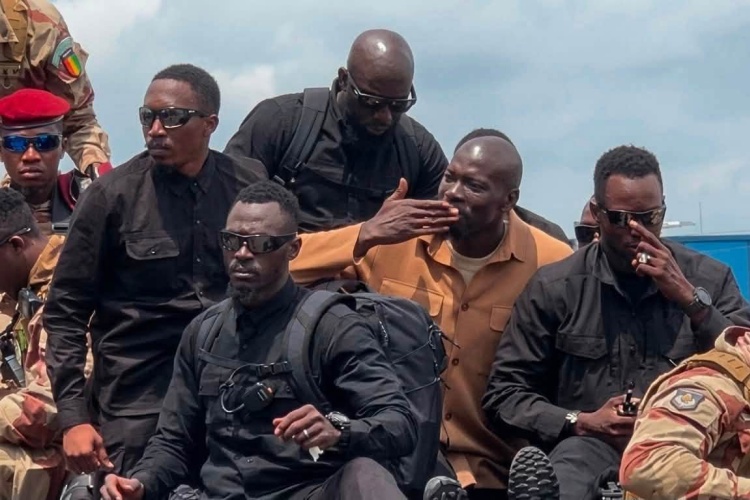
Gambiaj.com – (CONAKRY, Guinea) – Guinea may have officially closed its transition period and returned to the Economic Community of West African States (ECOWAS), but political space remains tightly restricted under President Mamadi Doumbouya, according to Jeune Afrique editorial director François Soudan.
Speaking to RFI, Soudan examined the state of Guinea’s opposition, describing a political landscape divided between a limited opposition operating inside the country and a more radical opposition movement whose leaders are largely in exile.
A tolerated opposition operating within narrow limits
According to Soudan, Guinea currently has two forms of opposition.
The first is an internal opposition that is tolerated by the authorities because it is considered moderate. It has a small parliamentary group and a handful of prominent political figures.
But its room for maneuver remains extremely limited.
Public demonstrations remain banned, while the media environment is tightly controlled, making it difficult for opposition parties to mobilize supporters or openly challenge the authorities.
Soudan quoted opposition figure Abdoulaye Baldé as describing the situation as a constant balancing act.
“We are constantly walking a tightrope,” Baldé said, according to Soudan. “We have to play our role as opponents while staying within the rules.”
Outside Guinea, however, the opposition has adopted a much more confrontational position.
The Forces Vives de Guinée, a coalition bringing together civil society organizations and long-established political parties dissolved by the authorities since March, has become the main vehicle for the external opposition. Many of its leaders are living in exile.
The coalition called in a statement published earlier this month for an end to the current regime.
Disappearances remain a major political issue.
One of the most sensitive issues dividing the authorities and their opponents is the alleged abduction and disappearance of political activists and opponents.
Soudan said the Tournons la page collective has documented 35 cases of disappearances.
The issue was raised directly with Prime Minister Amadou Oury Bah by Jeune Afrique reporters Marie-Ève Soma and Diawo Barry.
According to Soudan, the prime minister appeared both uncomfortable and tired of repeatedly addressing questions about the disappearances.
Bah described the cases as individual matters and said the courts were dealing with them. He nevertheless acknowledged that there may have been shortcomings, arguing that no country successfully completes a political transition without upheaval.
For Soudan, however, the government’s explanation does little to answer the questions being asked by the families of those who have disappeared.
He suggested that the prime minister may simply not have the answers, arguing that only President Doumbouya and a small circle of military figures around him may be in a position to provide clarity.
The disappearances therefore remain a major unresolved grievance for the opposition and families seeking information about their relatives.
Alpha Condé seeks a political comeback.
Soudan also provided an update on former President Alpha Condé, who remains in exile and continues to express a desire to return to Guinea.
Condé has been living in Brazzaville since mid-April, following a lengthy and relatively isolated period in Istanbul.
According to Soudan, the former president appears to have regained a degree of political visibility since moving to the Republic of Congo.
Condé, he said, needs to recover a role commensurate with his long experience on the African political stage and to demonstrate that he remains respected, consulted, and welcomed by former counterparts.
He has attended several public and private events in the region and has become involved, on his own initiative, in efforts surrounding dialogue in the Democratic Republic of Congo.
His long-standing relationships give him access to both President Félix Tshisekedi and opposition figures such as Moïse Katumbi and Martin Fayulu.
A return to Guinea remains Condé’s main objective.
Despite his renewed regional activity, Soudan said Alpha Condé has not abandoned what remains his principal objective: returning to Guinea.
The former president wants to return to the country and complete the presidential mandate that was interrupted by Doumbouya’s military coup nearly five years ago.
That ambition is a source of concern for the authorities in Conakry.
Soudan noted that while the authorities in Brazzaville are unlikely to allow their guest to use Congolese territory to destabilize a foreign government from afar, they have made their position known to Condé.
Alpha Condé’s continued political ambitions therefore add another layer to Guinea’s increasingly complex political landscape.
A transition closed, but political tensions remain.
Guinea’s formal return to constitutional and regional normality has not resolved the country’s deeper political tensions.
The opposition remains divided between those attempting to operate within the narrow limits permitted by the authorities and those calling from exile for a fundamental change of regime.
At the centre of the dispute are restrictions on political activity, the continued prohibition of demonstrations, tight controls on the media and unresolved allegations surrounding the disappearance of opponents.
The end of the transition may have restored Guinea’s place within ECOWAS, but, according to the picture presented by Soudan, the question of how much political space the Doumbouya government is prepared to give its opponents remains far from settled.


Leave a Reply