


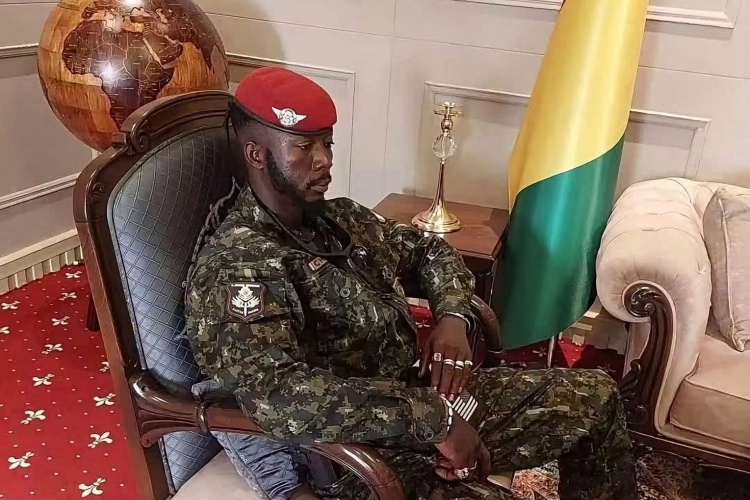
Gambiaj.com – (CONAKRYm Guinea) – The fate of Michel Lamah, a former commander of Guinea’s elite Special Forces who played a prominent role in the 2021 coup that brought Mamadi Doumbouya to power, has become the subject of growing speculation after he was among 173 soldiers dismissed from the armed forces for “desertion.”
A presidential decree issued on August 24, 2026, formally removed Lamah and the other soldiers from the ranks of Guinea’s defense forces. The decree, read on national television by General Amara Camara, did not specify when the alleged desertion occurred or provide details about the circumstances surrounding the decision.
But Lamah’s inclusion has given the mass dismissal an added political significance.
According to Confidentiel Afrique, several security sources in Conakry say Lamah has stopped responding to his military superiors, and that neither the military hierarchy nor the highest levels of government have been able to establish his whereabouts.
From coup-maker to ‘deserter’
Lamah became widely known during the September 5, 2021, coup against then-President Alpha Condé.
He was among the Special Forces officers who took part in the operation that seized control of the presidential palace in Conakry and ended Condé’s rule. Images of Lamah, wearing traditional amulets, circulated widely after the coup, including footage showing him at the wheel of a vehicle transporting the ousted president following his arrest.
Lamah later publicly acknowledged his role in the operation and described Doumbouya, then the leader of the Special Forces, as a “big brother.”
Five years later, the former ally has been officially branded a deserter.
The report portrays his expulsion as potentially significant beyond the military disciplinary process, given his place in the group of officers who helped establish the current political order.
A wider purge of the security forces
Lamah is not alone.
The presidential decree removed 173 members of the defense and security forces, including personnel from the Special Forces, the Autonomous Airborne Troops Battalion, and several territorial units.
The move follows an earlier purge in September 2025, when 19 members of the Special Forces were expelled from the military for “misconduct.”
The scale of the latest dismissal has raised questions about whether the measures represent routine military restructuring and discipline or whether they point to deeper tensions within the security establishment.
The report notes that rumors in Conakry have linked Lamah to Guinea’s forest region near the Liberian border. Some accounts suggest he may have fled, while others speak of a possible break with the military hierarchy.
However, there is no independent evidence establishing that Lamah is in Liberia or that he organized an armed desertion with other soldiers.
Why Lamah matters to Doumbouya
The uncertainty surrounding Lamah is particularly sensitive because of the role played by the Special Forces in the 2021 coup.
Doumbouya himself commanded the elite unit for several years before formally relinquishing the position in January 2024. Since taking power, he has sought to reorganize the military while gradually transforming his authority from that of a coup leader into that of a constitutional president.
The report argues that the removal of officers associated with the 2021 takeover raises a broader question about the durability of the alliance that originally brought Doumbouya to power.
The Guinean president has also moved to consolidate his institutional position. According to the report, he was elected president in December 2025, inaugurated in January 2026 for a seven-year term, and now serves as commander-in-chief of the armed forces under the new Constitution.
Loyalty at the heart of the system
The question of military loyalty has remained particularly important in Guinea, where successive governments have been shaped by military interventions.
The report points to a public declaration by Guinea’s military leadership earlier this month, while Doumbouya was on holiday in Greece, affirming its “constant fidelity” and “unwavering loyalty” to the president.
After returning, Doumbouya convened the Higher Council of Defense and National Security and called for increased vigilance along the country’s borders and greater “fraternity in arms” among the various defense and security forces.
The timing has fuelled speculation about the state of cohesion within the military.
The government could portray the mass dismissals simply as part of a disciplinary or restructuring exercise. But the report suggests that the scale of the operation could also reflect an effort to prevent divisions within the institution that remains central to Doumbouya’s hold on power.
The shadow of Alpha Condé
The Lamah affair is also unfolding against the backdrop of Alpha Condé’s continued political presence.
The former president, overthrown by Doumbouya’s forces in 2021, remains a reference point for some of his supporters and has continued to call on the military to oppose the regime that removed him.
That creates a potentially sensitive scenario in which officers who participated in Condé’s downfall could themselves become opposed to the man who succeeded him.
The report stops short of establishing such a development but argues that Guinea’s history makes the possibility politically significant.
Since independence, the country has repeatedly experienced political transitions driven by military force. The collapse of one military-backed order has often created the conditions for another.
A test for Doumbouya
The disappearance of one former Special Forces officer does not, by itself, constitute a threat to Doumbouya’s government.
The larger concern, according to the report, would be the emergence of collective dissatisfaction among officers who believe they played a decisive role in the 2021 takeover but are now being removed from the institution.
The sequence is striking: 19 Special Forces personnel were expelled in 2025, followed by 173 soldiers from various security and defence units in August 2026.
For Doumbouya, who knows better than most how quickly military loyalty can determine the fate of a government, the issue goes beyond the case of Michel Lamah.
The president has built considerable institutional authority since taking power, including through a new constitutional order that strengthens the presidency. But control of the armed forces remains crucial in a country where political power has repeatedly changed hands through military intervention.
The unresolved question is therefore not simply where Michel Lamah is.
It is whether his disappearance and expulsion are isolated disciplinary matters or signs of deeper tensions within the military establishment that helped bring Doumbouya to power.
For now, the presidential decree has settled Lamah’s administrative status. It has not settled the mystery surrounding his whereabouts, or what his case may reveal about the stability of the military system underpinning Guinea’s current government.
Source: Confidentiel Afrique




Leave a Reply