


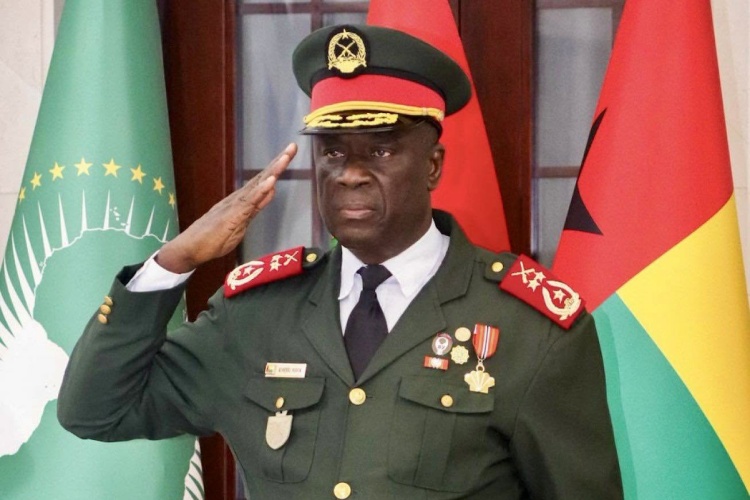
Gambiaj.com – (DAKAR, Senegal) – With Guinea-Bissau’s planned presidential and legislative elections increasingly unlikely to take place on 6 December, Senegal has called on the country’s transitional authorities to ensure that any change to the electoral timetable is consensual, inclusive, and accompanied by clear guarantees for a rapid return to constitutional rule.
The intervention by Dakar comes at a delicate moment for Guinea-Bissau, where the transitional authorities have acknowledged legal, technical, and institutional difficulties that could prevent the elections from being held as scheduled.
The Senegalese government said it was following developments “with great attention” and had taken note of the concerns raised by the transitional authorities over preparations for the vote.
The election date had been presented as a key milestone in the transition following the military takeover of November 2025. But on 8 October, Prime Minister Ilídio Vieira Té and the vice-president of the National Electoral Commission, Felisberta Moura Vaz, indicated after meeting transitional leader General Horta Inta-A Na Man that the necessary conditions were not in place for the elections to proceed on 6 December.
Dakar wants any delay handled through dialogue
For Senegal, the issue is no longer simply whether the December timetable can technically be maintained. The concern is how any adjustment is made and what safeguards accompany it.
Dakar has made clear that any modification of the electoral calendar must take place through a “consensual, inclusive, and transparent” process, with “clear guarantees” that the transition will be completed as soon as possible.
That places the emphasis on consultation.
Senegal, which currently holds the rotating presidency of the Economic Community of West African States (ECOWAS) and has been designated by the regional bloc to mediate the Guinea-Bissau crisis, is urging the transitional authorities to engage national political and social stakeholders as they consider the way forward.
The message is significant because a postponement without broad political agreement could deepen uncertainty over how long the military-led transition will last.
Senegal’s position is also that the transition cannot simply acquire an open-ended timetable. Any revised electoral process, it says, must retain a clear route towards constitutional government.
Political space becomes part of the electoral question
Dakar has also linked the credibility of any future election to the political environment in which it is organised.
The Senegalese government is calling for the lifting of restrictions on political and civil activities, arguing that this is necessary to restore confidence and create conditions for credible elections.
That appeal comes against a backdrop of restrictions on political activity during the transition, including limitations affecting political gatherings and opposition activity.
The question therefore extends beyond the mechanics of preparing ballot papers, voter registers, and polling stations. For the electoral process to be accepted as a genuine return to constitutional rule, political actors need sufficient space to organize, campaign, and compete.
For Dakar, restoring that space is part of restoring confidence in the transition itself.
ECOWAS backs Senegal’s mediation
The regional response has followed a similar line.
In its 8 October statement, ECOWAS said it was closely monitoring developments, particularly the announcement by Guinea-Bissau’s transitional authorities concerning the difficulties of holding the 6 December elections.
The regional bloc called on the transitional authorities to conduct broad consultations with national stakeholders over the electoral calendar in a transparent and inclusive manner.
ECOWAS said the objective should be to preserve the conditions necessary for a peaceful, inclusive, and transparent return to constitutional order. It also urged Guinea-Bissau’s political parties to pursue peaceful means and constructive dialogue.
Crucially, ECOWAS reaffirmed its support for Senegal’s mediation mandate and urged the transitional authorities to engage fully with the process led by Dakar.
The bloc also said it remained ready to support Guinea-Bissau through the transition and in preparing credible, inclusive, transparent, and peaceful elections.
A test for Senegal’s regional mediation
The developments are giving Senegal’s mediation role a more immediate test.
Dakar’s response has so far been framed not as an ultimatum to Bissau but as an attempt to establish the conditions under which a possible postponement could take place without allowing the transition to drift.
The distinction is important. The Senegalese statement was issued by the country’s foreign ministry rather than in the name of ECOWAS, although Dakar explicitly invoked its role as both the bloc’s current president and its designated mediator.
That leaves Senegal carrying a dual responsibility: protecting the regional position on constitutional order while trying to facilitate an agreement among Guinea-Bissau’s competing political and institutional actors.
For Guinea-Bissau, the immediate question is whether a new electoral timetable can be agreed quickly enough to maintain confidence in the transition.
For Senegal and ECOWAS, the larger challenge is ensuring that a delay in voting does not become a delay in returning the country to elected civilian rule.
With 6 December approaching, the debate is therefore shifting from whether Guinea-Bissau can meet the original deadline to what political guarantees will govern whatever comes next.



Leave a Reply