


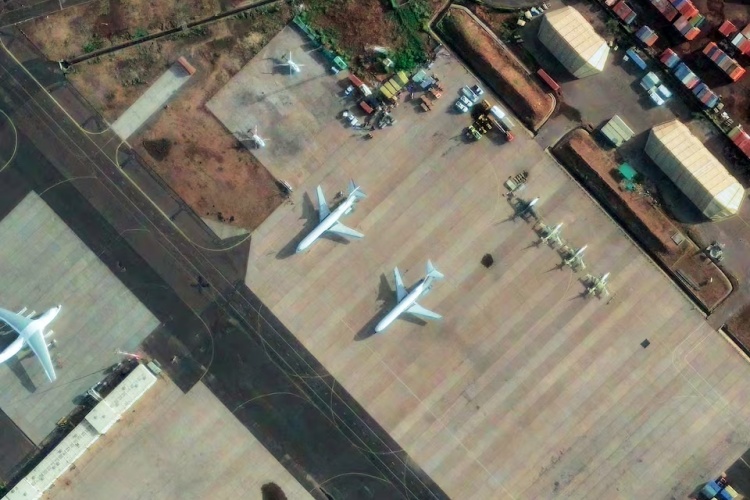
Gambiaj.com – (LONDON – United Kingdom) – Boeing aircraft previously linked by Reuters to the business network of a former U.S. military contractor were used to transport Rapid Support Forces (RSF) fighters, foreign mercenaries, weapons, and drones into Sudan’s Darfur region, according to a draft United Nations report reviewed by Reuters.
The findings provide fresh evidence of the logistical network supporting the Sudanese paramilitary force, which UN investigators have accused of committing genocide and other grave violations in Darfur.
“The Panel received reliable information from four sources that the aircraft had transported RSF fighters and mercenaries, as well as military equipment, including drones and weapons,” the UN Panel of Experts on Sudan said in the draft report.
The panel cited two eyewitnesses in Nyala, the RSF’s principal military and logistics hub in Darfur, as well as communications from two UN member states. The report did not identify the sources or provide further details.
The draft report has been submitted to the UN Security Council for review and is expected to be published in September.
Aircraft Linked to RSF Supply Network
The UN findings build on a Reuters investigation published on July 15, which traced three aging Boeing aircraft operated by companies linked to Steven Shaulis, a former U.S. Army Special Forces soldier and longtime U.S. government contractor.
Reuters found that the aircraft traveled from an airport in Chad to logistics hubs associated with the RSF in Sudan, Libya, and Somalia.
One of the aircraft, a Boeing 737, was destroyed in May 2025 while carrying RSF fighters, according to Reuters. However, the precise nature of the cargo carried by the planes remained unclear at the time.
The UN panel has now identified three Boeing 727s as part of the network. One was sold in Brazil to a company linked to Shaulis, while two others were acquired from Michigan-based Kalitta Charters II.
The aircraft appeared in Chad in November 2024 and operated from the military apron of N’Djamena airport, according to the report.
The UN panel said it had found no recorded movements for the three aircraft after their arrival in N’Djamena and suspected they had taken “deliberate steps to avoid detection while in flight.”
Between January and July 2026, the panel said, multiple Boeing 727s and several Ilyushin Il-76 transport aircraft landed at Nyala at night.
Reuters independently tracked Boeing aircraft traveling from N’Djamena to RSF-linked hubs in Sudan and Libya using satellite imagery, mobile phone data, and an open-source video. It also found no corresponding records on independent flight-tracking systems that normally monitor aircraft broadcasting signals while airborne.
“The RSF utilized the N’Djamena-Nyala air corridor to transport fighters, foreign mercenaries, and military equipment, including drones and weapons, into Darfur,” the UN report said.
Contractor Denies RSF Connection
Shaulis and his business partner, Craig Munro, are joint owners of South African company Contractor Airways, which acquired two of the Boeing 727s from Kalitta, according to corporate records reviewed by Reuters.
Munro previously told Reuters that Contractor Airways had never had any connection with the RSF and disputed Reuters’ findings that the aircraft had landed in Nyala and Kufrah in Libya.
Shaulis did not respond to Reuters’ questions about the UN report. He had previously declined to answer questions about his companies and the Boeing aircraft.
Reuters reported that it found no evidence that Shaulis or his companies had been sanctioned or accused of wrongdoing by authorities.
Kalitta’s attorney said the company had conducted extensive due diligence before selling the aircraft and that no sanctions violations had been identified.
Chad’s Civil Aviation Authority said none of the Boeing aircraft had been authorized to operate from Chad. It also stressed that it did not oversee military aviation or provide services responsible for tracking military flight movements.
Chad’s Foreign Minister Abdoulaye Sabre Fadoul has previously said questions concerning the aircraft were covered by defence secrecy. He has maintained that Chad’s involvement in Sudan’s war was limited to diplomatic efforts to restore peace.
Colombian Mercenaries Also Linked to RSF
The Boeing findings form part of a broader UN investigation into violations of the 22-year-old arms embargo imposed on Darfur.
The panel also detailed what it described as significant support provided to the RSF by Colombian mercenaries, estimating that between 1,500 and 2,000 men were involved.
Known as the “Desert Wolves”, the Colombian fighters established a base in Nyala in March 2025 and fought alongside RSF forces, operating drones and participating in military planning during the siege and eventual capture of al-Fashir in October 2025.
According to the UN report, the mercenaries were recruited by Global Security Services Group (GSSG), a company based in the United Arab Emirates.
The RSF’s assault on al-Fashir was marked by some of the conflict’s worst atrocities. Hundreds of unarmed people were reportedly killed, women were subjected to rape, and children were abducted. The UN has previously described the violence as amounting to genocide.
Colombia’s Foreign Ministry did not respond to questions from Reuters. Its government has previously apologized to Sudan over the presence of Colombian mercenaries in the country.
Reuters was unable to reach representatives of the Desert Wolves.
GSSG also did not respond to questions. However, a spokesperson for the UAE mission to the United Nations said UAE authorities had investigated the company and concluded that it was not involved in mercenary activity in Sudan and had no links to individuals reported to be mercenaries there.
The spokesperson said GSSG operates in compliance with UAE laws and regulations as well as international law.
Sudan’s War and the International Arms Network
Sudan’s war erupted in April 2023 after a power struggle between the country’s regular army and the RSF, following a breakdown in plans to integrate the two forces as part of a transition to civilian rule.
The conflict has since killed hundreds of thousands of people and displaced millions, while famine, disease, and the collapse of essential services have deepened the humanitarian catastrophe.
The UN has described the crisis as the world’s worst humanitarian emergency.
The latest findings point to the increasingly internationalized nature of the conflict, with aircraft, foreign mercenaries, weapons, and drones moving through regional logistics networks to support the RSF.
The UN panel’s conclusions could also intensify scrutiny of the implementation of the Darfur arms embargo and the role of regional actors and private companies in supplying or facilitating military operations by the warring parties.











Leave a Reply