


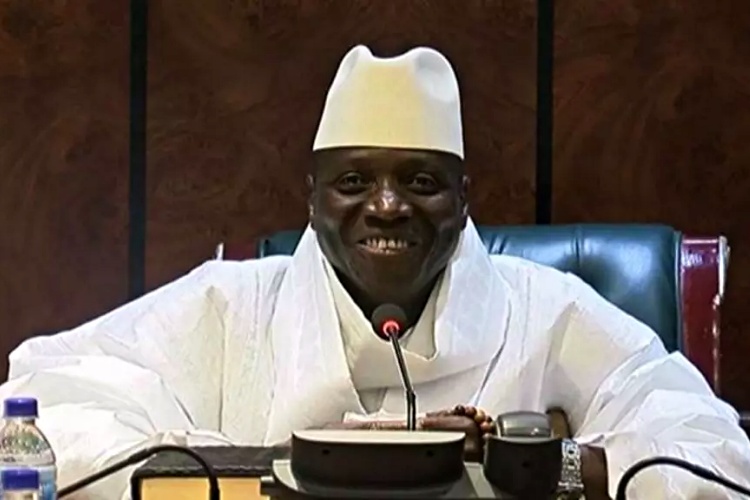
Gambiaj.com – (BANJUL, The Gambia) – Former president Yahya Jammeh’s latest barrage of voice messages from exile in Equatorial Guinea appears to be more than an attempt to settle internal disputes within the APRC No-To-Alliance.
Coming barely three months before The Gambia’s December 5 presidential election, the messages carry the unmistakable features of a political intervention aimed at reasserting control over a movement that has steadily fragmented, redefining who can legitimately speak in his name and restoring his relevance in an increasingly crowded electoral landscape.
But Jammeh’s renewed language of moderation, condemning tribalism, rejecting insults, and invoking religious principles, also raises an unavoidable question: how much weight should Gambians attach to this latest version of the former leader?
His political record, including the dramatic transformation of his rhetoric during the 2021 election cycle, suggests that Jammeh’s words from exile and his political behaviour when his authority is challenged can be two very different things.
Nine Audios and a Political Message
On Friday, August 29, Jammeh released almost nine new audio messages directed principally at supporters of the APRC No-To-Alliance. In one of the messages, reportedly lasting about 19 minutes, he again presented himself as the ultimate authority behind the party.
He declared that he is a soldier and would always remain one, adding that he can do whatever he wants. He insisted that the APRC No-To-Alliance belongs to him and made clear that it would not support President Adama Barrow.
He also predicted that President Barrow would eventually leave office, although he said he did not know how or when, adding that when the time comes, Barrow would know.
Perhaps most significantly, Jammeh warned interim party leader Yafaye Tamba that unless action was taken before next Thursday, “Friday will be fireworks” from his end.
The language is striking because it combines two different political messages. On one hand, Jammeh is preaching restraint, condemning insults and rejecting tribalism.
On the other, he is reminding party leaders and supporters that he still sees himself as the movement’s ultimate commander and is prepared to escalate his intervention if instructions from exile are not followed.
The message is therefore less about reconciliation than about authority.
A Party That Belongs to Jammeh?
Jammeh’s insistence that the APRC No-To-Alliance belongs to him provides perhaps the clearest insight into the continuing crisis within his political camp.
Political parties are normally institutions governed by constitutions, executive committees, congresses, and membership structures. Jammeh’s language, however, suggests a more personal conception of political ownership: the party exists because of him, carries his political legacy, and should therefore ultimately answer to him.
That understanding may explain the recurring tensions between Jammeh and leaders who have attempted to exercise independent political judgment.
His warning that anyone unwilling to work with interim leader Yafaye Tamba should simply leave, because he does not care, also comes at a time when many prominent figures once associated with Jammeh have already moved away from him.
The irony is difficult to miss. Jammeh is demanding discipline and loyalty from those who remain, while his movement has suffered repeated defections, internal quarrels, and a shrinking circle of unquestioning loyalists.
The more the movement fragments, the more frequently Jammeh appears compelled to intervene directly from Equatorial Guinea.
Why Jammeh Is Disowning Baitullah
The most politically revealing aspect of the latest messages may be Jammeh’s attempt to distance himself from Baitullah Al Mahrus Al Jammeh, the Gambian activist and social media commentator known for his fierce defense of the former president.
Baitullah, who was released from detention in Senegal in January 2026 after more than two and a half years in custody, had become one of Jammeh’s most aggressive public defenders. His rhetoric often portrayed Jammeh as possessing extraordinary spiritual or mystical powers and warned that opponents of the former president could face divine consequences.
Now Jammeh says he does not know him.
“I don’t know Baitullah. I don’t have his number,” Jammeh reportedly said, while questioning why Baitullah and others behaved as though they were speaking directly to him or acting under his instructions.
“This Baitullah is playing with fire,” he said, adding that he had not associated himself with him and would not ask anyone to insult others.
The disowning of Baitullah carries an important political message about Jammeh’s understanding of loyalty.
For Jammeh, loyalty appears not necessarily to mean publicly defending him by every available means. It also means respecting the limits of authority and accepting that only Jammeh himself can define his political message.
A loyalist who goes too far, speaks independently, or creates political liabilities can quickly become an unwanted association.
In other words, the issue may not simply be that Baitullah is aggressive. Jammeh himself has repeatedly used aggressive political language over the years. The deeper issue appears to be control: who has the authority to speak in Jammeh’s name?
By publicly disowning Baitullah, Jammeh is drawing a line between supporters he controls and supporters whose behavior he considers politically inconvenient.
The Return of the Moderate Jammeh?
In his latest audio, Jammeh presented himself as a defender of national unity.
He said he had “no iota of tribalism” in him and claimed that “even the birds know” this. He insisted that he loved all ethnic groups and did not care what language people spoke.
He also condemned insults and accusations, invoking Islamic principles and arguing that those who insult others take on their sins.
“Let God be the judge,” he said of those who had made allegations against him.
For a Gambian electorate increasingly exposed to social media polarization, tribal accusations, and highly personalized political debate, the language could be strategically calculated.
Jammeh is presenting himself as the elder statesman rather than the combative former ruler.
He is also seeking to detach his political brand from the excesses of some of his most militant online supporters.
But this is not the first time Jammeh has adopted such a moderate political playbook.
The 2021 Lesson: From Reconciliation to Rage
Ahead of the 2021 presidential election, Jammeh also attempted to project a more measured political image from exile. His messages focused heavily on political strategy, unity, and the need for his supporters to regain influence.
However, as political tensions deepened and disputes emerged within his own camp, the moderate tone did not last.
The former president increasingly returned to the combative and authoritarian political persona that many Gambians remembered from his 22 years in power.
He launched fierce verbal attacks and insults against President Adama Barrow, GDC leader Mama Kandeh, Sheikh Tijan Hydara, and, eventually, members of the leadership of his own APRC No-To-Alliance.
Those attacks exposed the central weakness of Jammeh’s moderate messaging: it appeared sustainable only while events were moving in a direction he considered acceptable.
Once challenged, contradicted, or politically frustrated, the language of reconciliation gave way to confrontation.
That history matters enormously in assessing the credibility of his latest messages.
The question for Gambians is not whether Jammeh can sound moderate in an audio message. He clearly can.
The question is whether moderation represents a genuine political transformation or merely a tactical phase.
An Attempt to Remain Relevant
Jammeh’s intervention also comes at a difficult moment for his political relevance.
The 2026 election campaign is increasingly dominated by new political alignments, opposition coalitions, and established presidential contenders. Jammeh himself remains outside the country, unable to directly participate in the political process in the way he once dominated Gambian politics.
Meanwhile, some of those who once claimed to be among his most loyal political allies have abandoned him or distanced themselves from his increasingly unpredictable interventions.
That creates a serious challenge for the former president: how does a politician who is physically absent, politically isolated, and unable to directly contest the election remain relevant?
Voice notes have become his principal political weapon.
Through them, he can issue instructions, settle scores, threaten political consequences, endorse or reject leaders, and remind supporters that he still considers himself the center of the movement.
The almost nine audios released on Friday therefore appear designed to achieve one central objective: Jammeh wants everyone inside the APRC No-To-Alliance to understand that, despite his exile, he still considers himself in charge.
Moderation With a Warning
There is also a fundamental contradiction in Jammeh’s latest intervention.
He tells supporters not to insult people.
He condemns tribalism.
He invokes religion and says Allah should judge those who accuse him.
Yet, at the same time, he warns party leaders of “fireworks” if his expectations are not met.
This combination reflects the dual political personality Jammeh has displayed since leaving office: the conciliatory voice seeking to rehabilitate his image and the former military ruler demanding obedience.
The first message may appeal to Gambians who want political discourse to become less toxic.
The second may alarm those who believe Jammeh has not fundamentally changed.
For now, his latest audio may succeed in generating debate and temporarily restoring him to the center of political discussion. But they are unlikely to erase the political memory of Gambians who watched his moderate posture collapse during and after the 2021 election.
As the December 5 vote approaches, Jammeh’s biggest challenge may not be making himself heard.
His challenge will be convincing Gambians that the moderate man speaking from exile today would remain moderate tomorrow if power, loyalty, or authority were once again at stake.






Leave a Reply