


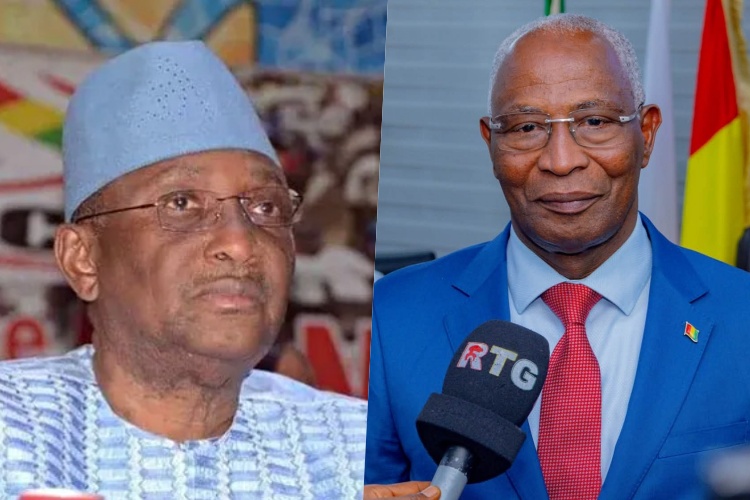
Gambiaj.com – (CONAKRY, Guinea) – The family of former Guinean prime minister and opposition leader Sidya Touré has decided that he will be buried in Abidjan, bringing to an end speculation over whether his remains would be returned to Guinea for a state-assisted funeral.
Touré, 81, died in Paris on 25 September 2026 after being hospitalized for nearly two weeks at the American Hospital. He had spent much of his final years outside Guinea, principally in Côte d’Ivoire.
The decision to bury him in Abidjan was confirmed by Mouctar Kalissa, a former youth official of Touré’s Union of Republican Forces (UFR), who said funeral formalities were still being completed in Paris before the remains are transferred to Côte d’Ivoire.
The decision comes after the Guinean authorities signaled their willingness to support the repatriation of the former prime minister while also insisting that the final decision rest with his family.
Government Hopes for a Funeral in Guinea
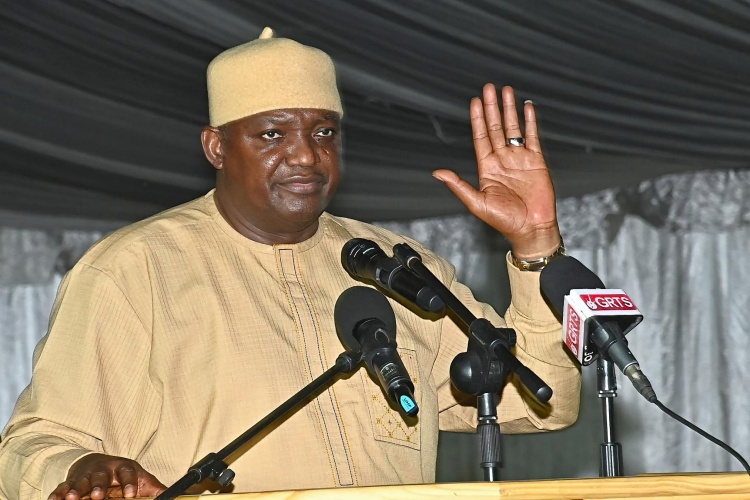
Prime Minister Amadou Oury Bah visited Touré’s family at the mortuary in Hamdalaye CBG on Tuesday to convey condolences on behalf of President Mamadi Doumbouya, his government, and the Guinean people.
Bah said Doumbouya was particularly saddened by the death of the former prime minister and stressed that the government had remained in contact with Touré’s relatives since news of his death emerged.
He said the president had recognized Touré first and foremost as a citizen of Guinea and that the authorities would respect whatever decision the family made regarding his burial.
But the prime minister made clear that the government would have preferred to see Touré return home for his final resting place.
“Our wish is that the one who wanted to lead Guinea should rest in Guinea,” Bah said, while stressing that the government was awaiting the family’s decision.
His remarks came amid calls from figures within Guinea’s political class for Touré’s remains to be brought back to Conakry so that he could receive honors befitting a former head of government.
Elhadj Sory Sanoh, a former official of the RPG Arc-en-ciel, had publicly called for Touré’s remains to be repatriated. The president of the National Assembly, Dansa Kourouma, also paid tribute to the former prime minister.
A Final Journey Shaped by Exile
Touré’s decision to remain buried in Abidjan gives his death an added political dimension.
A former senior civil servant and international economist, Touré served as prime minister under President Lansana Conté and later became one of Guinea’s most enduring opposition figures. He led the UFR for more than two decades and contested two presidential elections.
Following the 2021 military takeover, Touré lived largely outside Guinea. His party was among dozens of political organizations dissolved by the authorities in 2026.
His death therefore comes against the backdrop of a political career increasingly shaped by distance from the country in which he had sought to govern.
The question of his final resting place became particularly sensitive because of his status as a former prime minister. The government’s public position was that his family retained the right to decide where he would be buried, even as officials expressed a preference for Guinea.
According to reports circulating in Guinean political circles, efforts had been made to persuade relatives, including family members based in Abidjan, to organize the funeral in Guinea. Those efforts have not changed the family’s decision.
Abidjan Instead of Conakry
Touré will consequently return to the country that became his principal place of refuge rather than to Conakry, where he spent much of his political life.
The symbolism is difficult to miss. A man who once occupied the office of prime minister and spent decades seeking political power in Guinea will make his final journey away from the country he sought to lead.
His burial in Abidjan also places his death within a broader story of Guinean political figures living outside the country.
Cellou Dalein Diallo, another former prime minister and longstanding opposition leader, remains outside Guinea. Diallo has argued that the political and judicial circumstances make a return difficult, while the authorities maintain that there is no legal impediment preventing him from coming home.
Touré’s death therefore closes one chapter of Guinea’s contemporary political history while leaving unresolved questions about the political space in which figures of his generation once operated.
For the family, the decision is now settled: Sidya Touré will be laid to rest in Abidjan.
For Guinea, his final departure from the political stage comes with the memory of a former prime minister who spent his final years in exile and whose last journey home never took place.






Leave a Reply