


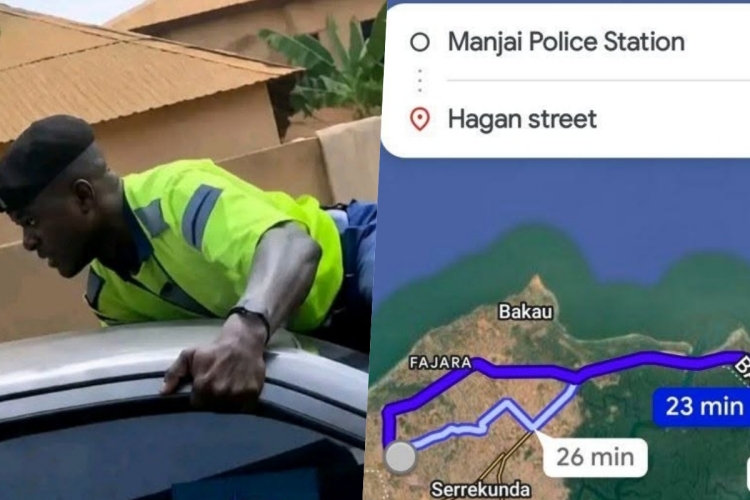
Gambiaj.com – (BANJUL, The Gambia) – The dramatic incident involving a police officer hanging onto the windscreen of a moving vehicle from Banjul to Manjai has generated laughter, jokes, and countless social media memes. To many, it looked like a scene straight out of an action movie. But once the amusement fades, what remains is a deeply troubling reflection of our attitudes toward authority, discipline, and the rule of law.
This was not entertainment. It was a potentially fatal incident.
Reports indicate that the confrontation began in Banjul and continued for approximately 17 kilometers, ending in Manjai Kunda. Throughout that journey, a law enforcement officer was clinging to his life on the front of a moving vehicle while the driver continued to navigate public roads crowded with other motorists and pedestrians.
At any point, the situation could have ended in catastrophe. A sudden brake, a collision, a sharp turn, or a loss of balance could have resulted in serious injury or death, not only for the officer but also for innocent road users.
The conduct of the driver deserves unequivocal condemnation. Whatever grievance or disagreement existed, no citizen has the right to endanger the life of a law enforcement officer carrying out his duties.
Respect for the rule of law requires citizens to comply with lawful instructions and seek redress through established legal channels when they believe they have been wronged.
Yet the incident also forces us to confront a broader and more uncomfortable question: what has happened to our collective respect for authority and public order?
There appears to be a growing tendency among some members of the public to challenge, resist, or ridicule law enforcement officers in ways that would have been unthinkable in previous generations.
This is not to suggest that police officers are beyond criticism. In any democratic society, law enforcement agencies must remain accountable, professional, and respectful of citizens’ rights. However, accountability and disrespect are not the same thing.
A society cannot function when lawful authority is routinely ignored, mocked, or physically resisted. The rule of law depends not only on laws and institutions but also on a culture of civic discipline.
Citizens must recognize that police officers represent the law, even when individual officers may occasionally make mistakes. Undermining that authority ultimately undermines the stability and security of society itself.
At the same time, the incident raises serious questions about police procedures and operational effectiveness.
How did a vehicle involved in such a dangerous confrontation travel from Banjul to Manjai without being safely intercepted? How many police checkpoints, patrol units, or traffic officers were encountered along the route? What communication systems were activated? What instructions were given? Why was the situation allowed to continue for such a considerable distance?
These are not questions intended to assign blame but to identify institutional weaknesses.
Modern policing relies heavily on communication, coordination, and risk management. Once authorities become aware that a driver is endangering an officer’s life and posing a threat to public safety, there should be mechanisms to contain the situation quickly and safely.
The fact that the incident unfolded over such a long distance suggests potential gaps that deserve careful review.
The objective should not merely be to punish the driver. It should also be about understanding how such a dangerous situation was allowed to escalate and persist.
Equally concerning is the parallel incident recently reported on the OIC Road, where construction workers used heavy machinery to surround and immobilise a taxi driver who attempted to enter a restricted area.
Together, these incidents point to a worrying erosion of discipline and respect for institutional authority.
The answer cannot be vigilantism by citizens, nor can it be defiance of law enforcement officers. The answer lies in rebuilding a culture where rules are respected, authority is exercised professionally, and citizens understand that disagreements must be resolved through lawful means.
The Gambia’s democratic development requires more than constitutional reforms, elections, and policy debates. It requires a renewed social contract between citizens and the institutions tasked with maintaining public order.
Respect for the law must be matched by professionalism in law enforcement. Citizens must fulfill their responsibilities, and state institutions must earn public confidence through competence, fairness, and accountability.
Yesterday’s incident should therefore not be remembered simply as a viral moment or a source of public amusement. It should serve as a wake-up call.
A nation where an officer can end up clinging to a moving vehicle across multiple jurisdictions while crowds watch and record videos is a nation being reminded that discipline, respect for authority, and effective law enforcement cannot be taken for granted.
The time has come for serious reflection, not only on the actions of one driver or one officer, but on what the incident reveals about the state of our civic culture and our relationship with the rule of law.













Leave a Reply