


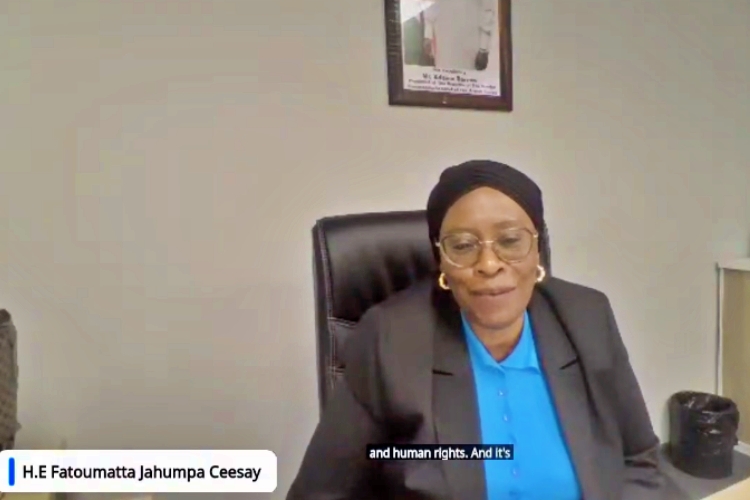
Gambiaj.com – (PRETORIA, South Africa) – The Gambia’s High Commissioner to South Africa, Her Excellency Fatoumatta Jahumpa Ceesay, has called for a stronger rights-based approach to tackling poverty across Africa, arguing that poverty should be treated not merely as an economic challenge but as a fundamental human rights issue affecting dignity, equality, and social justice.
Speaking during the opening of the Center for Human Rights at the University of Pretoria’s “Dialogue on Poverty and Human Rights” webinar on Monday, Ceesay said poverty remains one of the continent’s most pressing challenges despite significant gains in development, innovation, entrepreneurship, and democratic participation.
The online dialogue, the first session in a new webinar series examining poverty through a human rights lens, featured constitutional law scholar and human rights expert Prof. David Bilchitz as keynote speaker.
Addressing academics, civil society representatives, and policymakers from across the continent, the Gambian diplomat said poverty extends far beyond a lack of income and is reflected in limited access to healthcare, education, decent employment, housing, food security, and social protection.
“Poverty is not merely an economic condition. It is a profound human rights challenge that affects dignity, equality, opportunity, and social justice,” she said.
According to Ceesay, poverty continues to silence voices, limit opportunities, and disproportionately affect women, children, young people, persons with disabilities, and other vulnerable groups.
She noted that while Africa possesses enormous potential through its youthful population, natural resources, and growing culture of innovation, translating these advantages into inclusive prosperity remains a major challenge.
The High Commissioner urged African governments and institutions to move beyond rhetoric and focus on practical, people-centered solutions capable of delivering meaningful improvements in the lives of citizens.
She identified investment in education and skills development, women’s empowerment, youth employment, entrepreneurship, healthcare, and social welfare systems as critical components of any effective anti-poverty strategy.
Ceesay also stressed the importance of strengthening governance, accountability, and the implementation of socio-economic rights frameworks to ensure development efforts place people at the center.
“As African leaders, policymakers, diplomats, scholars, and citizens, we must recognize that poverty is not simply a development issue; it is fundamentally a question of justice, inclusion, and human dignity,” she said.
The Gambian envoy further highlighted the interconnected nature of poverty, pointing to its links with inequality, unemployment, climate vulnerability, migration, conflict, and social exclusion.
High Commissioner Jahumpa Ceesay paused to point to the ongoing anti-African migrant spree in South Africa, with many countries now repatriating their nationals. She thanked President Cyril Ramaphosa for finally addressing the problem.
She argued that these overlapping challenges require coordinated and holistic responses rooted in solidarity and regional cooperation.
Ceesay underscored the role of governments, academic institutions, development partners, civil society organizations, and the private sector in generating evidence-based solutions and ensuring that the experiences of affected communities are reflected in policymaking.
Commending the University of Pretoria’s Centre for Human Rights for convening the dialogue, she said such discussions are essential for deepening understanding of poverty and fostering collaborative approaches to sustainable solutions.
She concluded by reminding participants that poverty statistics represent real human experiences and called for sustained commitment to ensuring that no one is left behind in Africa’s development journey.
“The fight against poverty is ultimately a shared responsibility. It demands moral courage, political will, and sustained commitment,” she said.
The webinar forms part of ongoing efforts by the Centre for Human Rights to promote discussion on the relationship between poverty, human rights, and social justice across Africa.







Leave a Reply