


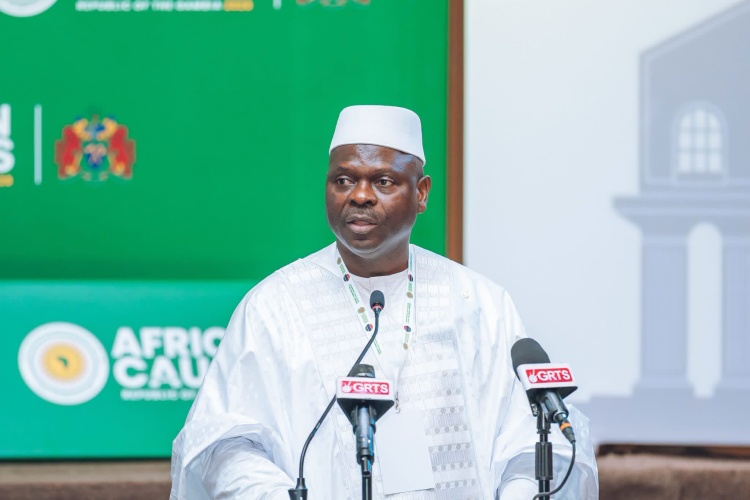
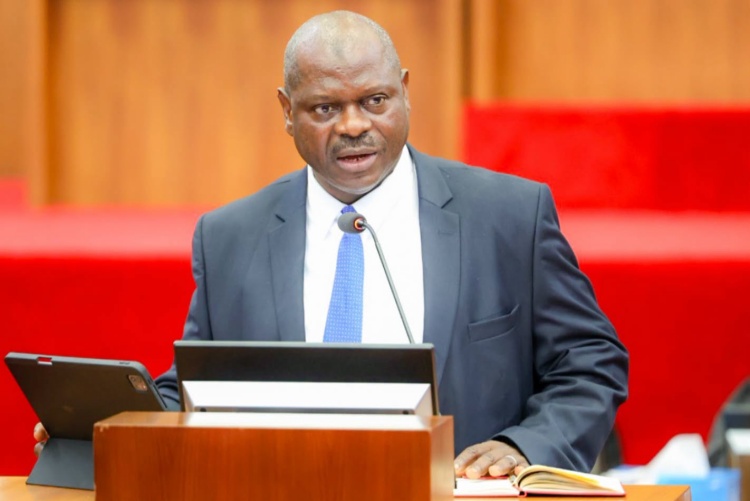
Gambiaj.com – (BANJUL, The Gambia) – Finance Minister Seedy Keita has defended The Gambia’s growing public debt, insisting that every dalasi borrowed by the government can be accounted for and has been invested in projects intended to strengthen the country’s infrastructure and economy.
Speaking in an interview, Keita rejected claims that the government has been borrowing recklessly, arguing that public criticism often focuses on the size of the debt without considering how the funds have been used.
“As of December 2025, the total debt stock stood at D140 billion,” Keita said, noting that 64 percent of the debt is external, while 36 percent is domestic.
The government inherited billions in liabilities
The minister said part of the increase in the country’s debt stock reflects liabilities inherited by the current administration rather than new borrowing.
According to Keita, the government absorbed D12.5 billion in previously unrecorded obligations, including debts linked to state-owned entities and other legacy commitments, as part of efforts to improve transparency and restore confidence in the country’s financial system.
He further stated that state-owned enterprises account for D28 billion of the country’s debt, leaving what he described as the government’s “net borrowing” at around D53.5 billion.
Keita said the borrowing has financed a range of major national projects, including the University of The Gambia’s Faraba Banta campus, the Bertil Harding Highway, the OIC road infrastructure program, electricity expansion projects, agricultural value-chain initiatives, renewable energy investments, and improvements to secondary schools.
He maintained that there had been “no speculative borrowing”, arguing that the funds were directed towards projects whose benefits can be seen across the country.
“When people say we are only borrowing, they should also ask where the money has gone,” he said. “Every dalasi can be traced.”
Keita calls debt “good debt”
The finance minister argued that borrowing is necessary for developing countries with limited domestic resources, provided that borrowed funds are invested productively and the country maintains the capacity to repay.
He described The Gambia’s debt as “good debt”, saying the country’s repayment capacity has improved significantly and that the government has never defaulted on its debt obligations.
According to Keita, international development partners continue to provide financing because of their confidence in The Gambia’s ability to manage and service its debt.
He also rejected assertions that the government relies heavily on expensive commercial borrowing. Keita said financing from institutions such as the World Bank and African Development Bank is provided on a grant basis, while IMF financing carries zero interest. Financing from the Islamic Development Bank, he added, contains a grant element of more than 35 percent.
The minister disclosed that the government has also begun rejecting some loan offers because they do not meet its requirements for concessional financing.
Government working on national balance sheet
Keita said public debt should not be assessed solely by its size, but also by the assets created through borrowing.
He revealed that the government is developing a national balance sheet that will record the value of public assets alongside national liabilities.
Such a system, he argued, would allow Gambians to assess the country’s debt against the roads, schools, hospitals, and other infrastructure built through public borrowing.
“We are borrowing responsibly, we are borrowing for productive investments, and we are ensuring the country has the capacity to repay,” Keita said. “If you don’t know where the money has gone, ask. There are no stupid questions.”







Leave a Reply