


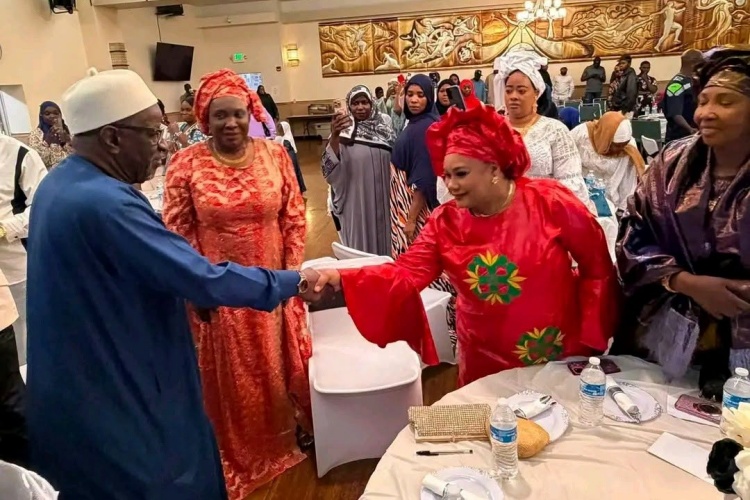
Gambiaj.com – (BANJUL, The Gambia) – Listening to Madam Tuti Faal speak at the recent NPP fundraising event in Seattle, what stayed with me was not a political slogan but a simple reminder about who we are as Gambians.
Speaking in Mandinka, she reflected on politics, relationships, respect, and tolerance, drawing on experiences from her own life. At the heart of her message was a point that deserves to be repeated at a time when political differences are becoming increasingly personal: politics is not war.
The Gambia has never been without political differences. We have supported different parties, voted for different candidates, and argued passionately about the future of our country. Yet there was a time when political disagreement did not necessarily end friendships or family relationships.
People could campaign against each other and still meet afterwards, greet each other, share a cup of tea, or sit together at a family ceremony. That ability to separate political differences from personal relationships is one of the qualities that has helped hold our society together, and we should be careful not to lose it.
When Political Opponents Could Still Share Tea
One of the stories Tuti Faal shared brought this home beautifully. She recalled Hamat Bah expressing confidence during an election while saying that, if he lost, he would come to State House for tea. When the election was over and the result did not go his way, she remembered his words and invited him to State House. They sat together, drank tea, talked, and laughed.
There was no bitterness and no sense that losing an election had turned a political opponent into an enemy. There was simply a human encounter between people who happened to stand on different sides of a political contest.
She also recalled an encounter with Ousainou Darboe in Bakau. She was in a shop when she was informed that Darboe was on his way. She stepped outside and greeted him as an elder. They talked and laughed.
These simple encounters say something important about our political culture. A political opponent does not become an enemy simply because he or she supports another candidate.
That distinction is particularly important today because political disagreement is increasingly spilling into personal relationships. Social media has made it easy to say things about political opponents that many people would hesitate to say face to face.
A disagreement over policy can quickly become an attack on character, family, or background, and before long, people who have known and respected each other for years find themselves divided by politics.
Yet democracy depends on disagreement. We must be able to question governments, challenge opposition parties, criticize leaders, and argue for different policies. The real test is whether we can do so without losing respect for one another.
There is a world of difference between saying, “I disagree with your politics,” and saying, “Because of your politics, I cannot respect you.” We should never confuse the two.
The Value of Honest Counsel
Her reflections also offered an interesting insight into the value of partnership. As the former wife of former President Yahya Jammeh, Tuti Faal experienced from close quarters the pressures and responsibilities that accompany political leadership.
She acknowledged that her former husband would sometimes speak strongly and that, on a number of occasions, she would advise him to tone things down. I find that particularly significant, not as a comment on any particular political position, but as an illustration of what genuine partnership can mean.
A partner is not merely someone who applauds us or stands beside us when things are going well. A partner should also be able to offer honest counsel, including the difficult advice that something could be said or done differently.
Sometimes the most valuable support we can give someone is to tell them to pause, reconsider, or tone things down. In public life, where words can affect an entire nation, that kind of honest counsel is especially important.
Respect Across Generations
This connects with another value she emphasized: respect for elders.
Respect for those who came before us has traditionally been part of Gambian life. It does not mean that young people must accept every opinion expressed by an elder, nor does it mean that elders are beyond question. It means that disagreement should still be accompanied by courtesy.
Elders have a responsibility to guide and listen to the younger generation, while young people have a responsibility to question ideas without abandoning respect.
Her appeal for greater participation by women in politics belongs within the same conversation. Women are not spectators in Gambian society. They are mothers, professionals, entrepreneurs, community leaders, and citizens whose contribution to national life is indispensable. A mature political culture must make room for their voices and leadership.
Political Power Is Temporary
Perhaps the most sobering part of the message is the reminder that political power is temporary.
Whoever occupies an office does so for a period, and eventually that period comes to an end. Governments change, leaders leave office, and political fortunes rise and fall.
Tuti Faal’s reflection was also grounded in faith: those who occupy positions do so by the will of Allah, and when their time comes, they will leave. What remains is the country and the relationships among its people.
The person campaigning against our preferred candidate today may be our colleague tomorrow. The person we criticize today may be sitting beside us at a family ceremony years from now. The political opponent we regard as an adversary may one day be the person with whom we must work for the good of the country.
Politics is temporary; relationships endure.
When Politics Comes Home
Her story about her own mother and voting brought the message even closer to home.
Political differences can exist within the same family. A mother can support one candidate while her child supports another. They can disagree, tease each other, and exchange words in the heat of political discussion, yet the bond between them remains.
Tuti told the story with humor, but the underlying lesson was serious: political choice should never become more important than family.
We should not be afraid of disagreement. A democracy in which everyone thinks alike is not a healthy democracy. We need competing ideas, alternative policies, and people willing to challenge those in power.
But we should compete over ideas, policies, and leadership, not over who can insult the other side most effectively.
After the Ballots Are Counted
As The Gambia moves into another important political period, we should expect robust debate. Parties will mobilize, candidates will make their cases,, and citizens will make their choices. There will be disagreements, disappointments and, eventually, winners and losers.
But when the ballots have been counted, we will still have to live together.
That is why Tuti Faal’s message from Seattle deserves to travel beyond the NPP gathering where it was delivered.
Her stories about Hamat Bah at State House, her encounter with Ousainou Darboe in Bakau, her reflections on partnership and honest counsel, her emphasis on respect for elders, her appeal for women to participate, and her family experience all point to a common truth: we do not have to surrender our relationships in order to defend our political convictions.
Politics will change. Parties will rise and fall. Governments will come and go. Leaders will leave office. But The Gambia will remain, and so will the people who call it home.
We have inherited a society in which people with different views have traditionally found a way to live together. That is a heritage worth protecting.
We can disagree without becoming enemies, compete without becoming bitter, and hold one another accountable without losing our humanity.
Politics is not war. It is a contest over ideas and leadership. When the contest is over, we must still have a country and a people capable of living together.




















Leave a Reply