


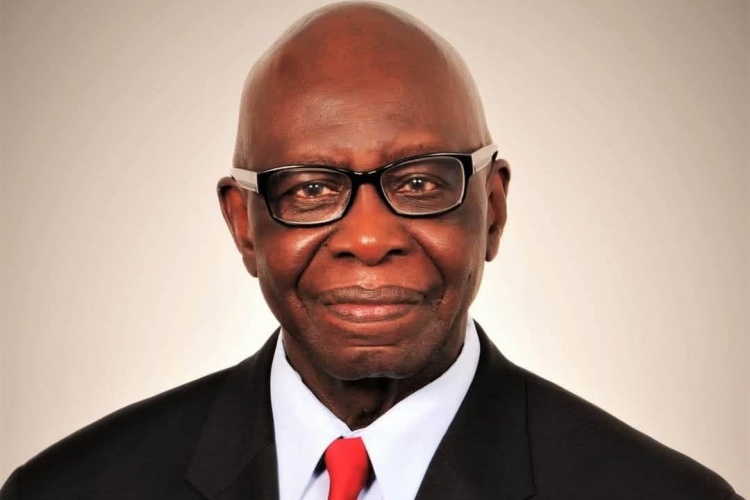
Gambiaj.com – (BANJUL, The Gambia) – I felt deep sadness when my Gambian friend, Mr. Habib Ghanim, informed me of the passing of Dr. Sidi Cherno Jammeh. Dr. Jammeh was a “larger than life” figure— bright, eloquent and kind. In any meeting, one could not be struck by Dr. Jammeh’s presence.
He had a way of carrying himself and speaking in such a weighty manner that commanded people’s attention. Masterfully eloquent (perhaps a relic of his broadcast journalist days at Radio Gambia), Dr. Jammeh spoke slowly and measuredly, picking his words carefully, showing that he belonged.
He was not a silent back-seater. He was a natural leader. I admired Sidi as a leader, brother and a friend, and I will miss him immensely. In this eulogy, I wanted to reminisce about our friendship.
In the late sixties and seventies, long before I met Dr. Jammeh, he was a major broadcaster (popular especially with broadcasting sports) over Radio Gambia and already a popular household name in urban and peri-urban Gambia. He worked at Radio Gambia for 8 years (from 1965 to 1973). As he revealed in an email message to a distribution: ‘These were “the glorious days, if you will. Broadcasting (Radio Gambia) was my 2nd reincarnation job. I was a UK-trained Telecommunications Engineer (trained in Belfast, Ulster in 1964) before I joined the broadcasting service. My journey has taken so many twists and turns, since I left home in 1973 to pursue further studies at Georgetown university.”
His stint in Belfast, Ireland was not uneventful as he also had a son there with an Irish woman. I was fortunate to meet his Irish son, a nice “young” man, who, despite his father’s absence in his childhood, came to meet him and developed good camaraderie with his father.
I have known Dr. Jammeh for over forty years. I first met him around 1981 when he was a graduate student at Johns Hopkins University, School of Advanced International Studies (better known by its acronym, SAIS).
Prof. Michael Nwanze of Howard University had organized a model OAU event in which students from various colleges and universities in the United States modeled the operations of the OAU, each college or university representing an African country delegation. We came as students from Berea College in Kentucky representing one African country (can’t remember which). It was the first time I met Dr. Jammeh — and also Prof. Sulayman Nyang— and we became instant friends.
In my subsequent visits to DC, Dr. Jammeh was then a student, single, and staying at Alban Towers apartment complex (near the Washington, DC National Cathedral), I stayed with him at his apartment. He was friendly and hospitable, and we would go to the Kilimanjaro Nightclub (then near Dupont Circle in the Adams Morgan area) and have fun together.
Dr. Jammeh, that time, would work shifts at the front desk of the Alban towers, managing the keys, mail and visitors to the apartments, to earn pocket money to pay his way through graduate school. He was a hard worker, self-confident in his abilities, pulling himself up by his own bootstraps.
Dr. Jammeh attended top notch universities in the U.S.; first Georgetown University from 1973-1977, graduating with a BSc degree in International Economics. He then continued on for his Masters (1981) and PhD degree (1987) in International Relations/International Economics at SAIS, Johns Hopkins University.
After completing his Ph.D, Dr. Jammeh worked as a researcher at the world-class think tank, International Food Policy Research Institute (better known by its acronym, IFPRI), which carries out research on agriculture and food systems to provide evidence-based policy solutions to help reduce poverty and hunger in developing countries.
He produced high quality research, working with eminent agricultural economists such as Christopher Delgado. This resulted in a book he co-edited with Delgado titled The Political Economy of Senegal Under Structural Adjustment published by Praeger, New York in 1991.
Dr. Jammeh continued to demonstrate that he was a serious scholar by publishing a highly important paper titled “Politics of Agricultural Price Decision-Making in Senegal” in the volume The Political Economy of Risk and Choice in Senegal , a prestigious book edited by Mark Gersovitz and John Waterbury, two then eminent professors, one at Johns Hopkins and the other at Princeton University respectively.
From IFPRI, Dr. Jammeh joined the World Bank where he served for about twenty years. He initially worked as a researcher with the distinguished Indian agriculture economist, Dr. Uma Lele, on a program of agricultural development known as Managing Agrcultural Development in Africa better known by its acronym, MADIA).
The program included world class researchers such as Dr. Jammeh, Dr. Chandra Ranade, Dr. Osita Ogbu (later to be a Minister in the Nigerian government), etc who carried out comparative studies of agricultural performance of six African countries (Cameroon, Kenya, Malawi, Nigeria, Senegal and Tanzania) looking at their policies and the role of donor assistance over a 25-year period. The MADIA work was one of the major research programs in the World Bank in the 1980s and Dr. Jammeh was a big player in it.
Following his stint as a researcher, Dr. Jammeh embarked as an Economist on project and program operational work in the Bank, first working on Sahel countries, then on Rwanda and finally Nigeria. In Nigeria, he led the design and implementation of a major national investment program in community driven development, irrigation and agricultural business value chain development known as the FADAMA Project aimed at increasing smallholder farmer incomes and reducing poverty.
He became famous in Nigeria as the “father” of that nationally consequential agricultural program known as the FADAMA.
Dr. Jammeh’s career in the World Bank did not move as fast as he had wished. Although he was a highly competent professional and worked hard, the World Bank he worked in had many structural barriers for Africans and other minorities.
When he entered the World Bank, it was dominated by Americans and Europeans (many of whom came from the British, French and Portuguese colonial services). These people were highly skilled and experienced on developing countries but had superior attitudes.
And, knowing Dr. Jammeh as a fighter, he fought these attitudes and his career therefore suffered and moved slowly. He ended retiring only as a Senior Economist. Although he was more than competent and deserving, the World Bank and IMF environments were never easy ones to navigate for minorities; so he never made it to the rank of management at the World Bank. He did not network effectively and was not aligned with the powerful at these institutions; regrettably he did not advance up as he had wished.
But Dr. Jammeh was not one who lied low and complained in the dark. He thought Africans and other minorities needed to organize and advocate for a level playing field so that future minorities will not fight the same battles as we had. My suspicion is that frustrations with his own career progress led him to run for the Chairpersonship of the World Bank- IMF Africa Society.
Following his election, it seemed he seemed to have found a new mission, and he led to become one of the most effective leaders that the Africa Society had ever had. What made his leadership even more consequential was that it coincided with the selection of Mr. James D. Wolfensohn as President of the World Bank.
Wolfensohn cared about Africans and developed excellent relationships with Dr. Jammeh. In fact, President Wolfensohn gave him his direct phone line; so he had direct frequent communication with the President. Dr. Jammeh used his new found leverage to push for major reforms to help Africans in the Bank and reform Bank policies towards Africans. I worked closely with him in the Africa Society as his adviser.
We drafted a major policy paper for Wolfensohn advising him about what he should do to support Africans and other minorities in the World Bank, and what the World Bank should do to to improve its approach to Africa. President Wolfensohn was so happy with this internal initiative by the Africa Society that he spoke about it in one of his meetings with the African Governors of the World Bank.
In the subsequent efforts that followed, the World Bank, under Wolfensohn, made major efforts to improve the recruitment of more Africans into the Bank, to facilitate the promotion of competent and deserving Africans into management, and the adoption of a zero-tolerance policy for racial and gender discrimination at the World Bank.
In fact, it was Wolfensohn who appointed the first African to be a Vice President at the World Bank, the Zimbabwean economist, Dr. Callisto Madavo, the most senior African in the World Bank at the time.
Today, because of the reforms that Wolfensohn led (pushed by the determined efforts of Dr. Sidi Jammeh and his team), the World Bank is a fairer and more level playing field for Africans and other minorities.
President Wolfensohn also championed some of the other recommendations by the Africa Society— pushing for debt forgiveness for poor African economies so they can have the fiscal space to invest in education, health and infrastructure. In fact, it can be argued that the Heavily Indebted Poor Countries (better known as HIPC) Initiative was initiated in 1996 under the championship of President Wolfensohn because of also the supporting influence of that Africa Society paper.
The Africa Society paper also called for Wolfensohn to help with mobilizing the U.S. private sector to partner with the Africa private sector to crowd in investments.
It is in the spirit of the latter, that Dr. Jammeh as Chairman of the World Bank-IMF Africa Society, with financial support from President Wolfensohn’s office, organized the Africa Business Forum in1998, which brought together the African private sector to meet and partner with the U.S. private sector in Washington, DC to help catalyze investments to boost foreign direct investment in Africa.
The event was unprecedented in the history of the Bank and Dr. Jammeh’s leadership was responsible for its success. One impressive quality of Dr. Jammeh was his unrivaled knowledge of Washington, DC with extensive outreach to the U.S. Congress, especially to the Congressional Black Caucus, and its members like Donald Payne, John Conyers and William Jefferson.
Dr. Jammeh had impressive political and diplomatic skills which made him one of the few African staff at the World Bank known in Capitol Hill and by the African Ambassadors. He was a “larger than life” figure who operated in important political circles.
It was no surprise, therefore, that Dr. Jammeh received, on June 26, 2018, a Lifetime Achievement Award from the Africa Trade and Investment Global Summit (ATIGS).
I could go on and on to recount the impressive achievements of Dr. Sidi Cherno Jammeh. He was an extraordinary man who insisted on being ordinary. He mentored and supported many young people along the way- Gambians (eg, the late Dr. Karamo Sonko) and non- Gambians (eg, Dr. Hippolyte Fofack). He was not an angel (none of us are), and he will be the first to admit, but he was a truly consequential Gambian whose enormous achievements deserve an important place when a balanced history of the Gambia is written.
One thing I always liked about him was that, when faced with his imperfections—and I have had moments when I spoke frankly to him, he was not defensive and always appreciated critical feedback. He was a man who did not suffer fools but, once he respected you and knew you were well-intentioned, he listened to critical and constructive advice.
In fact, in the World Bank he witnessed many staff who were less competent or experienced rise in the system above him, and he will sometimes seethe with irony, recognizing life was sometimes unfair. Its fortunes did not go sometimes to people who deserve it.
When President Yahya Jammeh carried out his coup on July 22, 1994 (overthrowing the civilian government of Sir Dawda Kairaba Jawara), Gambian professionals, comprising Prof. Sulayman Nyang, Dr. Sidi Jammeh, Dr. Sukai Prom-Jackson, Professor Momodou Darboe, Mr. Yusupha Crookes, Prof. Abdoulaye Saine, Mr. Ousainou Mbenga, Ms. Sohna Sallah, myself and others, formed the Gambia Pro-Democracy Movement. Dr. Sidi Jammeh was selected to be the chief spokesperson for the Movement and he was an able one.
The Yahya Jammeh government sent a delegation to Washington comprising Captain Ebou Jallow, etc and Dr. Jammeh and team held discussions with them about restoring the country to constitutional order and preparing the country for competitive elections. President Yahya Jammeh, however, had other intentions and little did we know he will entrench himself in power for over twenty years. Dr. Jammeh will speak to me that, after that meeting and his subsequent interactions with President Jammeh by phone, he was a marked man with his life at risk whenever he visited the Gambia.
At the World Bank, we had about twelve professional Gambians (??) at the time (not counting local field staff): Mr. Yusupha Crookes, Dr. Sukai Prom-Jackson, Mr. Seringe Omar Fye, Dr. Rakey Cole, Mrs. Lucy Fye, Ms. Deggie Young, Ms. Haddy Jatou Sey, Mr. James Oremie Monday and Dr. Ousman Jah, and later consultants such as Dr. Mohamed Edrissa Faal in the Legal Department.
On the World Bank’s Board side was Dr. Jabez Ayo-Langley (an Executive Director or ED) and Mr. Sering Cham (who served as Adviser to one of the African EDs). Of all these Gambians, Dr. Jammeh was my best friend, whom I knew very well and interacted frequently the most. Dr. Jammeh was strategic and was an activist, and he thought that, in the Bank, it was just not okay to only do your job but to also push to create a level playing field for all Africans and other minorities, and to fight for the interests of Africa. I too shared that conviction. So, we became bosom buddies.
Dr. Jammeh was born in Banjul in 1943 and died in Virginia on August 10, 2026. He once told me, when we had deep discussions about family, that his mother was from Baddibu, Suwareh Kunda. I then asked him if he was related to Chief Mama Tamba Jammeh of Baddibu.
I told him that my own father was a cousin of Mama Tamba through the Badjan clan. My grandfather, Musa Jojo Sallah, was son of Jojo Badjan, and Mama Tamba’s grandmother, Jabou Badjan (the wife of Nyiramasang Jammeh) was her sister. Mama Tamba’s father, Jatta Sirang, was a son of Jabou Badjan. When I told this to Dr. Jammeh he was curious and deeply interested but admitted that he was not related to Mama Tamba Jammeh. I told him that my father (who was born in 1914) recounted to me once that while he was at the Banjul Town Council (BTC) working in the Rates and Assessment Department during the colonial days, he was assigned to go to collect taxes in Baddibu.
Mama Tamba told my father, “Cousin, don’t come to collect taxes in Baddibu. Here they kill tax collectors.” Dr. Jammeh laughed at this episode, and relished the idea that we both had some Baddibu links. His comment was “Gambia was small”— a reference that many families (even sometime unbeknown to some) were related and therefore we should work to avoid social divisions and promote social solidarity.
Dr. Jammeh was popular in the greater Washington DC Community, attending various Gambian social events as a respected elder. Many called him “Koto Sidi” or “Koto-ke” as a sign of respect. For me, it was Dr. Jammeh and Dr. Nyang who were among the two Gambians I invited to the naming ceremonies of my two kids in the nineties.
Dr. Jammeh also reciprocated when he had his first US born daughter with his last wife, whom he gave me the privilege to hold while they were naming the baby. Our relations were close.
When I gave my US Library of Congress reading and talk on my poetry in their program of African authors, Dr. Jammeh, Professor Sulayman Nyang, Prof. Mbye Cham, Dr. Jabez Ayo- Langley, Mary Njie-Langley and Ambasador Alieu Ngum were there in the audience. It was a “who is who” of Gambian professionals in the greater DC are,a and they came to give their support and participate in the discussions. It was a memorable event.
Later when my World Bank friend, Dr. Sukai Prom-Jackson arranged for me to give a poetry reading at her house in Howard County, Maryland, Dr. Sidi Jammeh, Professor Sulayman Nyang, Mr. Habib Ghanim, Mr. Rene Prom, the Nigerian novelist Helon Habila, Ambassador George Haley (brother to Alex Haley of Roots fame) and his wife and many other Gambians and non- Gambians were there. Many young Gambians were also there.
Dr. Jammeh and Prof. Sulayman Nyang intellectually dominated the discussions. The intellectual discussions were so rich, lively, and the audience’s response so enthusiastic that after the event, email exchanges flowed that we Gambians needed to organize ourselves better to continue to culturally enrich our children.
My last communication with Dr. Jammeh is when I learned from an email I sent to him, querying that I did not see him at the Professor Mbye Cham memorial at Howard University, he replied that he had a stroke and was at a rehabilitation center. I was shocked and felt deep empathy for him. I told him that I will come for a visit.
When I visited him at the Carlin Spring post-Rehab center in Virginia, he was in an exercise room with other patients. He was seated. Immediately, he smiled when he saw me and proudly started to introduce me to his assistants.
He was fully with his faculties but had lost weight and aged a lot since I last saw him, and his body appeared weak. We sat and chatted for half an hour, but I felt uneasy that I was interfering with his exercise routine. I told him that he should continue his therapy and rest assured he will recover. After I left, I sent him the following message on November 18, 2025:
“Bro Dr. Jammeh, It was great to see you today. I was pleased to see you recovering well. You are a good and great person, and you have the right attitude towards your care. I am confident you will get back to normal.”
“I felt bad that I came the wrong time while you are having your rehab therapy. But I was so happy to see you.
We don’t control our lives. I have come to this recognition after my car accident in London. All we can do is to think and act positive and ask our creator to help with the rest. I know you mentioned rehab is tough. But keep faith. I have known you always to be a positive and resilient person.
Stay hopeful, my brother.
We will continue to pray for you.”
And Dr. Jammeh replied on November 19, 2025 with his usual humor calling me Tallubeh Cheikh referring to my Tijani connection, (as I used to tease him that he was a Murid):
“Talubeh Cheikh!
Visiting me was very timely and your goodwill message and warmth and Prayers inspired and fortified me in my Resolve to WIN this fight of and for my Life!!
ABARAKA. JEREJEUFF!”
After that visit, we had a few more exchanges but then in 2026, I could no longer get responses from him on his phone. I learned later he was moving between various care institutions.
I will miss Dr. Jammeh. He was a great and good man, caring about people, lively in spirit to the end. He was also a professional and a highly accomplished Gambian. I was at his funeral this Thursday, August 8, held at the Adam’s Center Masjid.
His bereaved wife, Mrs Amie Menga; his children, and some members of the Mbenga clan were there. His bereaved wife was in tears. There were other Gambians there: Mr. Momar Mbergan and his wife, Mr Habib Ghanim and his wife, Mr. Alieu Demba (formerly IMF), Mr. Saul Mbenga (his in-law), Mr. Amadou Cisse (from Timbuktu, Mali and formerly of the World Bank), Mr. Alpha Barry (Guinea, formerly of the World Bank), Mr. Mathurin Gbetibuo (Ivory Coast, formerly of the World Bank), Imam Ahmed Sy (from the Sy family of Tivaone) and several other attendants whom I could not identify.
We had a graceful prayer for Dr. Jammeh following usual Moslem practice and he was taken for burial in Sterling, Virginia. We pray that our gracious God, in his infinite mercy, grant our beloved Dr. Jammeh the best of abode in Al-Jannah (heaven).
The Author, Dr. Tijan M. Sallah, the author of some 13 books, is a former economics professor and World Bank economist, poet and writer.












Leave a Reply