


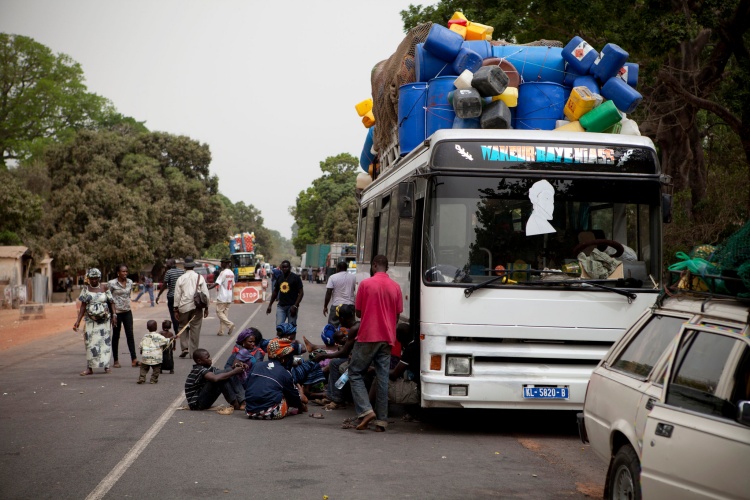
Gambiaj.com – (ZIGUINCHOR, Senegal) – A transport dispute between Guinea-Bissau and Senegal has disrupted cross-border travel since August 12, forcing passengers to change vehicles at the border and adding significant costs and delays to journeys between Guinea-Bissau and Ziguinchor.
Public transport vehicles from Guinea-Bissau have stopped entering Senegal and no longer travel directly to Ziguinchor’s main transport station, as they previously did. Senegalese public transport vehicles have similarly stopped entering Guinea-Bissau.
The disruption is particularly affecting Guineans travelling to Ziguinchor, a major commercial and social centre in Senegal’s Casamance region, where thousands of Guineans live, work, study and conduct business.
According to Orlando Wam Sambú, Guinea-Bissau’s consul in Ziguinchor, the consulate has formally notified both the government in Bissau and the authorities in Ziguinchor about the situation.
“We did what was within our reach. We sent a letter to the Ministry of Foreign Affairs and the Governor of the Ziguinchor Region, informing them about what happened, but to date, we have received no response,” Sambú stated.
He said the matter is now being handled at a higher level and declined to provide further details while the two governments consider possible measures.
Passengers forced to change vehicles
The transport disruption has created an additional financial burden for travellers.
Guineans crossing into Senegal are reportedly forced to use motorcycle taxis between Djegue, on the Guinea-Bissau side of the border, and Mpack in Senegal, at a cost that can reach about 5,000 CFA francs.
From Mpack, passengers must then take another public transport vehicle to Ziguinchor, paying a further 1,000 CFA francs.
The arrangement has effectively broken what was previously a more direct transport connection between Guinea-Bissau and Ziguinchor, leaving passengers to navigate multiple stages of the journey.
The impact is significant because the border serves communities on both sides that have long-standing economic, family, and agricultural links.
Sambú said people from both countries regularly cross the border to cultivate land, trade, and maintain other social and economic ties.
Documentation adds to the difficulties.
The consul said some of the problems faced by Guinean nationals in Ziguinchor are also linked to inadequate documentation.
He estimated that more than 3,000 Guineans currently live in the city, although he acknowledged that the consulate does not have completely up-to-date figures because many Guineans have acquired Senegalese documents.
Sambú said many Guineans living in Senegal do not have consular cards, which can create difficulties during checks by Senegalese authorities.
He urged Guinean nationals to regularize their documentation and register with the consulate, noting that authorities may request a national identity card or passport as well as a consular card.
He also acknowledged that the consulate has dealt with several cases involving Guineans and Senegalese police, particularly over documentation.
The diplomat said tensions can sometimes escalate during such encounters, including arguments over delays in the return of identity documents.
Authorities seeking a solution
Sambú said the consulate has been intervening in cases that fall within its responsibilities and is awaiting action from the two governments to resolve the transport problem.
Despite the current difficulties, he described relations between Guinea-Bissau and Senegal as generally positive, stressing the long-standing ties between the two countries.
The Guinea-Bissau Consulate in Ziguinchor has operated since 1982.
The current dispute comes against the backdrop of intense cross-border movement between Guinea-Bissau and Senegal, where communities have historically maintained close commercial, agricultural, and family connections.
For travellers, however, the immediate concern remains the disruption of direct transport, which has made journeys more complicated and expensive.
Sambú urged Guineans living in Senegal to remain united and respect the laws of their host country while the authorities work towards resolving the outstanding issues.
The developments highlight how closely communities on both sides of the Guinea-Bissau-Senegal border remain connected and how disruptions to transport and documentation can have consequences extending well beyond the border itself.









Leave a Reply