


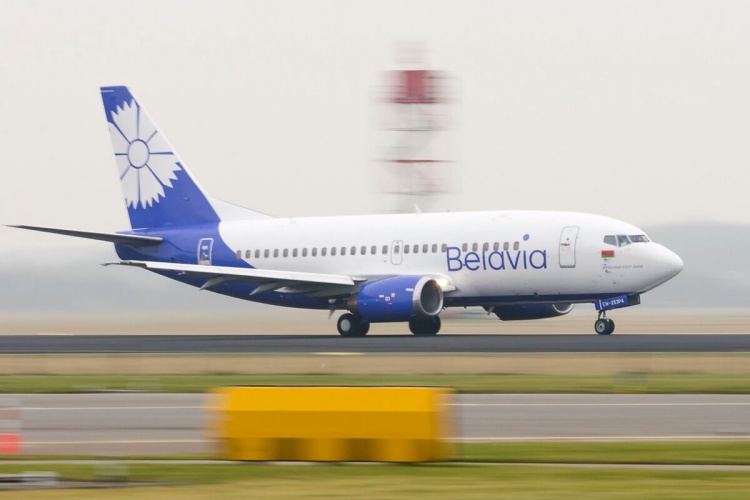
Gambiaj.com – (BANJUL, The Gambia) – The Gambia has once again found itself in the middle of an unusual aircraft trail involving sanctioned Belarusian national carrier Belavia. Three Boeing 737-800s that have now entered Belavia’s fleet passed through Gambian registration shortly before arriving in Belarus, according to aviation tracking records.
Belavia itself has said little about the aircraft’s origins.
In its report covering the first seven months of 2026, the airline simply announced that it had put three Boeing 737-800s into operation. The planes were introduced gradually and are already being used on some of the airline’s busiest routes.
It did not say where they came from.
Aviation enthusiasts, however, followed the aircraft’s movements and found a striking link to The Gambia.
The Gambian link
The three aircraft, EW-546PA, EW-547PA, and EW-548PA, were reportedly flown to Minsk in June after briefly carrying Gambian registrations.
The Belarusian aviation Telegram channel OtVinta reported that three Boeing 737s had been ferried to Minsk around that time. Aviation tracking service Skyliner Aviation subsequently showed that the aircraft had recently been registered in The Gambia.
Aircraft database Planespotters.net now identifies the three aircraft as the same Boeing 737-800s operating for Belavia.
Two of them, EW-547PA and EW-548PA, had spent years with Ukrainian airline SkyUp Airlines. Both were acquired by SkyUp in 2018 and remained with the airline until June 2026, just before the change in registration and their move to Belarus.
The third aircraft, EW-546PA, also came from the SkyUp group. It was with SkyUp Airlines from 2018 until April this year, when it moved to SkyUp Europe.
It later passed through Gambian registration before ending up with Belavia.
The aircraft are between 12 and 13 years old, hardly unusual ages for Boeing 737-800s still in commercial service.
From SkyUp to Minsk
There is another reason the journey of these aircraft is attracting attention.
Since Russia’s full-scale invasion of Ukraine, SkyUp has made aircraft available for leasing but has said that they could not be used for flights to Belarus or Russia.
SkyUp has also confirmed to the Ukrainian service of Radio Free Europe/Radio Liberty that the three aircraft now in Minsk were previously part of its operational fleet.
That does not, by itself, establish any wrongdoing by SkyUp or by the Gambian authorities.
But it does leave a rather interesting trail: Ukrainian aircraft, a Gambian registration, and ultimately a Belarusian airline that remains under Western sanctions.
The Banjul Airbus deal that came before
The Boeing story is also difficult to separate from what happened with Belavia’s Airbus A330s.
Belarus and Belavia have been under heavy Western restrictions since Minsk became one of Moscow’s closest allies following Russia’s invasion of Ukraine.
The sanctions have made it difficult for Belavia to obtain aircraft, spare parts, and other aviation services through normal European channels.
Yet Belavia has continued to expand and renew parts of its fleet through unconventional routes.
In 2025, the airline acquired three Airbus A330s through an ownership chain involving Magic Air, a little-known Gambian company, and intermediaries in the United Arab Emirates.
The aircraft changed hands and registrations several times before ultimately arriving in Belarus.
Two entered Belavia’s fleet in 2025, while the third was put into service in June 2026. They are now being used on routes from Minsk to South Asia.
At the time, Reuters reported that the arrangement allowed Belavia to get around restrictions on aircraft purchases by using intermediaries in countries outside the European sanctions regime.
In simple terms, the aircraft did not travel directly from their previous owners to Belavia. They moved through other companies and jurisdictions first, with The Gambia becoming one of the links in that chain.
The Boeing case is not quite the same.
It would be tempting to conclude that the three Boeing 737s represent another sanctions-busting operation.
The available evidence does not go that far.
There is an important difference between the Airbus and Boeing cases. The United States lifted sanctions on Belavia in September 2025, while neither The Gambia nor Ukraine has imposed sanctions specifically targeting the Belarusian airline.
Belavia does, however, remain under European Union sanctions and restrictions imposed by several other countries.
So the fact that the three Boeing aircraft passed through Gambian registration does not, on its own, prove that sanctions were circumvented.
The unanswered question is what role the Gambian registration played in the transactions.
Who owned the aircraft while they carried Gambian registrations? Which Gambian company or individuals were involved? Why was The Gambia chosen? And were the relevant authorities fully aware of the aircraft’s ultimate destination?
Those questions are likely to matter more than the registration itself.
The Gambian pattern that needs attention
There is nothing inherently unusual about an aircraft being registered in one country and operated somewhere else. Aircraft ownership, leasing, and registration frequently cross borders.
But when the same country repeatedly appears in complicated aircraft transfers involving a sanctioned foreign airline, attention is bound to follow.
The three Boeing 737s come less than a year after the Magic Air Airbus deal put The Gambia’s aircraft registry under international scrutiny.
The pattern does not prove that Gambian authorities have done anything unlawful. Nor does it establish that the latest Boeing transfers breached sanctions.
But it does raise legitimate questions about how much the Gambian aviation authorities know about the beneficial ownership and final destination of aircraft passing through the country’s registry.
For The Gambia, this is ultimately about more than three Boeing 737s.
It is about whether the country’s aviation registry is being used simply as a legitimate international registration platform, or whether it is increasingly becoming a convenient stop in complex transactions designed to keep aircraft moving despite the geopolitical restrictions surrounding their eventual operators.
That distinction may become increasingly important as Belavia continues to rebuild its fleet and international regulators pay closer attention to how aircraft reach Belarus.


















Leave a Reply