


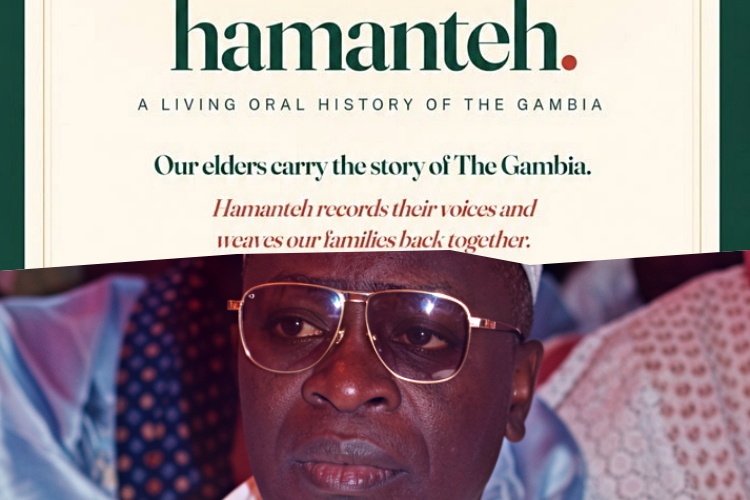
Gambiaj.com – (BANJUL, THE GAMBIA) – In 2021, I lost my father, the late Imam Tafsir Gaye of Banjul. After attending daara in Tivaouane and acquiring a degree from Al-Azhar University, he returned home and became an Imam and an Oustass, educating many in the ways of the Deen.
But he was not just an Islamic scholar and preacher. Like other Imams across the land, he was also a social worker: a joiner of people, a mender of grievances.
From my perch next to him growing up, I watched him mend fences and fix marriages. I saw him end years-long torngore and family feuds, and counsel wayward teenagers back onto the straight path.
And as I observed him work, I learnt. His skill was in remembering, and making others remember: of the familial and neighborly ties that bind us, fastened tight by our ancestors and nurtured through the generations by people like him.
What he did was replicated in communities all over The Gambia, by elders who held the memories of the places in which they lived. They were the nurturers of the flame that is our national history, replenishing and enriching it for each generation so we would not lose our way.
There are many things that threaten to separate us as Gambians, from the party we support to the tribe we belong to. But the network they built—which I’ve named the “Hamanteh network“—was above and beyond all that. It joined us as one People with one history, each of us connected to each other.
The Digital Renaissance of Oral History
I work with AI, and one of my passions is figuring out ways it can be used to preserve our culture and history from our own point of view.
The main challenge has been finding data. On the surface, it looked like I would have to travel the length of The Gambia collecting local histories—something very resource-intensive that would take years.
Then, about 6 months ago, I was approached by a good uncle from the Half Die Mansa Musa WhatsApp group, Bai Mass Taal. Of their own initiative, the group had made over 500 recordings of their family histories, with the elders in each family narrating their lived experiences unfiltered.
I was delighted; it fit my thoughts on using AI to preserve our culture exactly. I immediately retrieved the recordings and started working with them.
The Thread That Binds Us
The Hamanteh network we inherited held us all together in its loving embrace. A community that knows one another is one in which everyone is safer, with less crime, and people who are more willing to help and look out for each other.
Take me for example. Think about how you and I, dear reader, could be connected. Perhaps your uncle worked with mine at health, Abdoulie Mam Njie, and remembers him fondly. Perhaps my father, Imam Tafsir, performed the last rites for your parent and comforted you through your grief.
Perhaps my grandmother Aji Fatou Ceesay fed you as a child, because you were friends with my uncle Ebou Manneh as a teenager.
Perhaps you went to college with my Aunty Juka Jabang or my mother Aji Yama Gaye. And so on. All of us are connected in this way, across all of The Gambia.
As The Gambia grew, however, these connections faded, and the Hamanteh network started to shrink and wilt. We moved further inland with our families and started living in nuclear households rather than traditional extended ones. We became millions in number.
All of this is natural for a growing nation, but it also disrupted and erased large regions of the Hamanteh network. People moved away and lost the connections that had taken generations to build, while elders died with their memories of these connections never recorded.
Piecing Together the Whole
What the ancestors realized when they created and maintained the Hamanteh network was that a People need a common history, a source, and an origin.
It is what gives us cohesion as a society and informs our national dream, giving our children a sense of belonging—making them proud of where they’re from so they don’t feel such an urgent need to flee a land they feel no connection to.
Of course, no single elder knows the whole history of The Gambia, but all of the elders combined know all of it. It is knowledge not written in a single book, but scattered across the land, recorded only in memory.
Yet it would be impractical and prohibitively expensive to try to piece these memories back together into a whole history one by one.
There is another way: if we each gather our own little pieces and combine them, we can reconstruct the whole. This calls for a national effort where everyone submits their own family lineages and histories.
From them, we can create a sum greater than its parts: the story of OUR Gambia, this “improbable nation” that somehow still survives.
Finally, the technology exists to do this in the form of AI.
The Hamanteh Platform
This is the Hamanteh platform I envisioned. It is not a dream or an idea—I have already built it and am paying for it in order to make it free for all Gambians across the nation and the diaspora.
The tools are ready to use, and the people of Half Die have started us off in the right direction with a commendable collection. Now it’s your turn: to capture each of your family’s histories and to record what the elders know.
It is these individual family histories that we will then feed into the AI. It will take them and weave them into one national oral history of The Gambia from its inception. You will then be able to access it from anywhere and ask it any questions:
About your family history and family tree
Which mborka you have around the country
Who the people are in that old photo you’ve kept for a while
How you are connected to another Gambian you just met
Who sat at what vous
Who played on what nawetaan team
…and on and on. Any question you would want answered about the history of our beloved country and your place in it.
The end goal is an AI system that holds all our memories and histories, that recreates the Hamanteh network in digital form so it is ever-changing, ever-growing, recorded, and available to anyone of any age, now and in the future.
Celebrating Our Roots: Hamanteh Day
After each area completes its history, we will host a Hamanteh Day with them. We will watch a documentary of the history and the people who lived there—what they did with their lives, how the community evolved, and how buildings changed. We will listen to elders in that community give us a living narrative, and then we will mingle and get to know each other over traditional music.
It will be a day of national unity and renewal, something we do annually to bring us back together—the way we baalu aaha every Ramadan to wipe away all grievances and fitna and start fresh as a single connected Umma.
A Personal Tribute
By the time my father died, I knew the broad strokes of his life, but I never learnt it all, never recorded it fully. It is one of my regrets that the details of his life continue to elude me. He went to Azhar, yes, but what was life like there for him as a student on a scholarship in a foreign land?
What was it like even earlier in daara, having to beg for his food while mastering the Quran? What were his ambitions, what led to the path he chose in his life? His dreams, the things he held dear? All of it is lost, gone with him to the grave.
Building this platform is also a way of honoring him, and of replicating and scaling what he did for so many people to preserve jaama. It is my gift and challenge to those of you who still have elders alive to learn from. I lost the chance to record mine—but you still can.
Join the Movement
I cannot do this alone. To make it work, we will need volunteers in the following categories:
Story Gatherers: Interview elders, record, and upload.
Storytellers: Add your own knowledge and memories.
Transcribers: Convert audio in Wolof, Mandinka, Pulaar, etc., into English transcripts for the AI.
Fact Checkers: Follow up on uploaded histories to verify accuracy before publication.
Sponsors: Reach out and donate to cover things like the launch event, hosting, etc.
You can give as much or as little time as you can afford. Every little bit helps.
We launch Hamanteh on Saturday, November 21st, 2026 at the National Library in Banjul, with an online stream. It will be the first Hamanteh Day and, hopefully, the start of a new national tradition.
After the launch, the platform will be live, and you can start using it.
I look forward to your participation.
Amran Gaye





Leave a Reply