


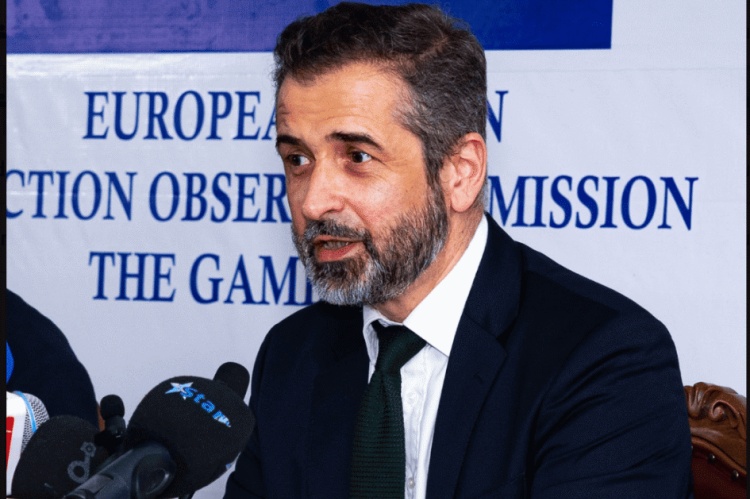
In an exclusive interview with The Standard, Mondon said the mission would have raised concerns if Barrow’s candidacy involved an attempt to breach an existing constitutional or legal provision limiting presidential terms.
“In The Gambia, the constitution doesn’t set any term limit. That’s why we haven’t said anything because there’s no infringement of the law, or the legal framework,” he said.
Constitutional Gap Behind EU Position
The EU has previously spoken out against attempts by political leaders in countries such as Senegal, Guinea and Côte d’Ivoire to circumvent constitutional term limits, which it considers an important safeguard for democratic consolidation.
However, The Gambia’s 1997 Constitution, enacted during former president Yahya Jammeh’s rule, contains no provision restricting presidents to two terms.
Two attempts to introduce a new constitution containing presidential term limits have failed, leaving the existing constitutional framework unchanged and allowing Barrow to seek another mandate.
The issue remains politically contentious as opposition candidates, including United Democratic Party (UDP) leader Ousainou Darboe, have pledged to serve only one term if elected.
Mondon said the EU would not comment on candidates exercising rights permitted under the country’s laws, stressing that respect for national sovereignty and non-interference remained central to the mission’s approach.
“But it’s not the case as of now in the country. So if candidates respect the law of the country, we don’t comment. It’s the sovereign issue of the country to respect,” he explained.
EU Monitoring Campaign Conduct And Media Freedom
With 16 long-term observers deployed across the country, the EU mission is monitoring several aspects of the electoral process, including campaign violence, hate speech, media access and the use of state resources.
Mondon said the mission was particularly attentive to the advantages enjoyed by the incumbent and whether all presidential candidates had fair access to the media.
“We monitor to see if the media gives a level playing field to all candidates, and if the narrative is not inflammatory or targeting a specific ethnic group,” he said.
He also emphasized the importance of protecting journalists from intimidation and attacks while carrying out their professional responsibilities.
Mondon said journalists must be allowed to work freely and that individuals unhappy with their reporting should use the right of reply rather than resort to intimidation.
“If you disagree with a report, you have the right to reply. You don’t have the right to attack the journalist,” he said.
EU Cautious On IEC Preparedness
Responding to concerns raised by opposition parties about the credibility and preparedness of the Independent Electoral Commission (IEC) to conduct a free and fair election, Mondon said it was too early for the mission to reach a definitive conclusion.
“It’s a bit early to say,” he said.
However, he praised the transparency demonstrated by the electoral commission during the nomination process for presidential candidates, describing it as a positive aspect of the preparations so far.
Mondon stressed that the EU mission was not in The Gambia to endorse or reject the eventual election outcome but to assess whether the process reflected the will of voters.
“We don’t come here to validate or invalidate the result of the election. We are not the arbiters of this process,” he said.
He added that the mission would speak out if it observed irregularities capable of undermining voters’ choices, including during the announcement of results.
“However, if we see something that could threaten the will of the voters, including in the announcement of the result, we will definitely say it,” he said.
Peace Pact Welcomed
Mondon also welcomed the peace pact signed by all presidential candidates, including Barrow, describing their collective commitment as a positive development ahead of the December 5 presidential election.
“The fact that all candidates, including the incumbent, signed, is definitely a positive step. An election is a fight of ideas. It is not a fight of people,” he said.
The EU Election Observation Mission is expected to release its preliminary statement on December 7, two days after polling.
Mondon said the statement would outline the mission’s initial findings and conclusions on the electoral process, alongside recommendations for improving future elections.





Leave a Reply