



Gambiaj.com – (DAKAR, SENEGAL) – Inside Senegal’s National Assembly on Wednesday, November 18, Ousmane Sonko delivered a fierce denunciation of the International Monetary Fund (IMF), accusing the Washington-based lender of political interference (ingérence) and sidelining lawmakers.
Yet beneath the nationalist framing of parliamentary sovereignty lies a far more immediate domestic reality: the former prime minister is systematically deploying his PASTEF legislative majority to settle political scores with President Bassirou Diomaye Faye, trapping Senegal’s fragile economy in an institutional deadlock.
With only 18 lawmakers voting in favor of the government’s 2027 draft budget report, parliament dealt a second consecutive blow to the executive in just over two weeks, following its November 3 rejection of the revised 2026 finance bill.
Rather than a technical dispute over fiscal projections, the blockade represents the legislative weaponization of a personal and political rupture—days after Sonko reportedly told party officials in closed-door meetings that his political divorce from Faye was “definitive“.
The IMF as a Political Foil
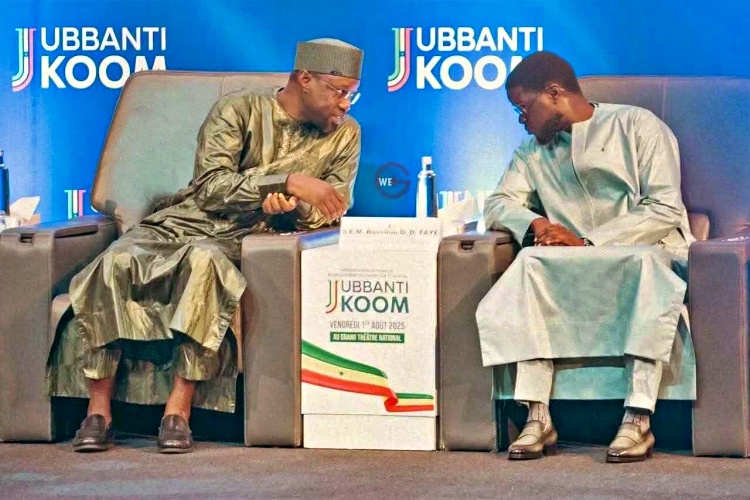
Removed from the premiership by Faye on May 22, 2026, following months of escalating friction, Sonko wasted little time converting his leadership of the ruling PASTEF party and his subsequent election as Speaker of the National Assembly into an alternative center of power. By targeting the IMF on Wednesday, Sonko found an expedient rhetorical shield.
Questioning why the Fund consulted President Faye, Prime Minister Ahmadou Al Aminou Lô, Finance Minister Cheikh Diba, and the central bank while bypassing the legislature, Sonko cast his blockade as a principled stand for constitutional transparency and against a “second financial adventure.”
However, the timing and mechanics of the confrontation undercut his institutional defense:
Targeting the Executive’s Lifeline with Scorched-Earth Tactics
Senegal reached a staff-level agreement with the IMF in September 2026 for a 36-month, $2.2 billion Extended Credit Facility designed to stabilize public finances following revelations of roughly $13 billion in previously undisclosed public debt.
The IMF has explicitly stated that its board cannot approve the disbursement until Dakar adopts a credible budget framework.
By torpedoing both the 2026 revisions and the 2027 draft budget, Sonko is directly starving the Faye administration of the external financing required to govern.
The depth of the retaliatory posture was laid bare by reports that the parliamentary resistance even extended to blocking the budget of the National Assembly itself, an institution Sonko presides over, demonstrating that paralyzing the executive’s financial machinery takes precedence over routine institutional administration.
Even after Finance Minister Cheikh Diba addressed parliamentary queries on revenue, expenditure, and borrowing projections, PASTEF lawmakers overwhelmingly voted down the bill, signaling that no technical concession from the executive would satisfy a legislature determined to deny the presidency a political victory.
A Heavy Price for an Exposed Economy
While Sonko invoked European parliamentary democracies to normalize budget rejections, Senegal’s macroeconomic reality leaves almost no margin for political theater.
Following debt misreporting scandals that pushed public debt estimates to 132 percent of GDP and prompted Moody’s to downgrade Senegal’s foreign-currency rating to Ca in October 2026, the country is effectively locked out of affordable international capital markets.
By turning the $2.2 billion IMF lifeline into a battleground for settling intra-party grievances, the parliamentary blockade threatens immediate, tangible fallout.
Delaying IMF board approval stalls parallel disbursements from the World Bank and the African Development Bank, both of which hinge on an active IMF program.
The government has already warned that prolonged budget paralysis risks triggering electricity shortages, halting arrears payments to local businesses, and cutting off state aid to low-income households, all while ordinary Senegalese contend with high unemployment and rising living costs.
An Institutional Impasse With No Easy Exit
The confrontation has plunged the 2024 revolutionary coalition into an existential crisis. Faye faces the prospect of governing through constitutional workarounds, such as enacting spending by decree or rolling over previous budget ceilings, or exercising his constitutional authority to dissolve the National Assembly once eligible in early December 2026, a gamble that would plunge the country into snap elections amid severe financial distress.
For Sonko, leveraging PASTEF’s parliamentary dominance ensures he remains the decisive kingmaker—or spoiler—in Dakar despite losing his cabinet post.
Yet by cloaking a domestic power struggle in anti-IMF populism, the parliamentary speaker risks winning a tactical victory over his former ally at the cost of pushing Senegal’s public finances toward insolvency.



Leave a Reply