


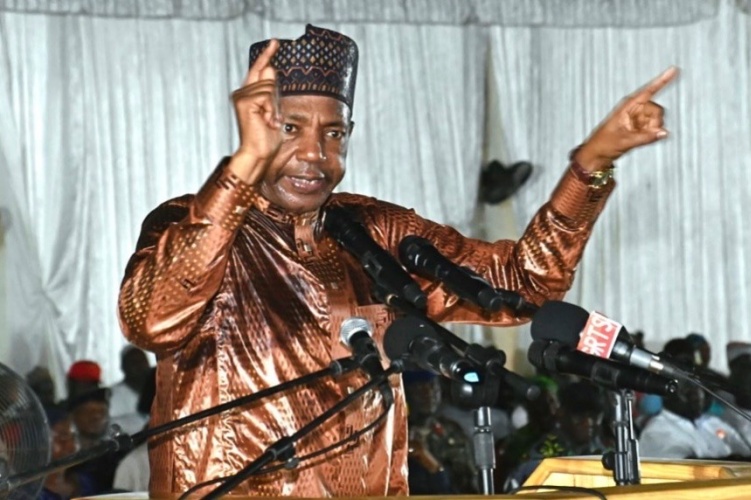
Gambiaj.com – (BANJUL, THE GAMBIA) – Minister of Lands, Regional Governments and Religious Affairs Hamat Bah has defended the Barrow administration against growing complaints over the cost of living, arguing that prices of essential commodities in The Gambia remain relatively low compared with several neighboring West African countries.
Bah said the price of a bag of rice, which he claimed previously sold for about D2,200, had fallen to between D1,650 and D1,700, attributing the reduction to government measures aimed at easing economic pressures on households.
“There is a message that has been circulating throughout the country, that the cost of living is high. There are some things the Gambian people must know,” Bah said.
The minister cited salary increases as another measure taken by the government, claiming that wages had risen by more than 110 per cent since President Adama Barrow came to power.
“This is a government that has increased salaries by more than 110 per cent since Adama Barrow came to power. No previous government has done that. Whatever this government is doing today, it is aimed at reducing the high cost of living,” he said.
Rice Prices
Bah compared the price of rice in The Gambia with prices in five other West African countries, saying a bag cost D1,770 in Senegal, D1,880 in Guinea-Conakry, D2,130 in Liberia, D2,670 in Sierra Leone and D2,770 in Guinea-Bissau.
Against those figures, he said, rice in The Gambia was selling for between D1,650 and D1,700.
“So, what exactly are we complaining about?” Bah asked.
The minister, however, did not specify the type or weight of rice used in the comparison, nor did he provide details on where or when the prices in the respective countries were recorded.
Agriculture Seen As Long-Term Solution
Bah acknowledged that reducing the cost of living sustainably would require greater domestic food production, arguing that The Gambia must reduce its dependence on imported food.
“If we want the cost of living to come down, we must focus on agriculture so that we can produce more food in The Gambia,” he said.
He also defended the government’s management of public finances, claiming that the Barrow administration had not issued any sovereign guarantee for a loan since taking office and was servicing loans contracted by previous administrations.
Bah further claimed that all government institutions had been audited under the current administration, describing the exercise as unprecedented.
Debt Burden
Addressing concerns over the country’s debt, Bah acknowledged that the debt-to-GDP ratio had increased from below 30 per cent before Barrow assumed office to between 69 and 71 per cent.
“Since President Barrow took office, his government has not provided any sovereign guarantee for a loan. Today, the government is also repaying some of the loans taken by previous administrations. All government institutions have been audited under this administration. That has never happened in The Gambia,” he said.
Bah maintained that the government’s policies were focused on protecting the welfare of Gambians, arguing that conditions in The Gambia compared favorably with those in other parts of the sub-region.
“There is too much talk going around. But when you travel to other countries, you realize that what we have in this country cannot be found elsewhere in the sub-region,” he said.
With the December 5 presidential election approaching, Bah urged Gambians to support President Barrow for another term, arguing that his re-election would allow the government to continue implementing its development agenda.







Leave a Reply