


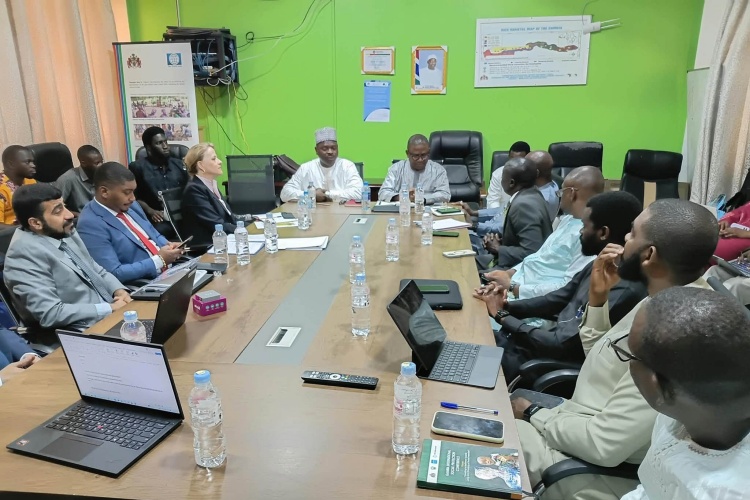
Gambiaj.com – (BANJUL, THE GAMBIA) – The Gambia has reached a staff-level agreement with the International Monetary Fund (IMF) on the sixth review of its Extended Credit Facility (ECF) program and the third review of its Resilience and Sustainability Facility (RSF), potentially unlocking an additional $28 million in financing.
The agreement, announced on Friday following an IMF mission to Banjul from October 19 to 30, 2026, remains subject to approval by the IMF Executive Board and the implementation of agreed prior actions.
If approved, the two reviews will provide The Gambia with SDR 20.73 million, equivalent to approximately $28 million, bringing total disbursements under the two arrangements to SDR 105.75 million, or about $142 million.
The IMF mission was led by Eva Jenkner, who said the Gambian economy remained resilient despite external uncertainties and domestic disruptions in electricity supply.
Economic growth is projected at 5.1 percent in both 2026 and 2027, supported by construction, tourism and remittances.
Inflation has also continued to ease, falling to 6.1 percent in September from seven percent in April. However, it remains above the Central Bank of The Gambia’s five percent target.
The IMF described the economic outlook as favorable but warned of significant downside risks, including fluctuations in global commodity prices, geopolitical uncertainty, climate shocks, and persistent weaknesses in the energy sector.
Fiscal Discipline and Debt Vulnerabilities
The Fund said the government’s economic reform program continued to perform strongly, with all eight quantitative performance criteria for end-June 2026 met. Three of the four indicative targets were also achieved, although the tax revenue target was narrowly missed.
It called for continued fiscal discipline to ensure that targets set for December are met, particularly through stronger revenue mobilization, expenditure controls, improved cash management, and the timely clearance of government arrears.
The IMF also welcomed the government’s decision to reprioritize public spending in response to the electricity crisis, noting that the 2027 budget targets an overall fiscal deficit of approximately one percent of GDP.
However, it stressed that efforts to reduce public debt vulnerabilities must be balanced with the need to protect priority social spending, particularly as poverty remains a persistent challenge.
Electricity Crisis Raises Concerns Over NAWEC
The IMF identified the recent electricity crisis as a major warning about the financial and operational weaknesses of the National Water and Electricity Company (NAWEC).
It acknowledged emergency financial support provided by the government to help the utility clear arrears owed to regional electricity suppliers and restore electricity generation capacity.
But the Fund warned that further reforms were necessary to reduce operational losses, improve revenue collection, and move towards cost-recovery electricity tariffs while protecting vulnerable households.
The IMF said strengthening NAWEC’s operational efficiency and financial sustainability was essential to containing risks to public finances and ensuring reliable electricity supply.
Governance Reforms Remain a Priority
The Fund also called for stronger governance and public accountability, welcoming progress made by the National Audit Office in clearing longstanding audit backlogs.
However, it said more work was needed to operationalize the Anti-Corruption Commission, strengthen transparency, and improve the business environment to encourage private investment and job creation.
On monetary policy, the IMF urged the Central Bank to maintain a prudent, data-driven approach to bring inflation towards its medium-term target.
It also highlighted the importance of exchange rate flexibility and adequate foreign reserves in maintaining external stability.
Although the banking sector remains resilient, the Fund warned that banks’ exposure to government debt and concentration risks require close monitoring.
It further stressed the need to strengthen the Central Bank’s governance and institutional autonomy, including through amendments to the Central Bank of The Gambia Act and an end to quasi-fiscal activities.
Climate Reforms and Long-Term Resilience
Under the Resilience and Sustainability Facility, the IMF noted progress in reforms aimed at addressing the country’s vulnerability to climate change.
These include measures to strengthen groundwater management and incorporate climate resilience into coastal zoning regulations.
The Fund said continued implementation of these reforms would help reduce exposure to climate shocks, limit fiscal risks, and improve access to climate financing.
During the mission, the IMF team held discussions with Finance Minister Seedy Keita, Justice Minister and Attorney General Dawda Jallow, First Deputy Central Bank Governor Abdoulie Sireh Jallow, Gambia Revenue Authority Commissioner General Yankuba Darboe, and Auditor General Cherno Sowe, among other senior government officials.
The delegation also met representatives of the private sector, civil society, and development partners.
The IMF said it remained committed to supporting The Gambia’s reform program through financing, policy advice, and technical assistance.









Leave a Reply