


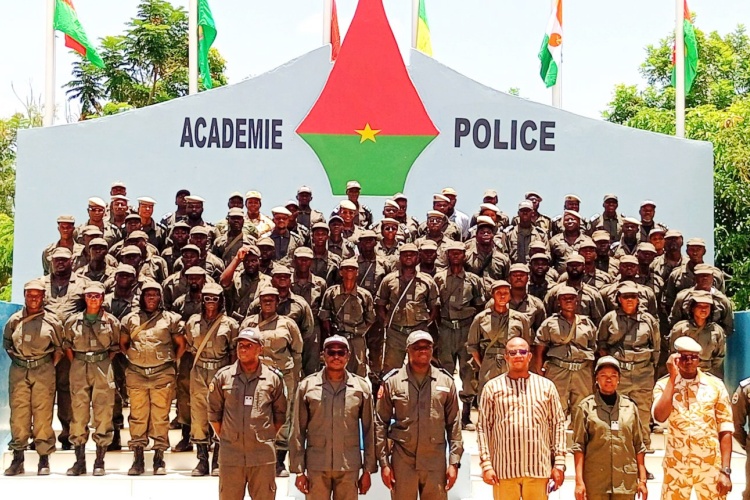
Gambiaj.com – (OUAGADOUGOU, Burkina Faso) – Forty-four media professionals traded their microphones, notebooks, and cameras for military fatigues this week, undergoing a five-day training program at the Police Academy in Pabré that authorities say is meant to prepare journalists for the dangers of covering the country’s ongoing jihadist insurgency.
The training, which began on Thursday, August 13, included basic military drills, supervised weapons handling, tactical first aid, and instruction on operating in conflict environments. Government officials described the exercise as a professional development program designed to keep reporters safe while they cover the war.
But the initiative has drawn scrutiny because of the language used by senior officials to frame it and because of Burkina Faso’s recent record of using military mobilization against journalists and critics of the ruling junta.
“Patriotic journalism”
Addressing the participants, Minister of Communication, Culture, Arts, and Tourism Pingdwendé Gilbert Ouédraogo said that in a country confronting terrorism and seeking to reclaim its sovereignty, a journalist “cannot be regarded as an ordinary citizen.” He said journalists must become “engaged actors,” guided by patriotism, professionalism, and commitment.
“Patriotism is not an option; it is an obligation for everyone, and even more so for you, journalists,” the minister said, adding that “a professional journalist who is not patriotic is a threat to his country.”
Security Minister Mahamadou Sana went further, describing the media as indispensable to the country’s “revolution” and to what he called the changing of mentality and the awakening of national consciousness. Sana also indicated the training could become an annual program.
Officials have not clarified what standards will be used to judge journalists’ “patriotism” or how such a standard would apply to reporting that is critical of the military or the government.
A history of forced conscription
The program comes against the backdrop of documented abuses against journalists and civil society figures under Burkina Faso’s military government.
Human Rights Watch has reported that the junta has used an emergency mobilisation framework to forcibly conscript journalists, civil society activists, opposition figures, lawyers, prosecutors, and judges, sending some to participate in military operations while others disappeared after being taken into state custody.
In March 2025, three journalists, Guezouma Sanogo, Boukari Ouoba, and Luc Pagbelguem, were arrested amid a wider crackdown on the media. Footage later emerged showing them in military uniforms. They were eventually released, though other conscripted journalists remain unaccounted for.
Investigative journalist Serge Oulon is among those still missing. Authorities have acknowledged that he was conscripted, and Amnesty International reported in June 2026 that he was allegedly held in secret detention and abused after being targeted over his reporting. His whereabouts remain unknown.
Civil society activists Rasmané Zinaba and Bassirou Badjo of the group Balai Citoyen were also unlawfully conscripted after criticising the junta, according to Human Rights Watch. Both later appeared on state television in military uniforms, taking part in exercises, before their release in October 2025.
Rights groups have separately documented a broader shrinking of civic and media space in Burkina Faso, including outlet suspensions and journalist arrests, alongside serious allegations against the security forces themselves.
Human Rights Watch’s 2026 reporting documented unlawful killings, forced displacement, and arbitrary detention attributed to Burkinabè military forces and allied Volunteers for the Defense of the Homeland as the conflict continues to produce widespread civilian suffering.
Weighing safety training against editorial independence
Media analysts note that technical training, understanding battlefield risks, tactical first aid, evacuation procedures, and military terminology, can genuinely improve journalists’ safety and the accuracy of conflict reporting. Such preparation is common practice for war correspondents worldwide.
The concern raised by observers is not the safety instruction itself but the framing around it: officials’ repeated emphasis that journalists must be “engaged” participants in the national struggle and the suggestion that a lack of demonstrated patriotism amounts to a threat to the country.
Critics warn that where patriotism becomes a yardstick for acceptable journalism, legitimate reporting on civilian casualties, allegations of abuse by security forces, corruption within the military, or disputed battlefield claims, risks being recast as disloyalty or as aiding the country’s enemies.
Given the junta’s documented history of forcibly conscripting journalists who angered the authorities, observers say the symbolism of voluntarily placing dozens of reporters in military uniforms for training cannot be viewed entirely apart from that context, even though officials insist the Pabré programme is different: structured, time-limited, and voluntary.
Whether the Pabré initiative strengthens or compromises Burkina Faso’s press will likely be determined not by the training itself, but by what happens afterward, specifically, whether the 44 journalists who took part remain free to investigate military conduct, interview civilians who allege abuses by security forces, question official casualty figures, and report on corruption within the security apparatus without being accused of insufficient patriotism.
Government officials have not responded publicly to questions about how the “patriotic journalism” standard will be applied to critical reporting once the training concludes.


Leave a Reply