


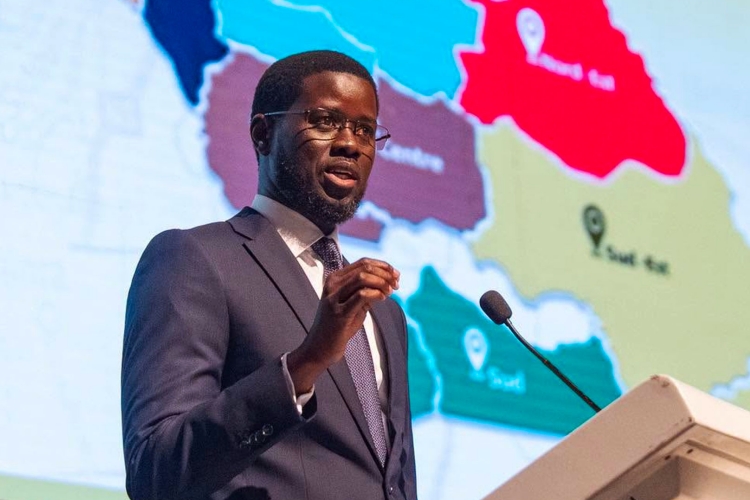
Gambiaj.com – (DAKAR, Senegal) – President Bassirou Diomaye Faye has announced the creation of his own political party, ending months of speculation about his political future and setting the stage for a formal, if delicate, parting of ways from the party that made him head of state, PASTEF.
The announcement was made at the Presidential Palace before 306 mayors drawn from all 14 regions of Senegal, all of them members of the Coalition Diomaye Président.
According to a communiqué issued after the four-hour meeting, President Faye told the mayors he wanted to move towards a more “organic unity” of the political forces that back him, language widely read in Dakar as the clearest signal yet that he intends to build a structure he alone controls, separate from PASTEF and its leader, Prime Minister Ousmane Sonko.
To carry the plan forward, the President instructed the general supervisor of the Coalition Diomaye Président to set up a reflection committee. That committee has been tasked with preparing, as quickly as possible, the groundwork needed to formally launch the new political formation.
A Long-Awaited Break
For over a year, President Faye has occupied an unusual position in Senegalese politics: head of state, yet formally still a member of PASTEF, the party led by Sonko, the man who handed him the presidential candidacy in 2024 after his own bid was blocked by the courts. That arrangement made the two men a political tandem that swept to power together, with Faye as president and Sonko installed as prime minister.
But the relationship has cooled considerably since then. Disagreements over governing style, control of the party machinery, and the direction of the country’s reform agenda have opened a visible rift between the Palace and PASTEF’s leadership.
Faye’s decision to build his own party, while formally still carrying a PASTEF card, effectively confirms what many observers had already concluded: that the presidential couple that won Senegal’s 2024 election has become, in practice, two separate political centers of gravity.
Whether Faye will now be pushed out of PASTEF or will step away voluntarily remains an open question.
Either way, his announcement narrows the space for reconciliation and raises the prospect of an eventual, formal split, a scenario few would have predicted when the two men stood together on the campaign trail less than two years ago.
Why the Mayors and Why Now
The choice of audience was deliberate. By making the announcement before 306 sitting mayors rather than at a party congress or a PASTEF platform, Faye signaled that his new project will be built from the grassroots up, anchored in local government rather than in the parliamentary or party structures currently associated with PASTEF.
The timing also matters. Senegal is due to hold local elections in January 2027, and control of municipalities and regional councils will be a critical test of strength for whichever camp, Faye’s emerging formation or Sonko’s PASTEF, can claim the broader mandate of the Senegalese electorate.
Rallying nearly all of the coalition’s mayors behind him now gives Faye a head start: a ready-made network of local officials, incumbency advantages, and territorial reach well ahead of the vote.
In its own communiqué following the meeting, the Coalition Diomaye Président said its members had welcomed the President’s commitment to “territorial equity” and to placing every commune at the heart of national development.
The coalition thanked Faye for his availability and willingness to work closely with local government and praised the mayors’ turnout as proof of strong commitment to the success of his mandate. It went further, describing the planned party as a “major turning point” ahead of the country’s next electoral contests, an unmistakable reference to the 2027 local polls.
What It Means for PASTEF and Senegalese Politics
The move carries real risk for both men. For Sonko and PASTEF, losing the mayors who form the backbone of the Coalition Diomaye Président would weaken the party’s grip on local government just as it heads into a bruising electoral cycle.
For Faye, formally breaking from the party under whose banner he was elected invites questions about legitimacy and continuity, even as it gives him a freer hand to build a political machine loyal to him alone.
For now, President Faye has stopped short of announcing his resignation from PASTEF, and the reflection committee’s work, expected to define the new party’s structure, leadership, and platform, will likely determine how quickly and how cleanly that separation unfolds.
What is no longer in doubt is that Senegal’s ruling alliance, once presented as a single, unified movement, is fracturing into two distinct political projects less than two years after taking power together.
As the January 2027 local elections approach, the contest will not simply be between the ruling camp and the opposition. Increasingly, it looks set to be a test of strength between President Faye and the man who made his presidency possible.




Leave a Reply