


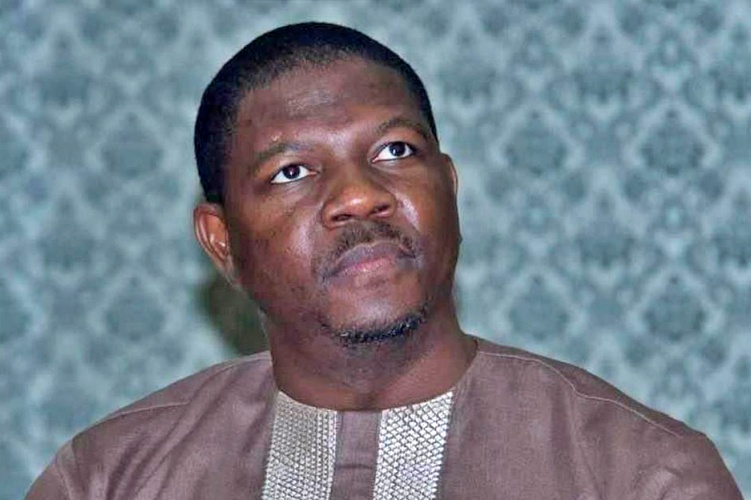
Gambiaj.com – (BISSAU, Guinea-Bissau) – A new political party has emerged in Guinea-Bissau during the country’s military-led transition, with the Guinean People’s Party (PPG) being linked to transitional Prime Minister Ilídio Vieira Té, raising questions about whether the authorities are laying the groundwork for a political vehicle ahead of the return to constitutional rule.
The PPG was announced in Bissau by an ad hoc secretariat and has reportedly completed the legal requirements for registration as a political party. Its emergence coincides with reported departures of members and figures from established parties, particularly the Social Renewal Party (PRS) and the Movement for Democratic Alternation (MADEM-G15).
Uffé Vieira, head of the PPG’s ad hoc secretariat, has denied that the party is an extension of the transitional government.
Party Denies Government Connection
Vieira said the party had completed the formalities required under Guinea-Bissau’s political parties law, including obtaining its legalization certificate.
He said the PPG is now preparing for its first congress, which will elect the party’s leadership for a four-year mandate once political activities are reopened.
The party says it intends to participate in the next elections and presents itself as a platform focused on inclusion, dialogue, and political normalization.
Vieira also sought to distance government officials associated with the PPG from the party’s institutional structures, saying those serving in the transitional government were appointed by the High Military Command in their capacity as citizens, rather than as representatives of the PPG.
The party argues that normalization requires the participation of political parties, civil society, business groups, and other important sections of society, alongside respect for democratic rules.
Ilídio Vieira Té at the Centre of Suspicion
Despite the PPG’s denials, its emergence has attracted particular attention because of its reported association with Ilídio Vieira Té, the head of the transitional government.
Vieira Té has emerged as one of the most prominent civilian figures under the military-led transition that followed the November 26, 2025, disruption of Guinea-Bissau’s constitutional order.
The transitional authorities have increasingly placed him in high-profile positions representing the country internationally. On Friday, September 25, Vieira Té addressed the 81st session of the United Nations General Assembly in New York on behalf of Guinea-Bissau.
In his address, he said the transitional government was committed to creating the conditions for the presidential and legislative elections scheduled for December 6 to take place in an “inclusive, free, transparent, and credible” manner.
He described the events of November 26, 2025, as an interruption of the constitutional order and presented the transition as a process aimed at restoring institutional normality.
The prominence given to Vieira Té by the military authorities has fueled speculation that the transition’s leadership could seek to retain political influence after the transition through a civilian political formation.
There is, however, no public evidence in the information currently available establishing that the military command created or controls the PPG. The connection is instead being inferred from the party’s emergence, its reported association with the transitional prime minister, and the political movements taking place around it.
Timing Raises Questions
The timing of the PPG’s creation has added to the speculation.
The announcement comes as Guinea-Bissau’s established political landscape appears to be experiencing movement, including reported departures from the PRS and MADEM-G15.
The coincidence has raised questions over whether political figures leaving established parties are being drawn towards a new formation capable of participating in elections after the transition.
For now, the PPG maintains that it is an independent political force and says its priority is to contribute to national normalization through dialogue and inclusion.
Its first congress, once political activity resumes, is expected to provide a clearer indication of its leadership structure, political program and relationship with figures serving in the transitional administration.
With elections scheduled for December 6, the emergence of the PPG and the political repositioning around it could become an important feature of Guinea-Bissau’s transition from military rule back to elected government.




Leave a Reply